DAOs Always Become Companies in the End
The reality of thousands of treasuries converging on a handful of Safe multisig signers. Exploring the pattern of decentralized governance reverting to hierarchy under pressure for efficiency, through the lens of Korean web3 teams' dilemma between corporate structure and DAO.
AI Summary
The article argues that DAOs converging toward hierarchical, company-like structures is not a failure of individual founders but an inevitable outcome of transaction-cost economics — decentralized consensus simply costs too much for fast-moving markets. Korean web3 teams face a compounding disadvantage: no domestic legal personhood for DAOs, a venture capital establishment that shuns token exposure, and no regulatory framework for progressive decentralization, pushing founders to incorporate in Singapore instead. The author proposes three systemic fixes — DAO-compatible legal entities, token-friendly investment channels, and a regulatory stance that treats gradual decentralization as a legitimate corporate development path — and calls on Korea's ecosystem, including Busan's blockchain free zone, to catch up with founders who are already following global standards.
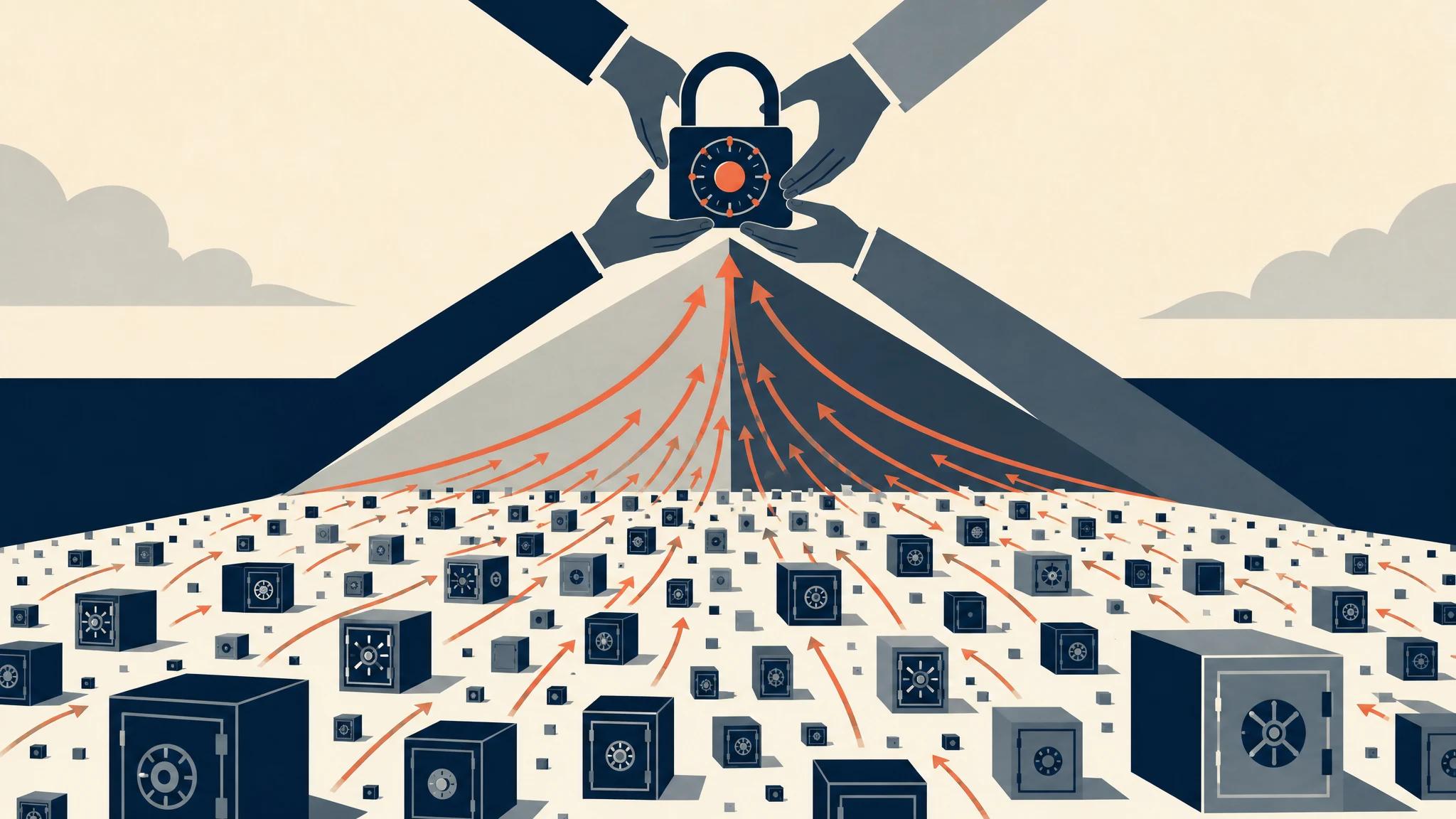
A web3 team in Seoul's Gangnam district stopped in its tracks just before launching its token. The whitepaper said "DAO governance," but the lawyer asked: who executes the funds? No one had an answer. The treasury sat in a Safe multisig wallet, with signing authority held by two founders and one early investor. Is this a DAO, or just a company with three signers? Faced with that question, the team delayed the token.
This scene is not an exception — it is the norm. Trackers like DeepDAO, which aggregate on-chain data, list thousands of registered DAOs, yet only a fraction hold actual votes and active discussions each quarter. Most treasuries operate on Safe (formerly Gnosis Safe) multisig with a small circle of signers. Even where governance tokens have been issued, votes are typically decided by single-digit numbers of addresses, while the rest delegate or stay silent. An organization that launched with an elegant decentralized architecture, examined a year later, runs like an ordinary company where a handful of committee members make all the decisions.
Decentralization is the ideal; hierarchy is gravity
At this point, the familiar diagnosis emerges: that team was lazy; they lacked a genuine will to decentralize; they failed to design their tokenomics properly. It is a comfortable narrative that blames the individual founder's capabilities and sincerity. I believe this diagnosis is wrong. The problem is not the people — it is the structure.
For an organization to move quickly, it must lower the cost of decision-making. Having 10,000 people vote on a marketing budget via token governance takes a week; three executives deciding takes an hour. Markets reward the one-hour organization. So even entities that profess decentralized governance end up delegating key decisions to a small group in order to survive. This is not betrayal — it is gravity. Ronald Coase's 1937 question — "why do firms exist when markets do?" — applies here directly. When transaction costs are high, hierarchy internalizes those costs. DAOs promised to lower transaction costs through code, but they could not eliminate the costs of consensus and coordination. Faced with those costs, they converge back into companies.
Ecosystems in the United States and Europe did not deny this convergence — they institutionalized it. In 2021, Wyoming codified DAOs as a form of LLC; the Marshall Islands and several other jurisdictions also opened pathways for granting legal personhood to DAOs. Major funds like a16z long ago formally adopted "progressive decentralization" as an official strategy: build fast like a company first, and once the product is established, gradually transfer authority to the community. The global ecosystem has already built its tools on the premise that DAOs start from companies and return to companies. Korean teams have none of those tools.
The bottleneck is not will — it is infrastructure
Korean web3 teams face a four-layered wall: capital, talent, regulation, and customer access. The hardest of these layers is regulation, and the structural vacuum it creates.
Start with capital. When tokens are issued, a significant portion of Korea's established venture capital community hesitates to invest. LP aversion to virtual asset exposure, unclear accounting treatment, and valuation difficulties all compound each other. As a result, Korean web3 teams travel to Singapore and Dubai to find capital. Incorporating in Singapore with a foundation structure has become the de facto standard route — not because founders are clever, but because there is no domestic vessel capable of containing a token-based organization.
Regulation is the core issue. While Wyoming created the DAO LLC, Korea has no legal personhood that corresponds to a DAO. If a treasury is held in a multisig, whose property is it legally — the personal assets of the signers, or property belonging to a non-existent organization? Who pays the taxes? Korean law cannot provide clean answers to these questions. So Korean teams choose between two paths: register as an ordinary stock company and use web3 only at the product layer, or leave Korea entirely. The Virtual Asset User Protection Act enacted in 2024 focused on investor protection but left blank the question of how to recognize on-chain organizations as legal entities. That blank directly becomes cost.
Talent and customer access are tied to the same problem. Attracting global contributors through token incentives is one of web3's defining strengths, but regulatory uncertainty in Korea means Korean teams cannot fully play that card. Customers — token holders and users — are inherently global. Yet the organization's legal foundation is tethered domestically. A product that looks out at the world, enclosed within a legal entity that cannot cross borders: this mismatch is the structural reason Korean web3 teams tend to be strong at home but cannot scale outward.
Busan was designated a blockchain regulatory free zone and was once a candidate to fill this gap. Some experiments have been opened through regulatory sandbox exemptions, but the zone has yet to advance to the stage of resolving fundamental questions such as the legal personhood of DAOs or the ownership structure of treasuries. If the special zone could move beyond being a sandbox to become a "registry for on-chain organizations," Korean web3 teams would have their first real reason not to leave for Singapore.
Embracing DAOs' convergence into companies through deliberate design
There is a counterargument: if DAOs ultimately converge into companies, why bother with a DAO at all? Why not just be a company from the start? That is half right. Organizations whose purpose is governance itself are rare. But the fact that the destination is a company does not make the starting point or the journey meaningless. Tokens are a tool that simultaneously gives global users early capital and aligned incentives. Even heading toward a company as the final destination, the liquidity and community that tokens accumulate along the way are difficult for traditional corporations to replicate. The real question is not the binary of "company or DAO" — it is whether that convergent path toward a company can be legally walked in Korea.
Three conditions are therefore needed. First, legal personhood that recognizes DAOs as companies — a Korean equivalent of Wyoming's LLC, or a registration model originating from the Busan special zone. Second, capital channels that allow investment in token-issuing organizations — fund structures capable of holding tokens and matching accounting standards. Third, a regulatory framework that recognizes "progressive decentralization" at each stage — an attitude that treats the path of building fast as a company first, then transferring authority later, not as tax evasion or liability evasion, but as a legitimate and normal route.
Korean web3 founders already know all of this. They incorporate in Singapore, manage their treasuries with Safe, and design progressive decentralization. They are following global standards precisely. The founders are already looking at the world. What cannot keep up is the Korean vessel meant to contain them. Now the ecosystem must match that pace.
This article was automatically translated from the Korean original by AI. For the authoritative version, read it in Korean.
한국어 원문 읽기 →