Who Pockets the Seigniorage?
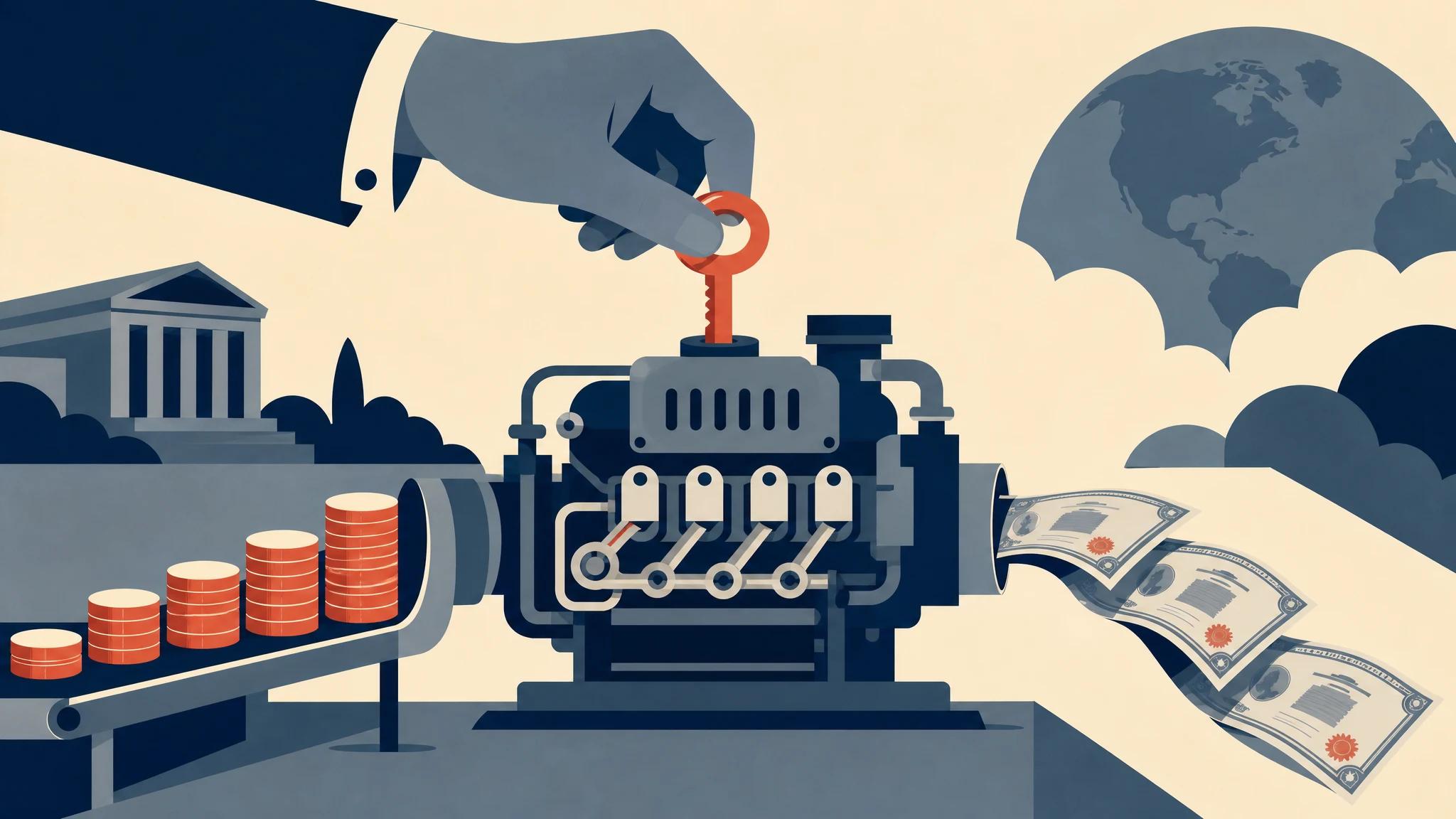
Stablecoin profits come not from payments but from a carry trade structure that converts users' interest-free deposits into short-term U.S. Treasury yields. The Federal Reserve holds the ignition switch to that engine.
AI Summary
Stablecoin issuers generate profits primarily through interest earned on reserve assets—U.S. Treasury bills and repos—while paying users zero interest on their deposits. This business model creates a carry trade structure whose profitability is directly tied to Federal Reserve policy rates rather than payment volumes. For Korea, opportunities lie not in issuance but in the infrastructure surrounding stablecoin flows, such as custody, settlement layers, and on/off-ramps.
Stop Talking About Payments and Look at the Balance Sheet
Nearly every article covering stablecoins starts from the same place. Remittances complete in seconds, borders disappear, people carry dollars without banks. All true. But there's one missing piece in this narrative: How does the company that issues these coins make money?
The answer is not payments. Looking at the figures published by Tether and Circle, their profits don't come from remittance fees. When a user pays $1 and receives one coin, that dollar enters the issuer's vault and is converted into short-term U.S. Treasuries (T-bills), repurchase agreements (repos), and money market funds. Users receive not a cent of interest on those deposits. The issuer keeps all the interest. The fact that nearly all of Circle's 2024 revenue came from reserve interest income summarizes this business in one line.
In other words, stablecoins are a mechanism for collecting dollars interest-free, lending them to the U.S. government, and pocketing the entire interest rate spread. The structure resembles banks taking deposits and turning them into loans, but with one crucial difference: banks pay depositors interest. Stablecoins don't. Zero interest on the inflow side, around 5% annual yield on the deployment side. This asymmetry supports the entire business. Payments are merely the entrance for gathering money into this account; the room where profit is generated lies beyond.
The Fed Turns This Engine On and Off
This is where macroeconomics enters. What determines a stablecoin issuer's profit margin is not how many people use the coin. It's the policy rate set by the Federal Reserve.
Recall the period from 2022 to 2023 when the Fed raised the base rate from around 0% to over 5%. Tether's quarterly profits grew substantially during this time not because coin users multiplied proportionally, but because the same amount of reserves suddenly began generating nearly five times the interest. If reserves total $100 billion, at 1% interest that's $1 billion annually; at 5%, it's $5 billion annually. Even if coin issuance doesn't grow by a single unit, revenue quintuples. The reverse works identically. When the Fed starts cutting rates, revenue shrinks proportionally even if issuance remains constant.
This is the hidden weakness of this business. Stablecoin companies call themselves fintech, call themselves payment networks. But the shape of their income statements resembles a giant bond fund. Revenue is directly tied to interest rates while costs are largely fixed. Margins are fantastic in good times, but the owner of those margins is not the company—it's the Fed. An external variable called the interest rate cycle holds the ignition switch to the profit engine. When more than half of a business's profits are tied to variables it cannot control, we usually call that a dependent business.
A second layer overlaps here: exchange rates. Most stablecoins are dollar-based. During dollar strength phases, users in emerging markets flee into dollar stablecoins to escape their melting local currencies. That's what happened in Argentina, Turkey, and Nigeria. The stronger the dollar, the more reserves swell, and swollen reserves generate even more U.S. Treasury interest. When strong dollar and high interest rates arrive simultaneously, it's like turning on two engines for this business at once. The problem is that both engines are connected to the same handle—U.S. monetary policy.
What 'Growth' Really Means
Tech company growth is commonly described in terms of user numbers, transaction volumes, and network effects. Stablecoins are marketed the same way. Circulation hits all-time highs, payment acceptance expands. But viewed through the lens of capital cost, a different picture emerges.
For an issuer to mint more coins, it must receive more dollars as reserves, and those dollars are liquidity withdrawn from somewhere in the market. In other words, stablecoin growth is itself a pump that siphons dollar liquidity and redirects it to the U.S. short-term debt market. The larger the market grows, the bigger a player the issuer becomes in U.S. short-term Treasuries. Some estimates suggest Tether's U.S. Treasury holdings are comparable to the foreign exchange reserves of a medium-sized country. That a payment tech company has become a major buyer in the Treasury market means this business is not simple fintech but has entered as a node in the monetary system itself.
Yet there's a peculiar aspect to this growth where capital cost works in reverse. Normally when interest rates rise, companies face harder fundraising and slower growth. Stablecoins are the opposite. When rates rise, profit per unit of reserves increases, so high rates mean high returns. When all other growth stocks are crushed by high rates, this business alone uses rates as fuel. This paradox explains issuers' enormous profits over recent years. Simultaneously, this paradox is also a warning. If the fuel is interest rates, this engine will be the first to cool when rates drop.
Here we must confront the strongest counterargument head-on. One could say: even if rates fall, couldn't market size grow fast enough to compensate? If usage explodes, total reserves increase and could offset rate declines. This is a valid point. In fact, this is precisely why issuers stake everything on payment partnerships and emerging market adoption. However, this counterargument only holds if it acknowledges one thing: even in that case, the numerator of profit remains interest rates, and what the company controls is only the denominator—scale. A business where an uncontrollable variable is permanently embedded as one factor in the multiplication cannot escape the essence of rate dependency no matter how large it scales. Scaling dilutes dependency but doesn't sever it.
Watch Where the Money Flows
Once you understand this structure, global capital flows look different. From the U.S. government's perspective, stablecoins are an unexpected ally. They're a mechanism whereby people worldwide voluntarily buy dollars and prop up U.S. short-term Treasuries. In a situation where the U.S. must continue issuing massive amounts of debt, a new source of demand has emerged in the form of private coin issuers. It's natural to see this calculation underlying the U.S. Congress's active refinement of stablecoin legislation in 2025. Official statements speak of consumer protection and innovation, but the structural incentive lies in institutionalizing new capillaries of dollar hegemony. If you ask who rewards this behavior, the answer points toward U.S. fiscal authorities seeking to expand dollar demand.
Here the picture flips. If you read stablecoins only as payment innovation, the protagonist is the tech company. But if you read it as a carry structure, the real beneficiary is the United States itself, converting interest-free dollar deposits into demand for its own government debt. Users gain the primary function of inflation hedging, but in exchange they freely provide the secondary effect whereby their purchasing power flows into the U.S. short-term debt market, supporting the dollar system. Emerging market users who forgo interest are effectively lending to U.S. Treasuries interest-free. The side bearing risk and the side collecting interest are separated, and precisely which side each party stands on along that dividing line is the political economy of this business.
Hidden risks also reside in the same place. That reserves are tied up in short-term Treasuries and repos means that if the market trembles and coin holders simultaneously demand redemption, the issuer must sell those bonds in a hurry. The 2023 incident when one stablecoin briefly fell below $1 in the aftermath of a bank failure showed that this structure remains invisible in normal times but suddenly surfaces all at once in crisis. Carry trades quietly accumulate profits during calm and present the bill all at once in crisis.
Where Does Korea Sit on This Board?
So what about Korea? Korea is neither an issuing nation nor a reserve currency nation in this game. The possibility that a Korean won stablecoin could attract global demand comparable to U.S. dollar coins is realistically low, because the core fuel of the carry trade is U.S. short-term rates. Even if reserves running on Korean won short-term rates could create a similar structure, the starting line differs in that it's not the safe-haven asset the world flees to in crisis. Korea stands not as an early entrant on the adoption curve but on late-mover coordinates where it must find its place atop an already-formed dollar standard.
But there are not only risks. Korea's opportunity likely lies not in issuance but in the surrounding nodes. The trust infrastructure of where and how reserves are held and audited, the settlement layer connecting payment networks and coins, toll positions like exchange and on/off-ramps for emerging market users. The carry itself is tied to U.S. rates, but Korean companies can lay some of the pipes through which that carry flows. In a city like Busan where ports and trade settlements move in physical terms, examining which nodes in stablecoin settlement of trade payments capture fees is not an abstraction but an immediate practical matter to be reckoned with.
The question a Korean journalist should ask when covering the same topic tomorrow is clear: What percentage of this issuer's revenue comes from payment fees versus reserve interest? What maturity bonds hold the reserves, and how much does profit shrink if rates fall one percentage point? And does that interest income support user convenience or the issuing government's Treasury demand? When press releases speak of payment speed, income statements speak of interest rates. Of the two, the latter holds the business's fate.
Technology promises the future. Remittances have certainly gotten faster and that utility is real. But the way that technology makes money lies within old variables: interest rates, exchange rates, dollar liquidity. More than the speed at which coins circle the globe in seconds, the direction in which the dollars those coins gather flow into the U.S. short-term debt market determines this business's fate. That's why we must first see which way the money flows before marveling at technology's speed.
This article was automatically translated from the Korean original by AI. For the authoritative version, read it in Korean.
한국어 원문 읽기 →