Fabs Don't Scale Like Code
The forecast that memory capacity expansions won't materialize until Q1 2027 is not a failure of demand forecasting — it is the physical reality of capital goods lead times laid bare. Korea's materials, parts, and equipment sector stands at the intersection of software speed and the pace of fab construction.
AI Summary
High-bandwidth memory supply shortfalls stretching into early 2027 reflect not a demand forecasting failure but the irreducible physical timelines of semiconductor fab construction and equipment procurement. Korea's dominant position in DRAM and HBM masks a structural vulnerability: the upstream equipment and materials that determine production capacity — from EUV lithography machines to specialty chemicals — remain controlled by foreign suppliers built on decades of accumulated expertise. For Korea's southeastern manufacturing belt, including Busan, the path forward lies not in fast catch-up but in the patient, long-horizon accumulation of precision components, modules, and materials know-how that a short-termism-driven R&D culture has left largely undeveloped.
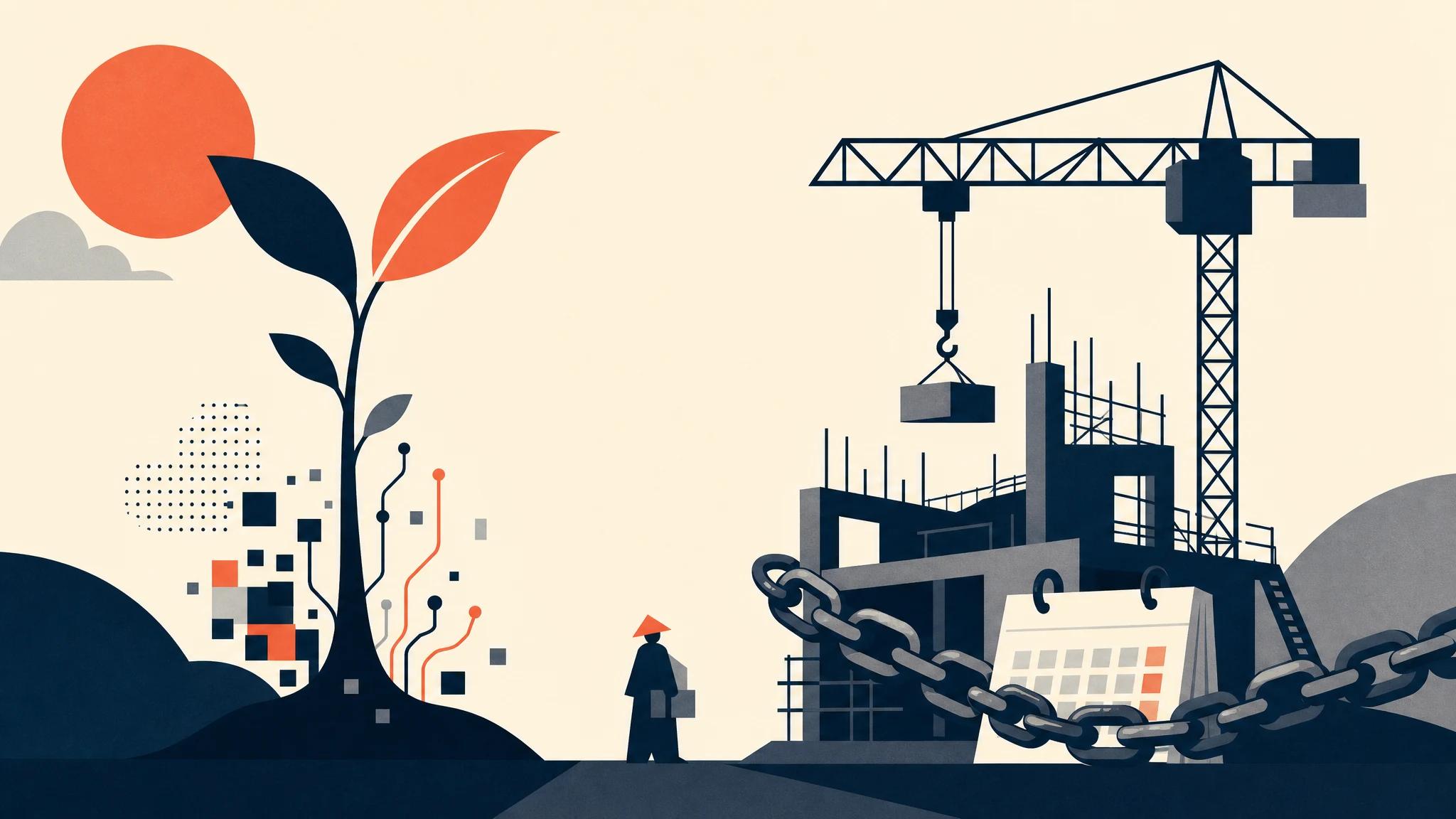
Sold-Out Cloud, Empty Cleanroom
A scene from 2026. One AI startup doubles its model weights overnight. Data center operators renew GPU orders every quarter. Yet the high-bandwidth memory that goes into those GPUs requires waiting in line. Samsung Electronics and SK Hynix are posting record-breaking operating profits, but even when customers ask for more, there is nothing to give. The phrase keeps repeating across the industry: expanded supply won't actually come online until Q1 2027 at the earliest.
This scene is often read as follows: memory companies cut investment during the downturn and failed to forecast demand. That is only half right. The real problem is not a failure of forecasting but the physical nature of time. Code can be deployed overnight, but fabs do not go up overnight. Even if you make a decision the moment you determine that HBM demand is exploding, the time it takes for that decision to become wafers coming off the line cannot be shortened by a company's will. This is not a matter of management judgment — it is a matter of capital goods.
What Is Written in the Number '27
Why 2027, of all years? Folded inside that number is an invisible project schedule. Building a single new fab from the ground up requires as long as a year and a half for site preparation and construction alone. On top of that, the cleanroom must be fitted out and core equipment installed. The waiting period from ordering a lithography tool to its installation can easily exceed a year. Even after equipment arrives, mass production does not begin immediately. Ramping up to stable yield requires several more quarters.
The hardest link in this chain is equipment. Extreme ultraviolet lithography machines are manufactured by essentially one company. That company's annual production capacity is fixed, and every fab in the world divides up a slot within it. Paying more does not make the queue disappear. Capital goods lead times are ultimately the bottleneck of manufacturing capability that someone accumulated over decades, and that bottleneck cannot be purchased with buying power. The fact that the true beneficiaries of the memory boom are not the DRAM companies but the equipment makers and materials suppliers upstream of them — that is what is written in the number '27.
The Grammar of Catch-Up and the Grammar of the Frontier
Korea's semiconductor industry became number one through the grammar of catch-up. It pursued roads already paved by others — faster, cheaper, at higher yields. In that era, the right answers already existed. The direction of miniaturization, the process roadmap — those who went ahead had already drawn them out. Korea solved those answers faster than anyone.
The grammar of the frontier is different. HBM is not simply DRAM; it is a domain where chips are stacked vertically, connected through microscopic through-silicon vias, and bundled into a single package — a territory where devices, materials, and assembly are tangled into one mass. There is no answer to copy here. Tens of thousands of trials and errors must be inscribed into the body of a company before yield becomes achievable. This is why fast catch-up does not work. Where there is nothing to copy, accumulation — not speed — is the asset. The reason a competitor that buys the same equipment still cannot achieve the same yield: that is Korea's real moat. At the same time, the uncomfortable truth is that this moat, at the level of equipment and materials, is not ours.
What Short-Termism Gnaws Away At
Advanced manufacturing nations invested over the long term in what was invisible. Japan's materials companies spent decades fixated on a single chemistry, capturing global market share in photoresist and specialty gases. The Netherlands' equipment ecosystem stands on a generation of industry-academia collaboration and accumulated failures. These nations buried their money looking at the next generation, not the quarterly earnings report.
Korea's sense of time is short. R&D budgets are tied to single-year results, and projects that fail to deliver are quickly wound down. Failure is recorded as one person's blemish, not retained as organizational experience. So Korea possesses the cell at the summit called memory, but the upstream — lithography equipment and critical materials — remains in others' hands. A substantial portion of the boom's profits flows up to that upstream. A strong counterargument is ready to be made here: Korea has already poured enormous budgets into domestic substitution for materials, parts, and equipment, and hasn't some of it actually succeeded? True. But most of the successful items were standardized commodity products. The areas that are the true gateways of the frontier — extreme ultraviolet lithography, the highest-difficulty materials, where decades of accumulation are condensed — remain almost untouched. Catching up in easy-to-catch places is a different matter from catching up in hard-to-catch places.
Busan, and What to Accumulate
Accumulation is not an abstraction — it is a matter of place. Busan and South Gyeongsang Province have a mid-tier manufacturing base in precision machining, machinery, and materials. Areas such as precision components for semiconductor equipment, vacuum and fluid handling modules, and optics for inspection equipment are unglamorous — but they are precisely the spaces left vacant by short-termism. When the structure shifts from subcontracting for capital-city fabs to occupying a node upstream in the equipment supply chain, the southeastern manufacturing belt will finally become a unit of accumulation.
What must be accumulated is clear. First: R&D accounting and evaluation frameworks where failure remains organizational data, not an individual's blemish. Second: the survival soil for specialized mid-sized firms that dig into a single material and a single module over a decade at a time. Third: continuity of employment where equipment and materials talent can grow old within a single company. These are all items that never appear on a quarterly earnings report.
In the era of catch-up, the country that found the right answer fastest won. In the era of the frontier, the country that first formulates the question wins. The lag in which capacity expansions do not arrive until 2027 is a confession that Korea had the cell but never held the question above it. Before the next cycle hits again, we must ask: does Korea have the structure to accumulate this technology over a decade? Not yet, it does not.
This article was automatically translated from the Korean original by AI. For the authoritative version, read it in Korean.
한국어 원문 읽기 →