Who Is the City Watching?
The smart city filled with sensors and CCTV is control packaged in the language of efficiency. Contrasting the promises and realities of Busan's Eco Delta City reveals the real question: who reads the city, and who gets read?
AI Summary
Smart cities promise efficiency through sensors and data networks, but Busan's Eco Delta City and comparable projects worldwide reveal a deeper tension: the same infrastructure that optimizes traffic and prevents floods also enables pervasive surveillance and concentrates data ownership in private corporate hands. Drawing on the collapse of the Sidewalk Toronto project and Barcelona's data sovereignty model, the article argues that South Korea must establish a data governance framework — defining citizen rights, minimal collection principles, and open standards — before a single sensor is installed. The real measure of a smart city, it concludes, is not the sophistication of its technology but whose rules that technology operates under.
The Streetlight Is Watching Me
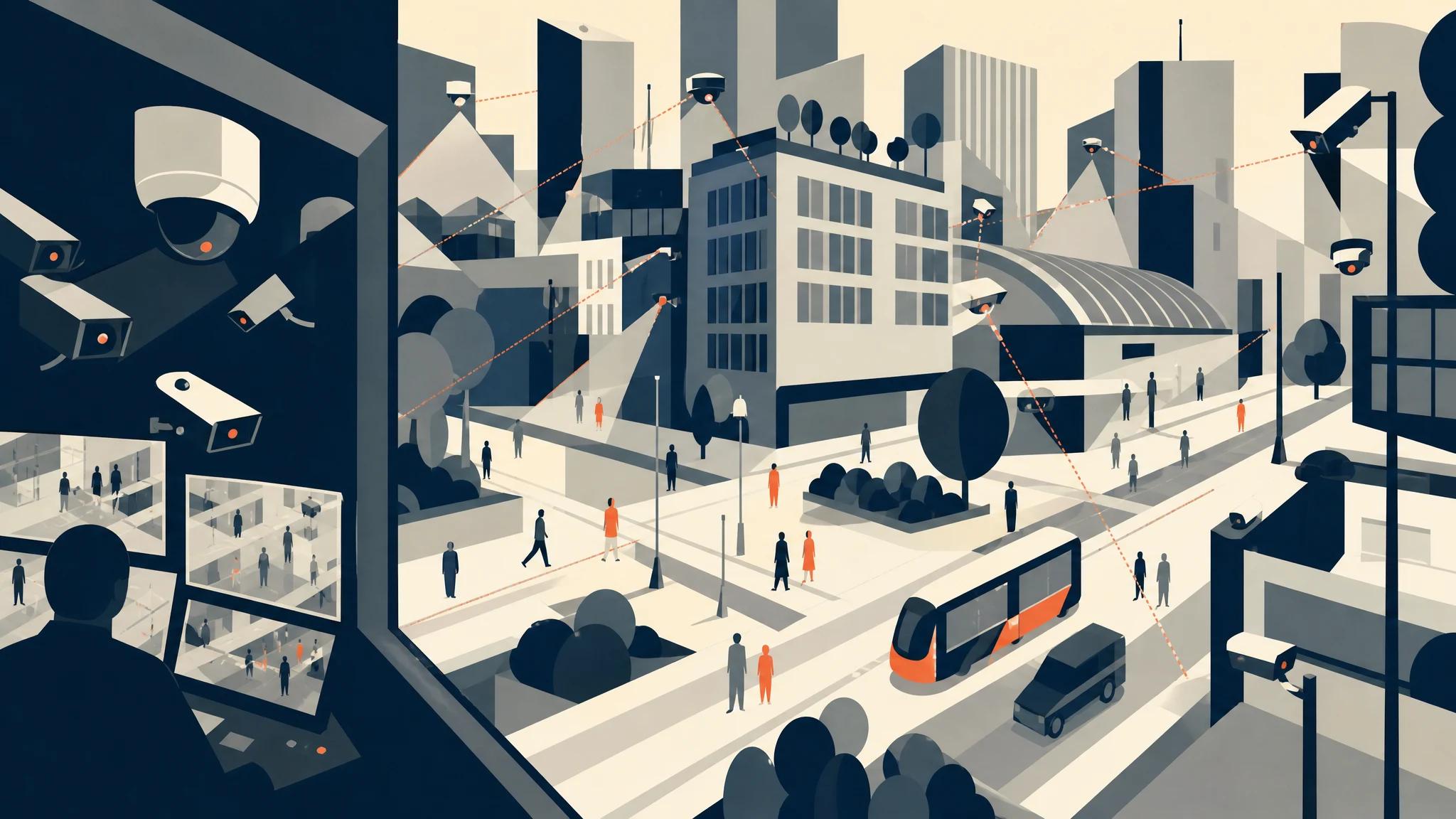
At seven in the evening, a person stands at a crosswalk. The streetlight detects him and brightens. Alleys where footsteps have fallen silent dim automatically, saving that much more energy. Billboards call this the future: a smart city, a light that cares for people.
But that streetlight does more than adjust its brightness. It knows who passed by, when, and where. It records pedestrian patterns, measures dwell time, and transmits the data to a server somewhere. Behind the savings on electricity bills, a new resource is being mined: one person's movement data. Yet there is no guarantee that the person who saves on electricity bills and the person who surrenders their movements are always the same individual.
Every piece of promotional material surrounding smart cities speaks of efficiency. Traffic flows more smoothly, garbage trucks seek out only the bins that are full, and flood risks are known in advance. These are all fine things to say. The problem is that this efficiency is not free. The cost does not disappear. It merely moves somewhere out of sight.
What the Word 'Efficiency' Conceals
Eco Delta City in Gangseo-gu, Busan, is one of two national smart city pilot projects in South Korea. Its blueprint includes a digital twin that replicates the entire city in virtual space for simulation, a city-wide sensor network, autonomous driving, and smart water management. The language of promise is dazzling: a city that conserves water, saves energy, and spares time.
Here, let us reframe the question. Who is the subject of the verb 'to save'? A digital twin creates a single, top-down vantage point over the city. Who owns that vantage point? Citizens have no say in the specifications of the data-collecting sensors, where the data is stored, who can access it, or how the algorithms that analyze it operate. In most cases, it is the company that won the contract — and the system that company designed — that decides.
The core of a smart city is not its buildings or roads, but its data platform. And a platform, by its very nature, concentrates power in one place. Once a city is built on the operating system of a particular company, the traffic, public safety, and administration running on top of it follow that company's rules. Even after the contract ends, the city cannot easily walk away from that system. This was the central reason the Sidewalk Toronto waterfront smart city project — pursued by Google affiliate Sidewalk Labs — collapsed in 2020. Citizens asked: why should a single corporation own the data of our city? That question never received an answer.
Surveillance in the Name of Safety
The most frequently invoked justification in smart city discourse is safety. More CCTV means less crime; more sensors means fewer accidents. It sounds like an argument that is hard to refute. And in fact, video analytics and integrated surveillance centers do have proven effectiveness in responding to certain types of crime.
Yet safety and surveillance share the same equipment. The difference lies only in who controls that equipment. Intelligent CCTV does not merely record. It identifies faces, classifies behavior, and automatically flags movements that deviate from the norm. The definition of 'deviating from the norm' comes from the data on which the algorithm was trained. If that data is biased, certain neighborhoods, certain styles of dress, and certain groups will more frequently be classified as threats. The road from efficient policing to efficient discrimination is shorter than one might think.
South Korea has one of the world's densest concentrations of public-sector CCTV. The Personal Information Protection Act and regulations on video processing devices exist, but the aggregation of data generated by smart cities poses a problem of an entirely different dimension. The moment movement data from streetlights, transit card trips, Wi-Fi connection logs, and payment records are fused in a digital twin around a single individual, anonymity becomes a statistical fiction. Fragments that were harmless when scattered, once assembled, reconstruct an entire person's day. Rules to prevent this have yet to find their way into city blueprints.
Redesign, Not Rejection
Let us be clear. This is not an argument for pulling out the sensors and returning cities to the analog age. Flood prediction genuinely saves lives. Traffic optimization reduces emissions. Technology itself is not the enemy. The enemy is the mindset that uses the single word 'efficiency' to obscure the costs of control.
When the problem is redefined, the direction of the answer becomes clear. The real issue in smart cities is not the level of technology, but the structure of ownership and control. The questions that should be examined at the design stage are not pixel counts or sensor density, but these: Who owns the data that is collected? What can citizens refuse? Can I access how the city is reading me? If the operating company changes, can the city take its data and leave?
Barcelona answered these questions with the concept of data sovereignty. It enshrined in city governance a set of digital rights principles: data collected by the city is publicly owned, and control is returned to citizens. Barcelona did not use less technology — it simply decided first, at the city level, whose rules the technology would operate under.
South Korea needs to follow the same sequence. Before building smart cities, it must first write a constitution for data governance: a principle of minimal collection, citizens' rights to access and delete their data, open standards that are not beholden to any single corporation, and above all, a social agreement on what will not be measured. If Eco Delta City is to be a genuine pilot, it must demonstrate not the most advanced sensors, but the most advanced rules.
Every city ultimately converges on one immense question: does this city read data for its citizens, or does it read its citizens as data? This is not a call to halt smart cities. It is a call for us to decide, before the sensors are laid, whose rules they will operate under.
This article was automatically translated from the Korean original by AI. For the authoritative version, read it in Korean.
한국어 원문 읽기 →