The Unmanned Terminal Switched On — and Ran at Half Speed
South Korea's first 100% automated terminal, New Port Terminal 7, opened but managed only 57% of its handling capacity in its first 18 months of operation. At shipyards, collaborative robots have numerically outpaced 20-year welding veterans. Between the announcements and the reality on the ground — who is bearing the cost?
AI Summary
South Korea's first fully automated container terminal, Busan New Port Terminal 7, launched in April 2024 but operated at just 57% of capacity through its first 18 months, with truck turnaround times stretching up to four hours due to sensor failures and ground subsidence. At HD Hyundai Samho's shipyard in Yeongam, collaborative robots have automated curved-block welding for the first time in the world, handling up to 50 steel panels a day — double the output of a skilled human welder — as the domestic shipyard workforce has nearly halved since 2014. Both cases illustrate the same lesson: commissioning an automated system and running it at designed performance are two distinct problems, and the gap between them carries a real human cost.
The Day an Office Monitor Ran a 1,050-Meter Berth
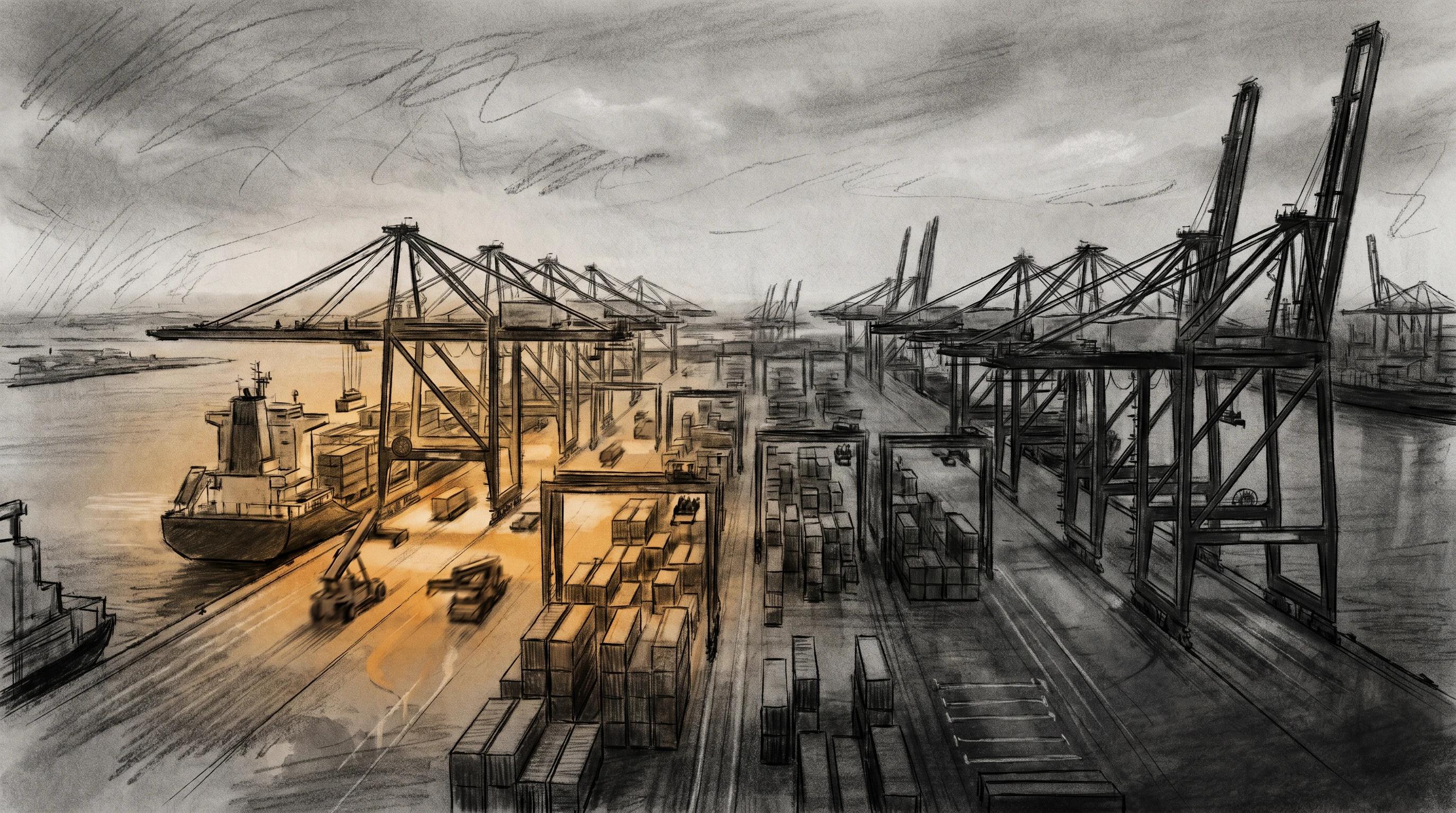
Busan New Port's Terminal 7 opened on April 5, 2024. With a berth length of 1,050 meters and a footprint of 837,237 square meters, the terminal is equipped with nine container cranes, 60 automated guided vehicles (AGVs), and 46 transfer cranes — and there is virtually no point in the entire operation where a person touches the cargo. Staff at the operating company, Dongwon Global Terminal Busan (DGT), sit in front of office monitors rather than on the dock floor. They remotely control only the moments when containers are loaded onto or unloaded from vessels and trailers; everything else in the cargo-handling chain is managed by the automated system. Developed directly by the Busan Port Authority (BPA) and commercially operated by DGT, this is South Korea's first 100% automated terminal.
That is the core of what makes this significant. The phrase 'smart port' had been embedded in press releases throughout the 2010s, but this was the first time a terminal in South Korea had removed human labor from the entire sequence — from berthing and transfer to storage. Expectations followed: fewer workplace accidents since no workers are present in the cargo zone, and a reduction in fine particulate matter since the AGVs run on electric batteries. As a Busan Ilbo reporter put it in a field report, the scene of 'controlling tens of thousands of square meters of port from an office' had become real.
The Real Achievement: Localization — and One Missing Piece
The most tangible result at this terminal was not the unmanned operation itself but the localization of equipment. Container cranes were manufactured by Hyundai Samho Heavy Industries, and transfer cranes by HJ Heavy Industries and Doosan Enerbility. Port automation equipment had until now been imported wholesale, but this project shifted production to domestic manufacturers. BPA estimated the procurement generated approximately 850 billion won in economic spillover effects and created roughly 2,400 jobs.
One piece, however, was still missing. The AGVs could not be localized: DGT contracted directly with Dutch firm VDL for 17 units, with Hyundai Rotem set to produce the remainder through a technology-transfer arrangement. But the introduction of these automated guided vehicles was delayed even before opening day. One logistics trade publication noted that late deliveries from the Dutch manufacturer disrupted Hyundai Rotem's technology-transfer production as well. The AGV is the heart of an unmanned terminal — yet that heart had not arrived on time when the opening schedule rolled forward.
There is an interesting postscript. In July 2025, Hyundai Rotem secured additional orders, bringing its cumulative AGV supply to New Port to 100 units. The first button was threaded with an import, but a domestic automated guided vehicle market is now being built at New Port.
Eighteen Months After Opening, the Terminal Ran at Half Capacity
Here the gap between the glittering announcement and the ground reality becomes apparent. Dongwon had expected productivity at the automated terminal to be 20% higher than at conventional terminals. But figures presented at the October 2025 National Assembly audit by Rep. Jeon Jong-deok of the Progressive Party (House Agriculture, Food, Rural Affairs, Oceans and Fisheries Committee) told the opposite story. Terminal 7's monthly handling capacity stands at 165,000 TEU, yet actual throughput was 92,000 TEU — just 57% of capacity, the lowest among all New Port terminals. In the same port complex, Terminal 1 was running at 146% of capacity, Terminal 2 at 136%, and Terminal 3 at 127%. The most technologically advanced terminal was handling the least cargo.
The causes lay in operational details. Frequent repair work was triggered by ground subsidence, and the stop-point sensors that underpin automated operation repeatedly malfunctioned. As a result, truck turnaround time — the interval from a truck's arrival to receiving a container and driving away — ranged from at least one hour to over four hours in some cases. The average at other terminals is 10 to 30 minutes. From a truck driver's perspective, the unmanned terminal was not 'cutting-edge' — it was 'a place where you wait endlessly.'
To add the other side of the argument: warnings were already present at the time of opening. One logistics trade outlet noted that unmanned systems are difficult to recover from when incidents occur and therefore require at least six months of safety testing, pointing to the thorough testing undergone by overseas examples such as Qingdao and Rotterdam. The outlet criticized BPA for rushing the opening with an eye on annual rental income of approximately 58.5 billion won and opening-delay losses estimated at around 29 billion won. Rep. Jeon also noted the need to 'establish a comprehensive plan for normalizing overall cargo-handling operations.' Who has been paying the cost? For at least the first 18 months, the answer has been the truck drivers waiting at the gates — and the terminal itself, running at half the capacity it was built for.
At the Shipyard, Robots Beat a 20-Year Veteran
The next site connected by a straight line from the port is the shipyard. Here, automation has been replacing people even more directly. At HD Hyundai Samho's shipyard in Yeongam, South Jeolla Province, collaborative robots achieved what is claimed to be a world first: automating the welding of curved blocks (bent steel plates) as well as flat blocks (straight steel plates). The on-site team leader's assessment is telling: 'Even a 20-year welding master can barely keep up.'
The numbers bear this out. For a single plate, a robot takes 15 minutes while a human takes 13 — humans are slightly faster — but robots do not rest. At a maximum of 50 plates per day, the robot processes exactly double what a skilled worker manages (25 plates). It is unaffected by temperature fluctuations and has no hand tremors. This is the striking point: automation is usually promoted as being 'faster' than humans, but the real competitive advantage of the shipyard welding robot is not speed — it is tireless consistency.
The backdrop is a workforce in structural decline. South Korea's shipyard workforce fell from 203,441 in 2014 to 96,254 in 2022 — cut nearly in half — and the average age of production workers is approaching the 50s. The industry fills a shortfall of more than 12,000 workers annually with foreign labor, but has run into a new set of problems: safety risks from language barriers and declining quality. Robots are filling that void.
Who Has Adopted Them, and How Far Have They Gone?
The scale is confirmed in numbers, not estimates. Collaborative robots across HD Hyundai's three shipbuilding affiliates — HD Hyundai Heavy Industries, HD Hyundai Samho, and HD Hyundai Mipo — grew rapidly in 2025, surpassing 170 units by December of that year. HD Hyundai Mipo alone operates 55 units and nearly doubled its fleet by adding 27 units from domestic manufacturer Rainbow Robotics. Danish firm Universal Robots remains the market leader by share, but domestic players such as Rainbow Robotics and Neuromeka are gaining ground fast. The same localization story playing out at the port is now repeating itself at the shipyard.
Samsung Heavy Industries introduced an automated welding system in 2024 and raised work efficiency by 30%, setting a three-phase robotics roadmap: expanded robot deployment (2024–2025), process automation (2026–2027), and full automation and unmanning (2028–2029). Hanwha Ocean has announced a target of raising its shipyard automation rate to 70%.
In summary, automation at the ports and shipyards centered on Busan is no longer written in the future tense in press releases. Terminal 7 has been switched on, and shipyard welding robots have surpassed veterans in measurable output. But the fact that Terminal 7 ran at only 57% of capacity for its first 18 months — with trucks waiting up to four hours — makes one thing clear: switching a system on and having it run as intended are two different problems, and the cost of that gap is being paid by someone at the worksite at this very moment.
This article was automatically translated from the Korean original by AI. For the authoritative version, read it in Korean.
한국어 원문 읽기 →