Why Deep Tech Is Delayed in Korea
A capital structure that measures semiconductor materials and robotics by software timelines. Reading the mismatch between capital recovery periods and technology maturity through the time units of industrial accumulation.
AI Summary
Korea's venture capital system, designed around software's fast iteration cycles, conflicts with deep tech's need for long-term accumulation in materials, semiconductors, and robotics. While VC funds operate on 8-10 year cycles, new materials take roughly 10 years to move from lab to production line, creating a fatal mismatch. The country must develop patient capital structures, institutionalize learning from failures, and leverage decades of manufacturing know-how to compete at the technological frontier.
5-Year Funds and 12-Year Technology
A materials startup in Gangseo-gu, Busan closed last year. It's difficult to reveal the company's name. It had technology to modify the microstructure of secondary battery anode materials, and the lab data looked good. What killed it was not the technology but the fund's maturity. The venture fund that first accepted them had an 8-year lifespan, and in the fourth year when investment execution ended, the company was just beginning to capture the first defect rate curve of its mass production line. The recovery clock wouldn't stop, but the process yield curve still remained at the knee. Follow-on investors kept repeating the same question: When will revenue come? There was only one honest answer: We don't know, we need to run the line one more time to find out.
This scene is uncomfortable because we believe Korea is already world-class in materials and components. That belief is only half right. The areas where Korea is strong are mostly those where catch-up has ended, where the answers to problems were already available externally.
The Catch-Up Clock Is Short, the Frontier Clock Is Long
The standard grammar of Korean venture capital comes from software. Fast launch, fast pivot, fast metric growth, next round within 36 months. This grammar only works in a world where the marginal cost of code converges to zero. Replicating a service once written to a million people doesn't require additional factories.
Deep tech is on the opposite side. Semiconductor materials and components, new materials, robot drive systems must pass through the friction of the physical world. 1-nanometer defects, 0.1 percent yield, 100,000-hour durability. These numbers don't decrease through code modifications. They only decrease through the number of attempts. One failed wafer, one cracked prototype becomes the input value for the next design. Accumulation is this process where failures remain as data and lower the cost of the next attempt.
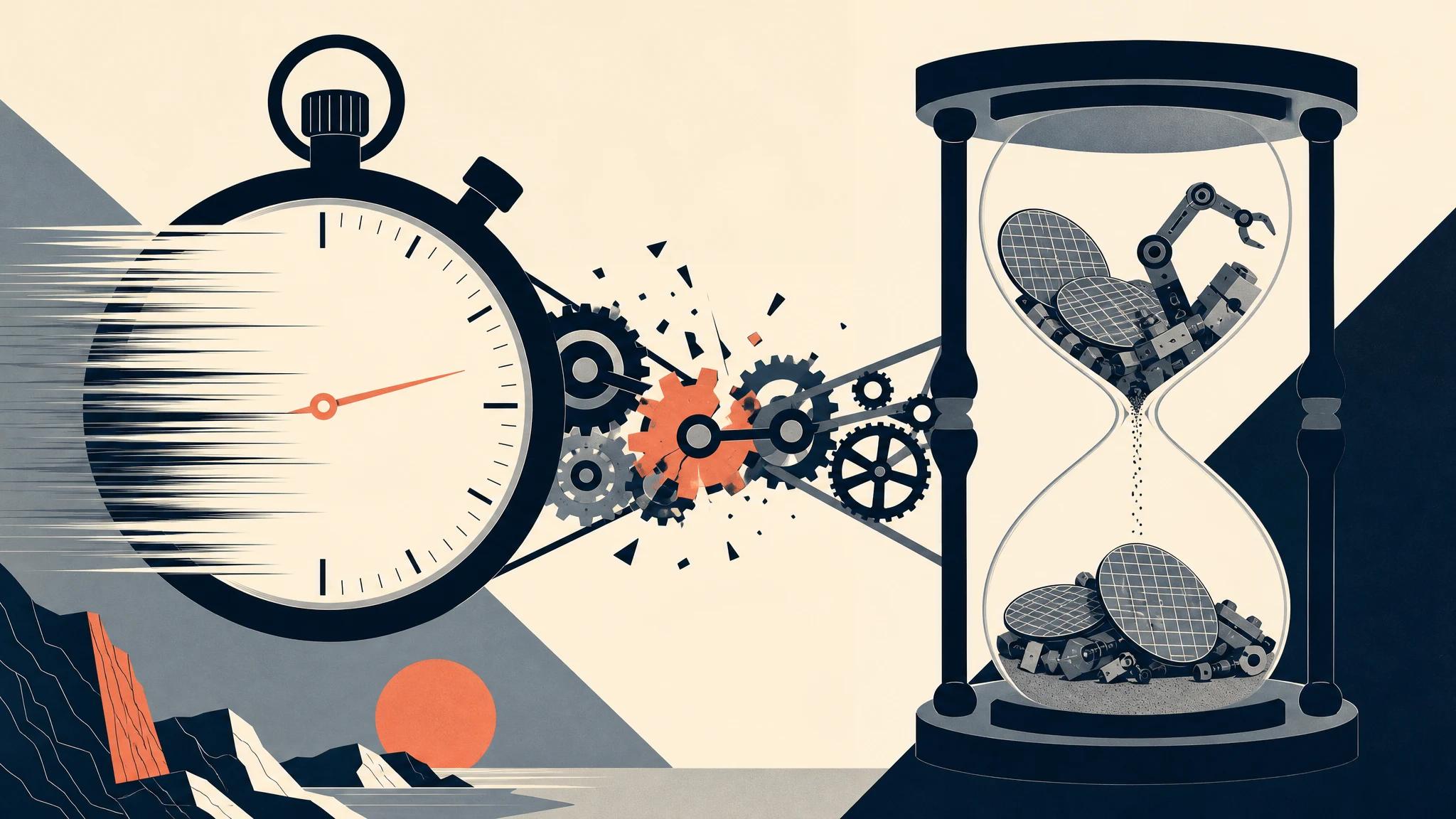
Here, capital recovery period and technology maturity diverge. The standard lifespan of VC funds is 8 to 10 years, with the actual investable period being half that. Meanwhile, it typically takes around 10 years for new materials to settle from lab to mass production line. This is precisely the time unit that the Ministry of Trade, Industry and Energy and the Korea Institute for Industrial Economics & Trade always emphasize when discussing materials, components, and equipment independence. The recovery clock runs at software speed, while the technology clock runs at manufacturing speed. When two clocks diverge within one company, the one that dies is always the slower one.
| Capital Clock (Recovery) | Technology Clock (Deep Tech) | |
|---|---|---|
| Standard Period | VC fund lifespan 8–10 years | New material mass production stabilization around 10 years |
| Actual Investment Window | Half of fund lifespan (approx. 4–5 years) | Yield only improves through repeated attempts |
| Speed | Software speed | Manufacturing speed |
Germany Buys Yield, Korea Asks About Revenue
The difference lies not in capital's patience but in the type of capital. Germany has the Fraunhofer Society. It supports applied research over decades and builds bridges across the valley of death between prototypes and mass production. America's semiconductor supremacy is also the result of DARPA funding unprofitable questions for decades. The process advantage TSMC enjoys today is 30 years of accumulated yield data, not a single stroke of genius.
Korea's structure is designed differently. Government R&D is fragmented into single-year or 3-year projects, and evaluation is based on success rate. A high success rate also means questions likely to fail were never asked in the first place. In a system where failure is penalized, researchers only apply for problems they already know the answers to. Private capital demands fast recovery and public capital demands fast success. Both effectively punish slow accumulation.
A counterargument is possible. As Coupang and Toss have proven, isn't fast capital turnover precisely Korea's strength? That's correct. However, both are in logistics and finance—areas where answers already existed overseas. They could be caught up through fast execution. At the frontier, there are no answers to catch up to. So the same weapon becomes a blunt instrument here.
What to Accumulate
First, the types of patient capital must be increased. What Korea lacks is not the total amount of money but the type of money that can wait 12 years. The National Pension Service and policy finance institutions should enter as subordinated investors in deep tech-dedicated funds with 15-year lifespans to extend the recovery clock.
Next is the capitalization of failure. A structure is needed where failed process data becomes input for the next company, where experimental records of dead startups don't disappear but remain as common industrial assets. That's precisely the core of what Fraunhofer does.
Last is field time. In the aging industrial complexes of Busan and Ulsan are engineers with decades of process know-how. This tacit knowledge exists neither in papers nor code, only on the line. This is why deep tech startups should emerge more often from manufacturing sites than university labs.
In the era of catch-up, countries that found answers quickly won. We excelled at that game. In the era of the frontier, countries that create questions first win. What Korea lacks now is not fast hands, but a temporal structure that can endure 12 years before unanswered questions. If we fail to build that structure, we will forever remain honor students who only solve problems posed by others, albeit quickly.
This article was automatically translated from the Korean original by AI. For the authoritative version, read it in Korean.
한국어 원문 읽기 →