Peak Viewership, Deficit Balance Sheets
Korean esports creates cultural assets that others monetize. The collapse of American franchise leagues is a record of failed attempts to reconcile this divide. In this structure, are Korean teams suppliers or standard designers?
AI Summary
Korean esports teams generate cultural assets—star players, narratives, fandom—but monetization occurs outside their control, primarily benefiting game publishers and streaming platforms. American franchise leagues attempted to solve this separation by selling permanent slots to teams for tens of millions of dollars, but collapsed when capital dried up before assets could be recovered. Korean teams must choose between remaining suppliers dependent on sponsorships or becoming standard designers who directly monetize fan relationships and content.
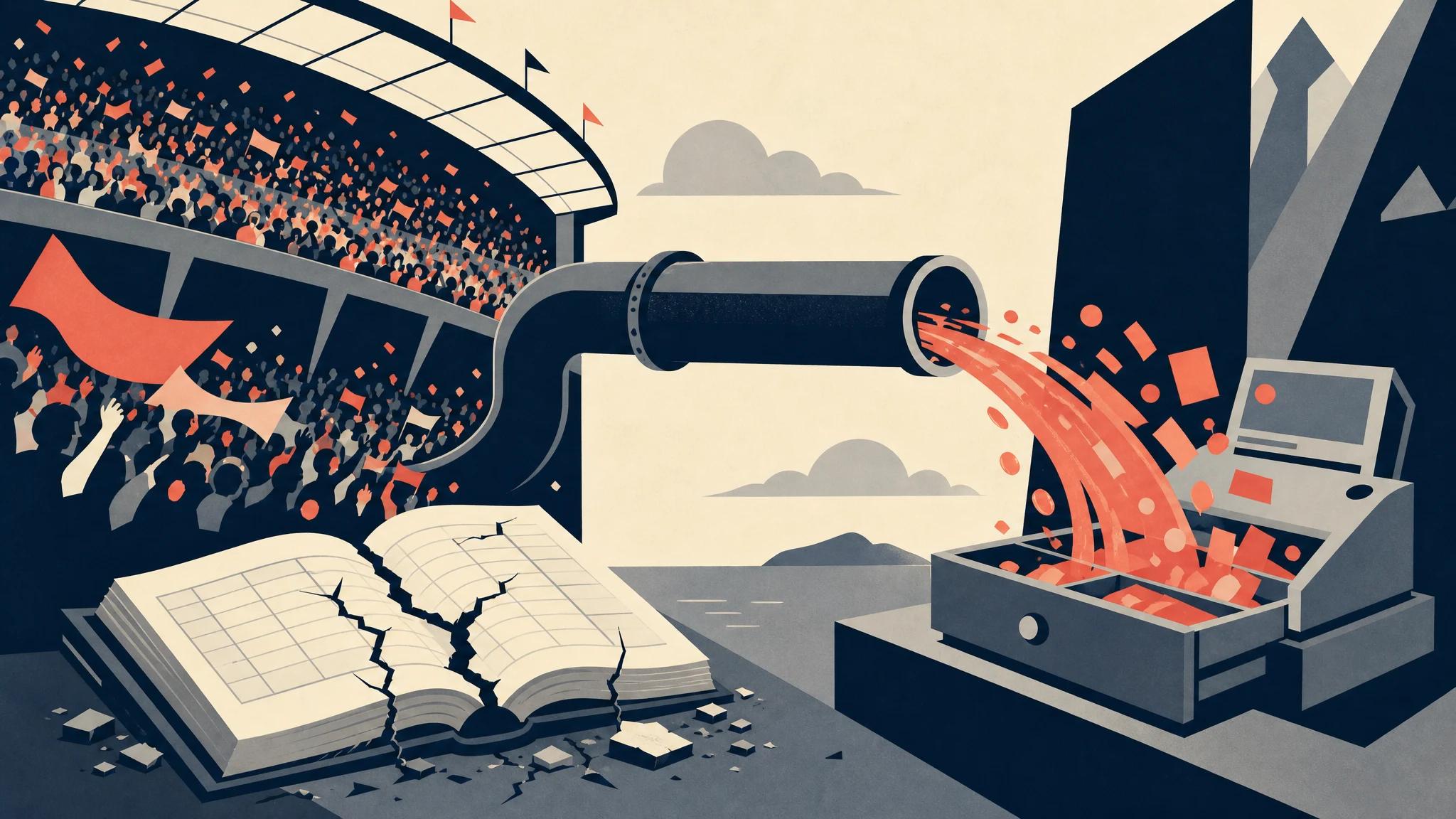
An arena in Seoul sells out within minutes of opening tickets for a finals match. Concurrent viewers exceed millions, and clips of the championship moment spread worldwide that night. The same week, the company operating that team shows a deficit on its income statement. The two scenes appear contradictory, but they are not. The blueprint of Korean esports itself is drawn this way.
The common interpretation summarizes this as "the industry is still young." The idea is that profitability will come with time. This is a mistaken interpretation. Deficits are not a symptom of immaturity but an output of the structure. Just as reading Big Tech announcements only as product news means missing the next industrial order, reading esports deficits only as management incompetence means missing who captures the value.
Where Value Is Created and Where It Is Captured Are Different
The key is the separation between cultural assets and revenue structure. Korean teams produce cultural assets: star players, narratives, fandom, and memorable moments. But the point where those assets convert to cash exists outside the teams.
| Where cultural assets are created | Where they are monetized | |
|---|---|---|
| IP·League | Teams (tenant companies) | Publishers (Riot, etc.) |
| Viewership traffic | Players·Teams | Broadcasting platforms (Twitch·YouTube) |
| Team revenue sources | Sponsorship only | Dependent on goodwill outside of matches |
The intellectual property holder is the game publisher. Riot Games decides who opens and closes League of Legends leagues, how broadcasting rights are sold, and how in-game item revenue is distributed. Teams are tenants filling content within that league. Tenants do not capture most of the building's appreciation in value.
Broadcasting platforms are the same. Viewing traffic flows into advertising and subscription revenue for Twitch, YouTube, and AfreecaTV. The accounts that harvest the attention created by players' faces belong to the platforms. What teams receive is sponsorship—a single revenue source dependent on goodwill external to the competition. When the entity creating assets and the entity monetizing them are separated, the creator is structurally impoverished.
America Tried to Reconcile the Separation and Broke
The experiment that attempted to solve this separation head-on was America's franchise leagues. Riot sold permanent slots to teams in LCS, and Blizzard did the same in Overwatch League and Call of Duty League. Entry fees climbed to tens of millions of dollars per slot. The rationale was clear: giving teams stability and revenue distribution rights would bring cultural assets and revenue under one roof.
The results went the opposite way. Overwatch League promoted a city-based model, but audience logistics and the broadcasting ecosystem failed to support it, and Activision Blizzard eventually put the league on a path to de facto dissolution. Even North American powerhouses like NRG and OpTic withdrew from titles. When they tried to forcibly reconcile the separation by imposing massive entry fees as a barrier to entry, capital dried up before assets could be recovered.
The signal here is critical. Revenue structure problems cannot be solved by putting in more money to buy slots. As long as publishers hold the upper layer of IP, what teams purchase is not ownership but tenancy. America's failure was an expensive demonstration showing Korean teams in advance that the expectation of "profitability once we secure a franchise" is an illusion.
Are Korean Companies Suppliers or Standard Designers?
So the question shifts to Korean coordinates. In this competition, are Korean companies suppliers, customers, or standard designers?
Currently, most teams are suppliers. Teams like T1 are attempting to reduce IP dependency by building global brand value and monetizing through merchandise, global sponsors, and direct fan community subscriptions. This is the most realistic layer Korea can currently capture. While game IP is held by publishers, there is room for teams to directly design the character IP of players and teams. This is the work of pulling the monetization point of assets inside the team.
There is a counterargument: "Still, the league only survives if the game thrives—isn't publisher dependency inevitable?" This is half right. The title's popularity itself is beyond control. However, fan relationships, content, merchandise, and direct subscriptions layered on top of the title are the team's assets. This is why soccer clubs have survived for hundreds of years with their own brands without being dependent on FIFA. Title dependency and revenue dependency are separable problems.
Busan could become a testing ground at this juncture. G-Star gathers esports traffic to Busan every year, but that attention does not accumulate as Busan-based assets and disperses once the event period ends. It is a microcosm of Korean esports as a whole, where traffic does not stack into assets.
The Cost of Waiting
Just as which layer Big Tech controls in Silicon Valley determines the next cost structure for Korean manufacturers, how game publishers design the IP layer determines the next profit and loss for Korean teams. This is not someone else's industry story.
The cost of waiting is clear. If teams now wait for profitability while relying only on sponsorships, cultural assets will continue to accumulate and their monetization will continue to go to publishers and platforms. The state of holding the world's best audiences and viewers while having empty bank accounts becomes entrenched. The moment deficits are treated as a problem that time will solve, value leaks out daily during that time.
This article was automatically translated from the Korean original by AI. For the authoritative version, read it in Korean.
한국어 원문 읽기 →