What Pressed Down Gaming Stocks Was Interest Rates
The stock prices of Nexon, Krafton, and NC are determined not by new releases but by capital costs, exchange rates, and closed game licenses. Game companies are closer to financial institutions selling probabilistic cash flows than content companies.
AI Summary
Between 2021 and 2023, Korean gaming stocks plummeted not due to poor performance but because of rising U.S. interest rates, which heavily discount the future cash flows that define gaming companies' valuations. Combined with exchange rate volatility and China's game license restrictions, these macroeconomic factors—rather than game quality or new releases—have been the primary drivers of stock price movements, positioning gaming stocks as highly sensitive assets in the global liquidity cycle.
Games Have No Losses, Yet Stock Prices Fall
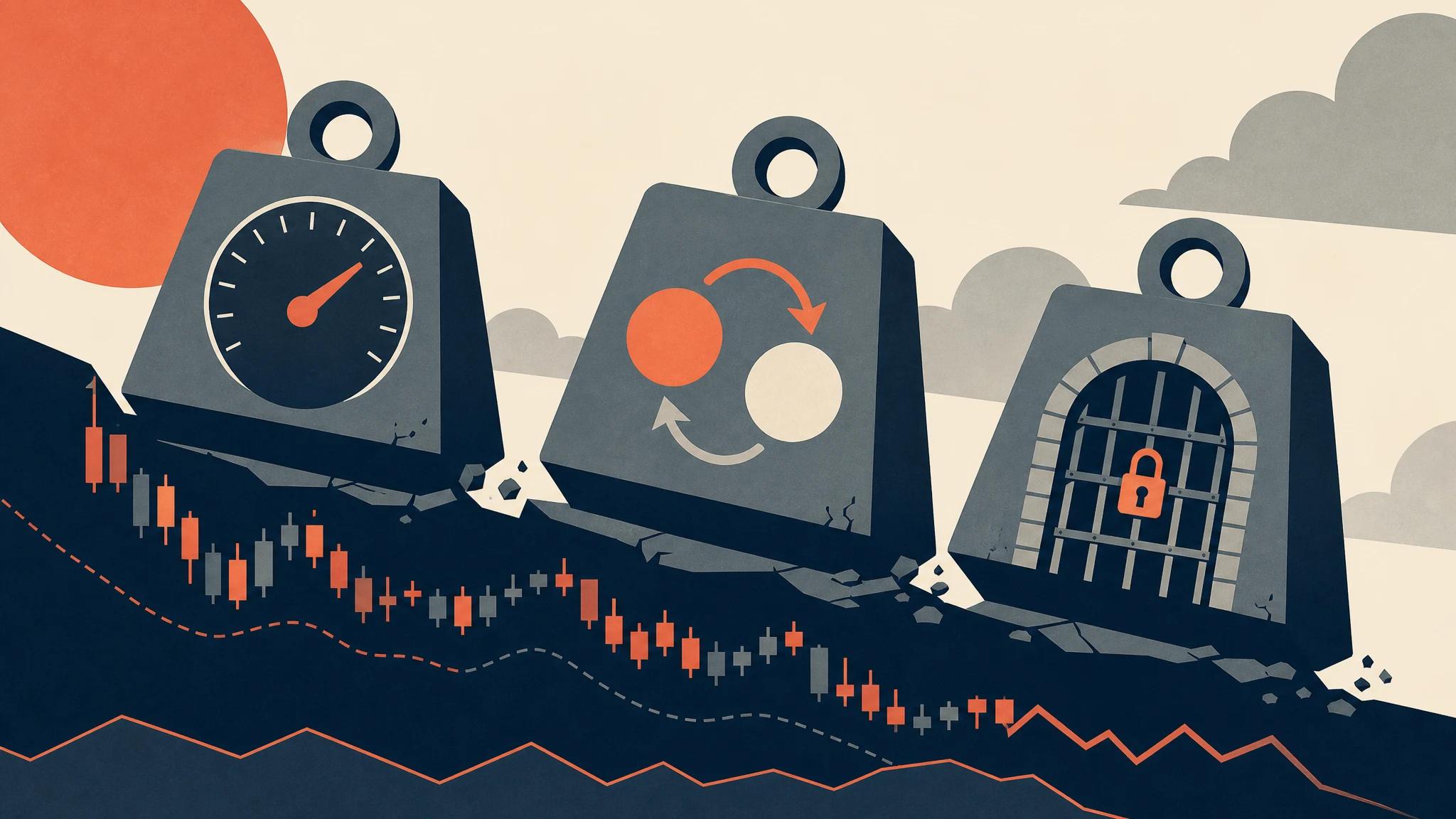
During the collapse of Korean gaming stocks from 2021 to 2023, few companies actually saw their revenues crumble. Nexon broke all-time records with Dungeon&Fighter and MapleStory, and Krafton's Battlegrounds continued printing money in India and the Middle East. The financial statements show no trace of crisis. Yet stock prices were cut in half.
The moment you try to explain this gap through gameplay, the analysis loses its way. Because new releases underperformed, because of loot box regulations, because the MZ generation left—all partially correct but mistimed. The inflection point of gaming stocks was closer to the day the U.S. Federal Reserve signaled interest rate hikes than to any new game launch date.
The question must change. The enemy of game companies is not competing titles. It's the price of money.
Game Companies Sell Not Content but Future Cash Flows
The most honest way to understand gaming stocks is to view them like financial institutions. What game companies sell is enjoyment, but what the market buys is the distant future cash flows that enjoyment will generate. The value of live service games depends mostly on the probability that users will make payments 5 or 10 years from now. Loot boxes are products that literally sell statistical expected values, and the company's future value is itself a massive probability distribution.
Money from the distant future is discounted by interest rates. The present value of 1 trillion won 10 years from now at 1% interest versus the same 1 trillion won at 5% interest are completely different numbers. Assets whose growth center of gravity tilts toward the future react violently to discount rate changes. This is especially true for game companies that lean on new game pipelines and new businesses. When NCSoft's valuation depends on something after Lineage—growth that hasn't yet arrived—interest rates are the first to shave down that future.
The view that technology is independent of capital costs breaks down here. The fun of games doesn't know interest rates. But the price tag attached to that fun does. The reason the stock price differs between 2021 and 2023 for the same game with the same revenue isn't because the game changed, but because the price of money changed.
Exchange Rates and Game Licenses: Two Exogenous Variables
Two variables unique to Korean game companies overlap here: exchange rates and Chinese game licenses.
Nexon is listed on the Tokyo Stock Exchange and generates a significant portion of revenue from China and Japan. Krafton has heavy exposure to India, the Middle East, and Southeast Asia. Their profit and loss are a function not of the Korean won but of the dollar, yuan, and yen. When the dollar strengthens, overseas revenue inflates in won terms, but simultaneously, from the perspective of foreign investors, the dollar-denominated return on Korean assets gets eroded by currency losses. Exchange rates are a variable that works in opposite directions—favorable to performance while hostile to stock prices.
Game licenses are more direct. When China closes service permits for foreign games, one of Korean game companies' largest potential markets freezes entirely. The game licenses that remained closed for years after THAAD reduced the China momentum item in game company valuations to zero. This is a policy risk unrelated to game quality, and simultaneously a sub-variable of the massive geopolitical cycle of U.S.-China conflict. The China discount embedded in gaming stock prices is in fact a diplomatic discount.
Global Capital Sells Korea First When It Dislikes Risk
Where is money flowing now? In phases when interest rates are high and the dollar is strong, global capital returns to safe assets and the United States. Among risky assets, emerging markets with high volatility, and within those, high-valuation tech stocks betting on future growth, become the first targets for selling. Korean gaming stocks nearly perfectly satisfy these conditions. They are emerging market assets with high foreign ownership, growth tilted toward the future, and policy risks to boot.
Much of what's called the Korea Discount is not some mysterious curse unique to Korea, but rather characteristics of the asset class that gets sold first when global liquidity contracts. Gaming stocks sit at the most sensitive edge of that discount. No matter how crowded G-Star in Busan gets every year, what explains next quarter's foreign investor flows better is where the exchange rate and U.S. Treasury yields stand that day.
Counterarguments are possible. Ultimately, if you make good games, stock prices follow—like how Dungeon&Fighter Mobile's success in China lifted Nexon's stock price, content beats all macro variables. Half true. Blockbuster hits clearly break through discount rates. But that's not evidence that macro variables are powerless; it's evidence that the hit was strong enough to offset the macro headwinds. If the same hit had launched during low interest rates and open game license phases, the stock price would have risen far more. Content determines the numerator, interest rates the denominator. Both are stock prices.
Conclusion: The Direction of Money Over the Speed of Fun
The real enemy of Korean game companies is not competing studios, regulatory authorities, or departing users. The enemy is the discount rate. When you view game companies as financial institutions selling probabilistic cash flows, it becomes clear that their fate is not entirely in their own hands. Half is determined inside the game studio, half in Washington's interest rate decisions and Beijing's game license signatures.
This is not investment advice. However, someone who opens the Fed's dot plot and yuan exchange rate before watching new game trailers when looking at gaming stocks can at least explain why stock prices fell despite good performance. Technology promises the future, but the price of that future is always set by money. How quickly fun is created matters as much as which direction money flows.
This article was automatically translated from the Korean original by AI. For the authoritative version, read it in Korean.
한국어 원문 읽기 →