Big Dreams on Borrowed Ground
The speed is there. The talent is there. Government funding grows every year. What's missing is a turf of their own. The real bottleneck behind Korea's failure to produce a big-tech-caliber company.
AI Summary
South Bridge's founder posed the same question to four columnists — why hasn't Korea produced a global big-tech-caliber company? — and received four diagnoses: blocked exits, impatient capital, platform dependency, and currency disadvantage. Arguing that the true bottleneck is Korea's near-universal habit of building on others' platforms, the author shows how the other three problems flow from that single root. The outlet commits to covering platform-owners over platform-renters going forward.
When I launched this outlet, I posed the same question to four columnists: Why hasn't Korea produced anything truly big? The country has fast followers, it has talent, and government funding grows every year. Yet nothing at the scale of a global big tech company has emerged. The four came back with four different answers. Today I'm putting all of them at the same table — and taking a side.
Start with 'Exit Fairy.' His argument is that the exit is blocked. In the United States, if you build a decent tech company, Google or Meta or someone will buy it. Founders move on to the next venture, and employees cash out, carrying that experience and capital into new startups. In Korea, the conglomerates don't buy. They copy and build it themselves. So founders design small from the start. There's no reason to build big if the company can never be sold. It's an accurate observation.
'Fed Brother' points to the asymmetry in the cost of capital. American founders receive patient capital that sustains them for a decade — money follows while they run at a loss and devour entire markets. Korean capital can't wait that long. Government-backed funds have maturity dates, exit pressure is constant, and failed founders rarely get a second chance. The same ambition gets trimmed when capital's time horizon is short. This, too, is true.
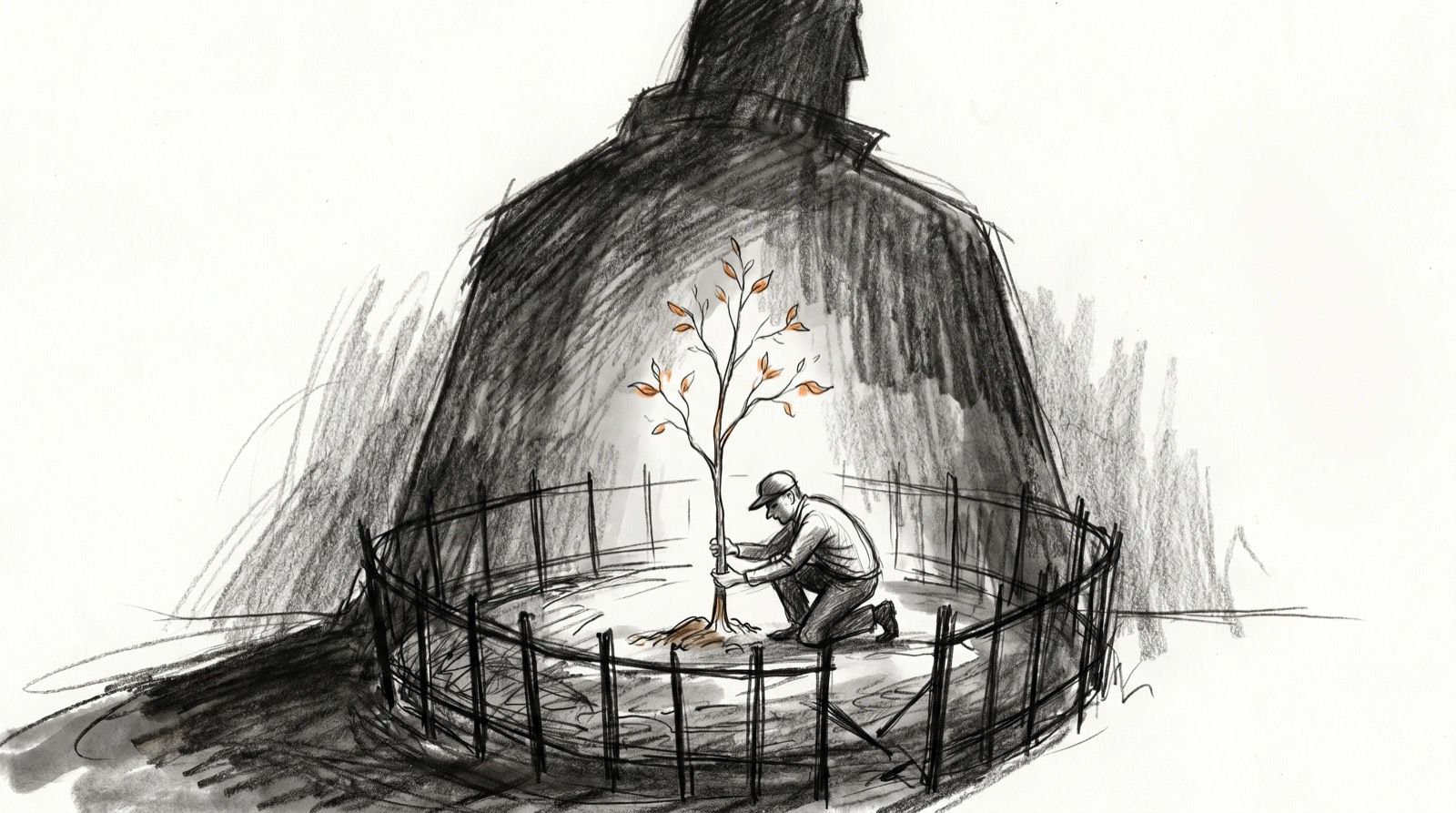
'Between 0 and 1' sees it more coldly. Most Korean companies are built on someone else's platform. Apps sit on Apple's and Google's stores; cloud runs on Amazon and Microsoft; models are layered on top of OpenAI. A tenant, no matter how well they decorate, is not the building owner. Toll payments flow upward, and when the rules change, a business can be upended overnight. No matter how much you grow on someone else's pipes, you are ultimately a renter.
'Won Defense Line' cites the limits of currency. Korea has a domestic market of 50 million people and a currency that is not a reserve currency. American companies can reach big-tech scale on the strength of their home market alone and raise capital in dollars. Korean companies have to go global from day one, shouldering currency risk and higher capital costs simultaneously. The starting line is simply different.
All four are right. But if all four are right and we leave it at that, nothing gets done. So the question is: which is the true bottleneck, and which are the symptoms that bottleneck produces?
I side with 'Between 0 and 1.' The real bottleneck is that we almost always build on someone else's turf. The other three are symptoms that flow from there.
Think it through and the sequence becomes clear. A company built on someone else's platform has low acquisition value to begin with, because the core assets belong to the landlord, not the tenant. So conglomerates copy rather than buy, and the blocked exit that 'Exit Fairy' observed comes into being. A company without its own pipes has a shallow moat and makes for a poor target for long-term bets. So the short patient capital that 'Fed Brother' described becomes the rational choice — why wait ten years when there is no deep moat? And without your own platform, going global means borrowing someone else's channels, and the cost of those channels compounds the starting-line disadvantage that 'Won Defense Line' named. Blocked exits, short capital patience, currency limitations — on closer inspection, all are branches from the same root.
| Tenant | Landlord | |
|---|---|---|
| Core Assets | Owned by Others | Self-Owned |
| Toll Fees | Drain upward monthly | Collected by me |
| When Rules Change | Upended overnight | I set them |
| Acquisition Value | Low | High |
When Naver built Line, when Coupang laid its own logistics network, when Kakao built its own ecosystem on top of its messenger, we glimpsed something big for a moment. They all had one thing in common: they refused to be tenants and laid their own turf. By contrast, the many well-built companies that placed themselves on someone else's app stores, someone else's clouds, someone else's models — they ended up as renters.
The move forward is then clear. It is not about increasing government subsidies again. It is about concentrating capital and patience on companies that aim to own their own platforms — companies willing to lay the pipes Korea currently rents from others. Whether models, cloud, payment rails, or logistics networks. It is better to build one landlord than to grow a hundred tenants. Don't treat the four symptoms separately — address the single root.
I am staking the direction of this outlet on this conclusion. Going forward, SOUTH BRIDGE will write first about companies that have built their own turf, rather than companies that have borrowed well. Distinguishing who is a tenant and who is a landlord — that is the record I intend to keep.
This article was automatically translated from the Korean original by AI. For the authoritative version, read it in Korean.
한국어 원문 읽기 →