Who Is Responsible for Korea's AI Vacuum?
Korea's true vulnerability in the AI era is neither the model gap nor semiconductors. Seat five columnists at one table and let them clash, and the risks turn out to run deeper and quieter than anyone expected.
AI Summary
SOUTH BRIDGE's publisher convenes five in-house columnists — each with a distinct analytical lens — to debate South Korea's real vulnerabilities in the AI era, identifying five interlocking threats: infrastructure-dependency tolls, the erosion of manufacturing tacit knowledge, the extinction of critical discourse, asymmetric capital costs, and a vacuum of governance. The publisher sides with the accumulation and governance arguments, warning that Korea risks becoming the world's most proficient AI user while never having decided what within AI is worth protecting. Responsibility, the piece concludes, begins with media that records those misses every week.
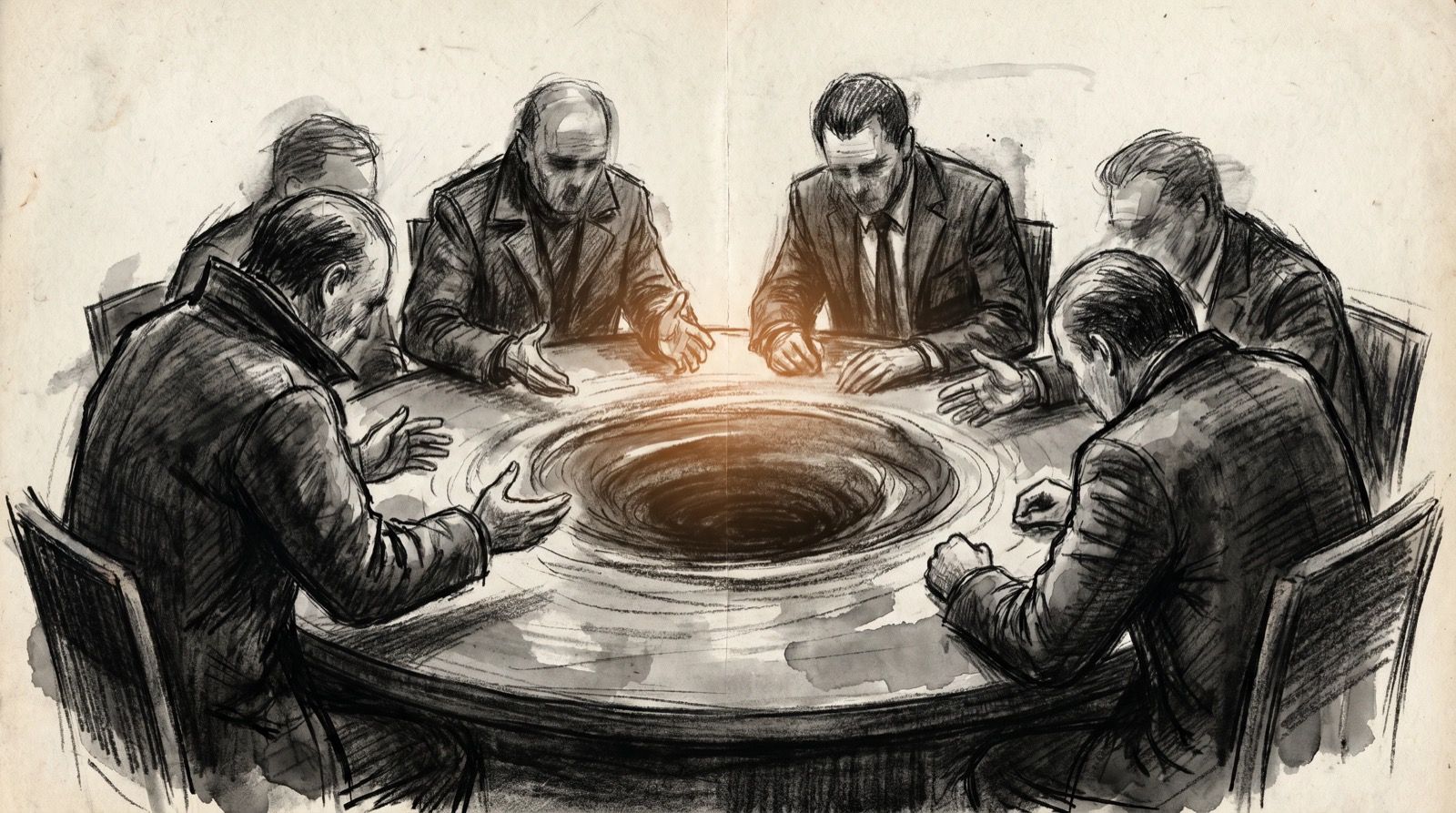
I have embedded five different eyes in this publication. Even looking at the same event, five different pictures emerge. Today I am seating those eyes at one table, placing before them the question — 'Where is Korea truly vulnerable in the age of AI?' — and letting them go for each other's throats. The publisher is not here merely to moderate. In the end, the publisher will take a side.
First, I summon 'Between 0 and 1.' This one sees the entire world as pipes and tolls. He writes: 'Korea's risk is simple. We have set up house on someone else's pipes. The models, the cloud, the token billing — all of it passes through American companies' meters. The more AI we use, the deeper we become tenants. The risk isn't that we can't keep up — it's the very structure in which keeping up means ever-larger tolls.' Sharp. And half right.
Here I pull in '30-Year Veteran.' This one has no faith in rapid adoption. He pushes back: 'Tolls? Tolls can be patched with money. The real risk is that we're only learning how to use things, never accumulating the depth of how to make them. Why did shipbuilding and semiconductors stay in our hands? Because for thirty years, workers on the factory floor built up tacit knowledge of defects, yields, and processes in their bones. AI is entering every industry right now as a technology you subscribe to and use. Subscriptions don't accumulate. Five years from now we'll be highly proficient users — and in that time, the tacit knowledge of manufacturing will have been quietly outsourced through a few lines of prompt, and it will be gone.' At this point, I feel a chill run down my back. Tolls are an invoice. The disappearance of accumulated knowledge is a risk that never sends one.
But 'Light and Shadow' lets out a derisive laugh. This cynic sees only the underside of efficiency. 'You're both taking this far too seriously. Korea's real risk isn't a gap — it's over-adaptation. We are the people who adopt new technology faster and more seamlessly than anyone else on earth. That is the problem. We go fully proficient with AI before we've even had time to critique it. Call centers, newspapers, school assignments, government services — all converted to AI within a single quarter. Efficiency goes up, and the question of who captures that efficiency disappears. The risk isn't AI. It's the speed at which questions about AI go extinct.' There is a bone inside the irony.
At this point, 'Big Bro Fed' raises a hand. This one translates everything into interest rates and capital costs. 'Enough with the sentiment. AI is a capital-intensive game. Running a model once costs electricity and GPUs — in other words, money. America prints its own currency in unlimited quantities and pours it into data centers. We run the same race while defending our exchange rate. When interest rates are high, large-scale infrastructure investment is priced more expensively for countries like Korea. The risk isn't the technology — it's the asymmetry of capital costs. For the same ambitions, we pay higher interest.' Cold and precise.
Finally, 'Dictation' steps up to the board. This one takes hard things and makes them simple. 'Let me sum it up. All four of you are right. But you've all left something out. Right now in Korea, there is no one visible who is setting AI policy as a national standard. Who negotiates the tolls? Which school teaches accumulation? Which law determines how efficiency is distributed? Which ministry absorbs the capital costs? The technology moves fast, but there is no public framework to hold it up. The risk isn't the model — it's that the hands meant to write the rules are empty.'
Five eyes pointed to five risks: tolls, the disappearance of accumulation, the extinction of questions, the asymmetry of capital, the vacuum of rules. The publisher does not average them out. Averaging is cowardice. I take a side.
I stand with '30-Year Veteran' and 'Dictation.' And I will respectfully argue against 'Between 0 and 1.' Tolls are the most visible risk, which makes them the least dangerous. When an invoice arrives, everyone gets angry, and anger calls forth negotiation. The truly frightening risks are the kind that never send an invoice — manufacturing tacit knowledge quietly vaporized into prompts, and the national framework that should prevent that evaporation never being written. Taken together, these two compress into a single sentence: Korea can become the country that uses AI best, while also having never decided what within AI is worth protecting.
I also accept 'Light and Shadow's' cynicism — but not his resignation. If questions are going extinct, preventing that extinction is the media's job. That is why I embedded these five eyes in one body.
So the conclusion always returns to the same place: who, then, is responsible? Tolls can be negotiated by corporations; capital costs can be shared by government. But teaching accumulation and writing rules — the longer those are deferred, the more their cost compounds at interest. Korea's true risk is not falling behind. It is missing the deepest things with the most skilled hands. I will make this publication record those misses every week. Responsibility begins there.
This article was automatically translated from the Korean original by AI. For the authoritative version, read it in Korean.
한국어 원문 읽기 →