Density in the Park
Twenty minutes from Pangyo, the destination was forest and lake. A hackathon where selected participants gathered for one night and two days. What made the space good was not its size or cost, but the clarity of its purpose. The flow of movement, even the distance within the park — all of it was by design. A space with a clear purpose draws people toward that purpose.
AI Summary
Columnist Kim Hyunseung (Gray) reflects on attending a curated open-source hackathon at a corporate retreat center in Yongin, Gyeonggi Province, arguing that purposeful spatial design — not size or aesthetics — is what makes a space truly good. He observes how every element, from the park setting to the unbroken layout linking workspaces, dining hall, and guest quarters, was engineered to sustain human connection and prevent participants from dispersing. The piece concludes that as digital tools handle more of daily work, intentional physical gathering becomes increasingly rare and valuable.
Into the Park
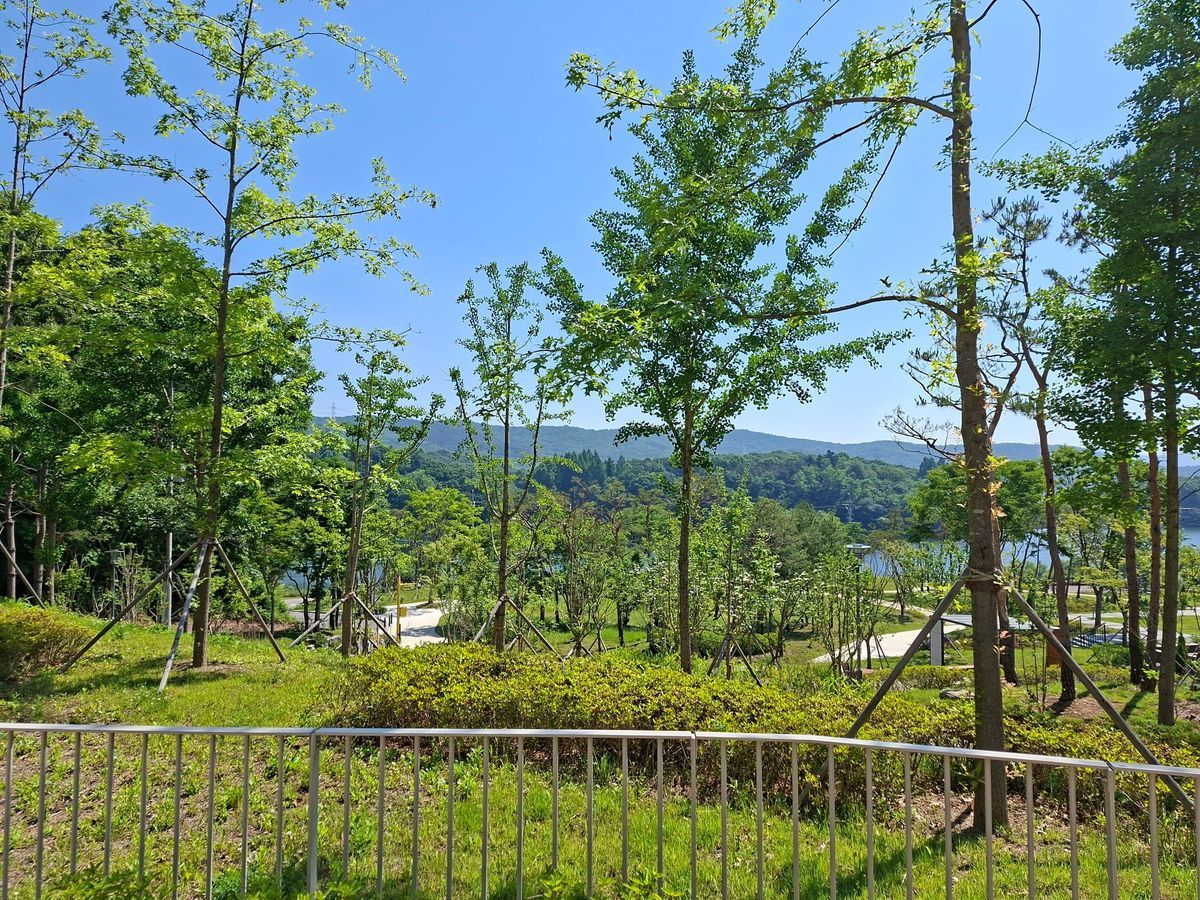
Twenty minutes by car from Pangyo. That is how we arrived at a place of forest and lake.
Yongin, Gyeonggi Province — a retreat center operated by an IT company. Not far from the forest of office buildings, yet the moment you step through the gate, the city disappears. A conference hall, dining room, meeting rooms, terrace, and guest quarters flow naturally into one another amid a quiet park. Close, yet removed. That distance had a strange appeal.
I had gone there to take part in a one-night, two-day hackathon where participants would build something using open source. And true to my habit of reading spaces, I began reading the place before I read the people.
The Selected
The first thing that caught my eye was that not just anyone was there.
The hackathon was open only to invited participants — not a gathering you could join simply by applying, but one you were chosen for. For one night and two days, those people faced each other in person rather than through screens, and built things together. They worked deep into the night, ate at the same dining hall, and rested on the terrace.
In terms of scale, it was a vast space. Yet the number of people inside was surprisingly small. A spacious venue with a curated few — it felt empty, yet strangely full.
What the Space Called Itself
The space described itself in these terms.
A foundation for growth. A place to meet for real, beyond the screen. They called their members 'crew' and used the phrase 'offline for online.' Reclaiming genuine sensation beyond the flat screen. Growing not alone but in solidarity with one another. Sentences like these were inscribed on walls and signage throughout.
They were good words. I nodded along. But standing before them, something slightly different made me curious. Why had this space been built this way? What purpose had driven all of this?
What Was This Space For?
What made the space good was not its size or the quality of its construction. It was the clarity of what it was for.
The rules of the hackathon were simple. It was not a competition to see who could build something better. Rather than quick results, participants were evaluated on how actively they had drawn on open-source tools and shared resources to build together. And so alongside the workspaces, there was a separate area for recording not only what had been made, but who had been connected with in the process. It was not a space for exhibiting output — it was a space for leaving behind the traces of relationships formed.
The space itself was designed to follow that purpose. The conference hall, workspaces, dining room, terrace, and guest quarters were linked without interruption. You could listen to a presentation and walk straight into the next room to start building; if you hit a wall, you stepped onto the terrace for fresh air; when the night grew late, you slept in the same building. With nowhere to disperse, the connections between people never broke either. In the middle of a city, everyone would have scattered by evening. Placing the venue inside a park and eliminating the option to go home — even that was by design.
A good space does not become good by accident. It becomes good when the purpose it serves is clear first, and everything else is aligned to that purpose. The size, the flow of movement, even the distance kept from the city.
Offline for Online
The phrase that stayed with me longest from that place was 'offline for online.'
These were people who work with open source. People who, if they chose, could do everything on-screen, each from their own desk. And yet they were deliberately gathered in one spot in the woods. In an age when screens are sufficient, this was for the sake of what screens cannot do. Looking each other in the face, eating together, building up something through shared sleepless nights — that is something no tool, however good, can produce inside a screen.
This kind of experiment does not seem unique to that place. I have heard that in Malaysia, builders who had only ever connected online are now living together in one place, learning and working. The more tools take over tasks, the more precious the spaces where people truly gather become. That retreat center was a space built with an awareness of exactly that.
The space called itself a foundation for growth. I call the same thing something slightly different: density. A good space is not one that takes in as many people as possible — it is one that deepens the connections between the people it does take in. By emptying out, by selecting, by investing time.
A space with a clear purpose draws people toward that purpose. I saw that again in a retreat center inside a park.
Space 100 · #02 · Gray (Kim Hyunseung)
This article was automatically translated from the Korean original by AI. For the authoritative version, read it in Korean.
한국어 원문 읽기 →