Who Owns the Infrastructure?
Trillions in capital and the language of national strategy swirl around AI infrastructure. On that vast playing field, individuals and creators have become guests. We ask who ends up with the bill for efficiency.
AI Summary
AI infrastructure — data centers, compute, and training data — concentrates control in the hands of a few corporations while distributing its hidden costs onto local residents, contract laborers, and creators. The efficiency gains flow upward while electricity bills, water use, unpaid labor, and unconsented data extraction are quietly billed to those who never appear in the trillion-dollar headlines. The article calls not for halting technology but for establishing public rules — consent, compensation, oversight, and transparency — before the current power structure becomes permanent.
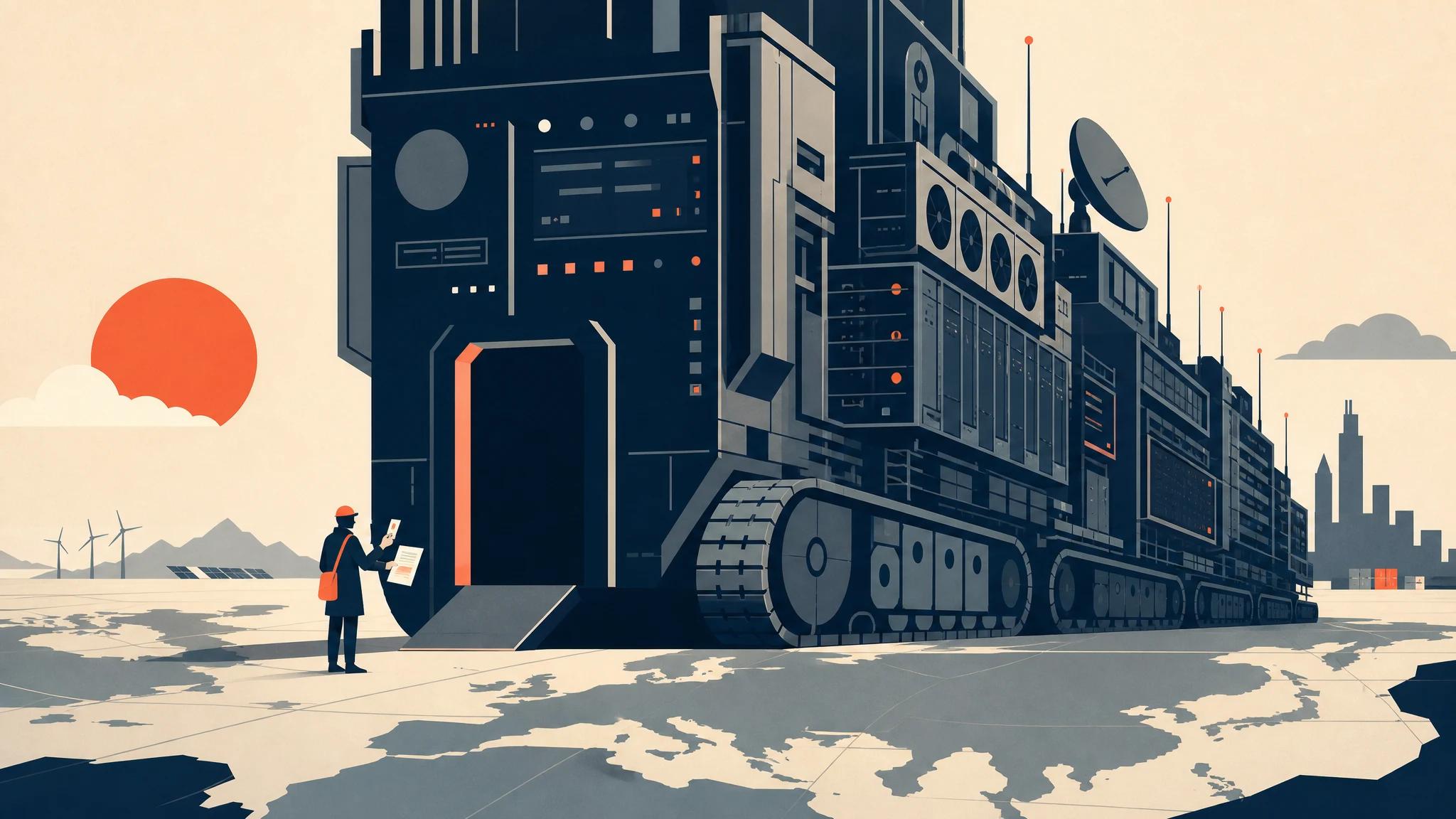
The news speaks every week in the same units. Trillion-dollar investments, gigawatt-scale power, hundreds of thousands of accelerator chips. Nvidia, Microsoft, and Amazon build data centers; governments around the world release semiconductor subsidies. You, reading this sentence, appear in none of those units.
Grand narratives always flow from the top down. National competitiveness, technological sovereignty, hegemony. Because the words are large, it is easy to assume the people inside them are large too. But let us revisit what infrastructure actually means. Infrastructure is the floor laid down so that people can live on top of it — roads, electricity, running water. The people who lay the floor and the people who walk on it are not the same.
We need to change the question. Not how powerful is this infrastructure, but who controls it and who bears the cost.
The first bill for efficiency arrives in the form of electricity and water. Data centers are not abstractions. They sit on real land, draw electricity from real power grids, and consume real water for cooling. In some parts of the United States, political pressure to raise residential electricity rates following data center deals has become a flashpoint. Busan and many other local governments across South Korea have also pitched data center attraction as a key driver of future growth. In the press releases promising jobs and tax revenue, lines about power-sharing arrangements and cooling water usage are typically brief or absent entirely.
This is where efficiency shifts. Corporate computing costs fall through economies of scale, but the burden of the electricity, land, and water propping up those savings migrates into the living costs of local residents. The costs have not disappeared. They have simply been billed to someone invisible.
The second bill is sent to labor. Large models did not fall from the sky. Contract workers in Kenya, the Philippines, and South Korea sort data, filter harmful content, and correct model outputs — all at hourly piece rates. Their names appear in no keynote address. Infrastructure wears the face of automation, but its interior is filled by human hands. Automation is not the disappearance of labor; it is also the pushing of labor into invisibility.
For creators, the bill arrives in a slightly different form. The writing, artwork, and music they have built over a lifetime became training data without their consent, and the models trained on that data are now said to be poised to replace their livelihoods. The structure is one where a tool is built from their own work to displace them. The raw materials are taken for free; the finished product is sold back under a subscription fee.
This is where the most subtle reversal occurs. We are undeniably users. We ask chatbots questions, write code, generate images. The convenience in our hands is real. But that convenience draws in every prompt we enter, every preference we click, every trace of context we leave — and feeds it back as fuel for model improvement. We use the infrastructure and simultaneously feed it. We thought we were guests; it turns out we are fodder.
Someone will say: if efficiency improves, won't the benefits eventually trickle down to everyone? Cheap computing becomes a weapon even for small startups, and anyone can borrow a model to use — can't they?
Half of that is true. The barrier to entry has genuinely fallen. But the word 'borrow' is itself the answer. Model weights, training data, accelerators, and power contracts are all in the hands of a few. The hand that decides whether to raise prices, which answers to block, which uses to cut off is not yours. What has fallen is the height of the entrance; what remains unchanged is who opens and closes the door. Power lies not in the price of the tool, but in the position that sets the terms of the tool.
Let there be no misunderstanding. This is not an argument to stop technology. Nor is it a call to refuse infrastructure itself. Just as we cannot prevent roads from being built, reversing the flow of this foundation being laid is unrealistic — and, frankly, not even appealing. The problem is not the existence of infrastructure, but the rules that govern it.
Electricity, railways, and telecommunications went through the same thing. They began as weapons of private enterprise, and then society dressed them in rules. Universal tariffs, obligations of access, price oversight, safety standards. We did not stop electricity. We simply decided whose rules it would run by.
The same questions must be pressed upon AI infrastructure. Data center attraction agreements should explicitly state power-sharing arrangements and cooling water impacts. Channels for consent and compensation should be opened for creative works used as training data. Minimum labor standards should apply to data labeling and review work. Users should have the right to know where the data they input flows and what it feeds. Minimum public oversight should be attached to the pricing and termination authority of major model providers.
If Busan calls data center attraction its future, reading the fine print of those agreements is where it must begin. The large print of press releases talks about jobs, but the bill is always written in small print.
The language of grand narratives puts us in the spectator seats. Individuals are designed to look small before trillion-scale numbers. But the rules of infrastructure belong to the political sphere, and in the political sphere there is room for citizens. Making you look small is itself one of the functions of that discourse.
So do not stop asking whose power this technology grows. This is not an argument to stop. It is an argument that we — before the mold sets — decide whose rules it will run by.
This article was automatically translated from the Korean original by AI. For the authoritative version, read it in Korean.
한국어 원문 읽기 →