Who Owns the Data of the Dead?
While death is processed merely as an administrative procedure, a person's lifetime data, AI avatars, and social media legacy drift without a custodian. This is not about bereaved families' grief, but about the state's data governance vacuum.
AI Summary
South Korea's death registration system handles only physical assets while leaving digital assets—cloud data, subscription accounts, and AI avatars—in legal limbo. The country lacks a legal framework defining whether posthumous data is inheritable property or protected personal information, forcing vulnerable families to navigate foreign platforms alone. Experts argue the state must establish governance rules that clarify data ownership and disposal rights after death, rather than leaving it as a private burden.
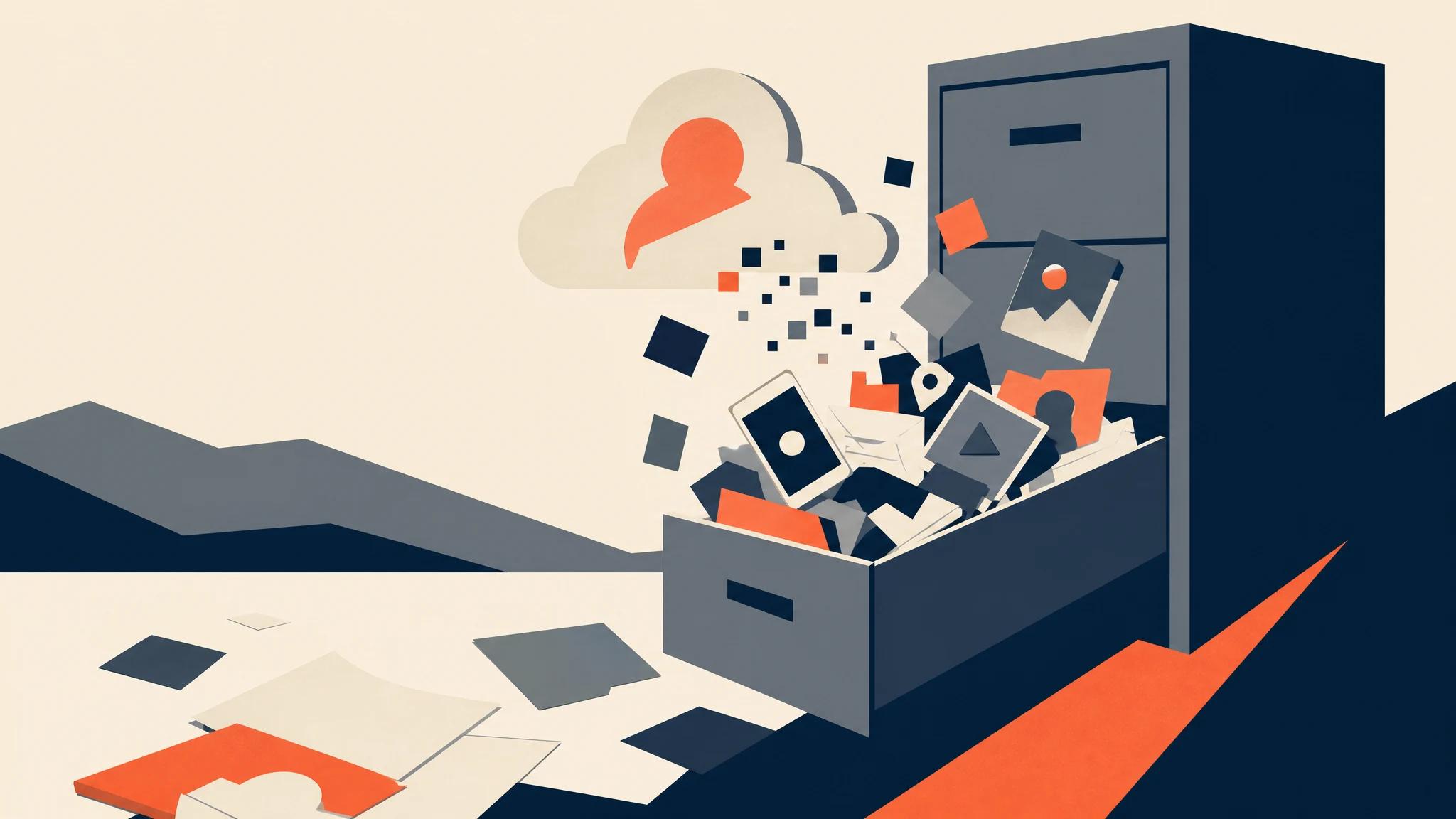
At funeral homes, people select a portrait photo. One good shot. But that's not all the person left behind. Fifteen years of messenger conversations, tens of thousands of images dormant in the cloud, dozens of accounts with subscriptions still running, and something that will become increasingly common: an AI avatar trained on that person's speech patterns.
Most consider this a private matter for the bereaved family. Something for the family to sort out. If they don't know the password, it's unfortunate but unavoidable.
This is where the misunderstanding begins.
In Korea today, death is strictly an administrative procedure. A single death certificate cancels resident registration, opens inheritance proceedings, and releases insurance payments. Paper, real estate, and deposits. The same asset inventory from the industrialization era.
But the center of gravity of what a person actually leaves behind has already shifted. Death registration does nothing about a person's digital existence. Accounts remain alive, data continues to flow, and algorithms still see the deceased as an 'active user.'
To use an analogy, death registration is a procedure that changes the title deed of a house. But no one can enter the real house where that person lived, the digital space they occupied daily. The keys are on foreign company servers, and those companies don't recognize Korean death certificates. The deed is settled but the house remains locked as is. The lights are on, mail piles up, and occasionally advertisements fly out from that house.
The core issue is not whether individuals organize their passwords in advance. That's a matter of personal usage, and stopping there misses the essence.
The real question is this: What legal status does a person's data have after death? Our society has never defined this.
Is data inherited property or personal information? If it's inherited property, children gain the right to view all of their parent's conversations. If it's personal information, does the deceased retain privacy? Neither answer has been determined. Korea's Personal Information Protection Act was designed with living people as the premise. The dead are outside the law's view.
When AI avatars enter the picture, the gap widens further. A chatbot trained on the deceased's data converses with bereaved families. It could be consolation or exploitation. Who has the right to create that avatar? The right to stop it? If that avatar fabricates words the deceased never said while alive, is it defamation or commemoration? There are no systems to answer this.
It appears to be a problem of grief, but it's a governance problem. The moment it's passed off as something individuals must handle, the most vulnerable families pay the greatest cost. Families of those who left without leaving passwords translate death certificates into English to send to foreign companies, get rejected, and wait for months. Digital divides are inherited even after death.
What the state must create is not memorial services but language and standards. How death affects data, where the right to delete and the duty to preserve diverge, who determines which records the public should preserve and which should disappear. These sentences don't yet exist.
When an elderly person in Busan passes away, where do the photos they took throughout their life and the conversations they had with neighbors go? Somewhere in the cloud, payments stop and one day everything is deleted entirely. Libraries collect even a single line of obituary. Data receives worse treatment than that.
The counterargument goes like this: If the state tries to manage even the dead's data, wouldn't that be an even more frightening surveillance state? It's a valid concern. That's why the answer is not for the state to store data, but to define the legal status of data and create rules that clearly transfer disposal authority to citizens and bereaved families. The state's role is not a vault but grammar. The public's responsibility extends to determining who opens and closes; citizens decide what to preserve.
Many countries will become good at using AI. Few will define how to handle the data of the dead. A digital portrait is not a single photo but the entirety of data a person left behind, and a society that cannot determine who manages, inherits, and deletes it is not using AI but leaving it adrift. What must come before a country good at using technology is a country with sentences of responsibility that extend beyond a person's death.
This article was automatically translated from the Korean original by AI. For the authoritative version, read it in Korean.
한국어 원문 읽기 →