We Import Questions Too Late
K-content is becoming similar not because tastes have cooled. While creation shifted from expression to betting, overseas markets were already debating that transformation in different terms.
AI Summary
As global streaming platforms use algorithms to shape content before it's even made, Western creators and regulators have been debating 'algorithmic mediocrity' and cultural sovereignty for years. Korea, however, has reduced this struggle to simple revenue-sharing negotiations, importing the question late while its content becomes increasingly uniform. Without ownership of the evaluation criteria that determine what gets made, Korean creators risk becoming permanent hypothesis-testers in someone else's laboratory.
What Happened at a London Screening
In fall 2023, British and American writers' guilds (WGA) almost simultaneously began using the same word: algorithm. What came to the strike negotiation table wasn't just wages. It was the way streaming platforms measure a work's success after the fact, and the structure by which those metrics then govern the planning of the next work in reverse. Writers said they have no way of knowing how Netflix internally handles 'completion rates' and '2-minute drop-offs.' The data belongs to the company, and writers write within the shadow of tastes created by that data.
In Korea, this scene was mostly translated as 'Hollywood union wage struggles.' It's not wrong. But it misses the point. Their real opponent wasn't people, but an invisible scorecard that determines a work's shape before it even comes into the world.
Korea Misunderstands This as 'Making It Well'
Let's look at our side's reaction. When Korean dramas consecutively rank high on global OTTs, discourse almost automatically flows toward 'the triumph of Korean production capability.' True. But when you look inside the form of that triumph, you see a strange uniformity.
Revenge narratives have similar emotional curves. Episode 1 hooks are positioned similarly. Cliffhanger intervals per episode are similar. Survival, death games, chaebol family secrets, private revenge for school violence. The subjects differ but the structures converge. Viewers feel that 'Korean dramas all seem similar these days,' yet interpret that feeling as creators' laziness. That's the first misunderstanding.
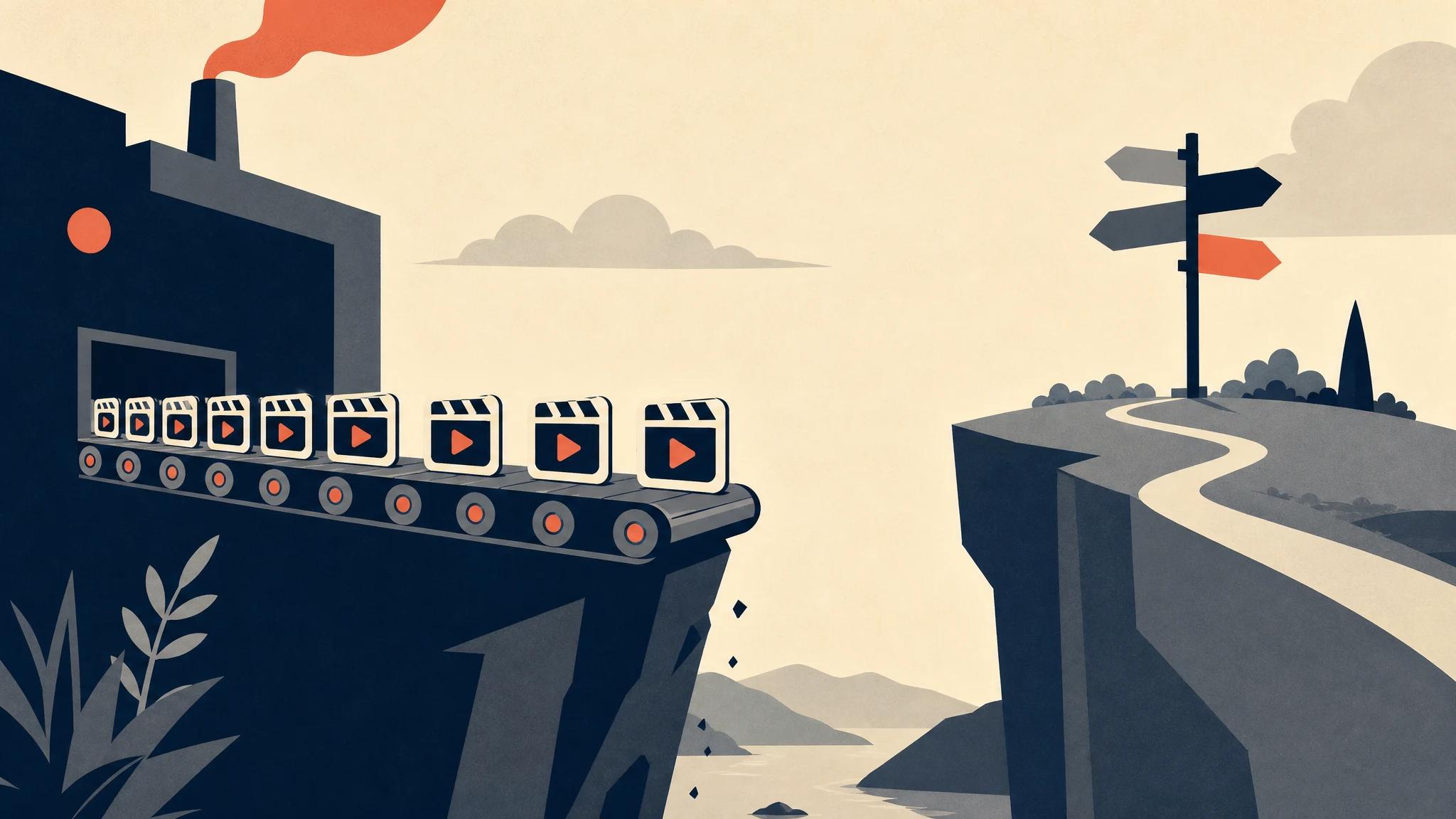
This isn't laziness. It's optimization. Global platforms don't receive works as expression. They receive them as bets. Proposals are hypotheses, releases are experiments, and completion rates are verification. Patterns that pass verification become preconditions for the next bet. It's not that creators freely vary their work, but that the results of platform scoring after the fact narrow the entrance to the next creation. Diversity doesn't disappear—the expected value of bets attempting diversity decreases.
Overseas They're Already Calling It by Different Names
American cultural criticism calls this phenomenon 'algorithmic mediocrity'—the average value enforced by algorithms. In music, Liz Pelly analyzed Spotify and tracked how 'mood-based listening' flattens songs into background music. Writer William Deresiewicz warned early on about the process by which artists are reorganized into platform data laborers. The proposition is one: when measurement becomes possible, only what's measurable survives.
European debate goes one step further. The EU has begun defining content recommendation algorithms not as simple technology but as 'distributional power over cultural exposure.' Behind the Digital Services Act's demand for recommendation system transparency lies the awareness that a private company's undisclosed function shouldn't decide what's seen and what's buried. For them, this isn't a content quality debate but a cultural sovereignty debate.
A counterargument is possible here. Isn't it an exaggeration that data optimization kills diversity? Don't platforms actually supply even niche tastes with precision? It's half true. Recommendations appear diverse at the individual level. But supply-side bets converge. Even if the ten titles recommended to you all look different, they passed through one scorecard. Consumption diversity and production diversity are different layers. The latter is collapsing.
What Do We Lose by Understanding Late?
The Busan International Film Festival is an annual venue for questioning the industry's coordinates. There, the question that should follow 'K-content boom' isn't the boom's sustainability, but whose the measurement structure that created the boom belongs to. Korea now discusses production costs, global rights, IP expansion. All important. But ownership of the scorecard that determines the actual shape of works remains outside discussion.
Importing questions late means this: while overseas markets have been fighting for five years over 'whether algorithms become prior censorship of creation,' Korea brings in that fight reduced to 'OTT revenue distribution negotiations.' If the words don't arrive, the debate doesn't arrive either. Without debate, structure is accepted like natural order.
The danger isn't abstract. If the scorecard is external, Korean creation remains forever in the position of verifying hypotheses in someone else's laboratory. The better it passes, the more refined only the method of passing becomes. The end is self-replication. It's the moment when that uniformity we now feel as 'all similar' becomes not a side effect of success but the definition of success.
Interpretive sovereignty is ultimately this: what Korea imports late isn't technology. Sometimes we import the questions themselves late. And when others define the question first, no matter how well you answer, that answer is only correct within someone else's sentences.
This article was automatically translated from the Korean original by AI. For the authoritative version, read it in Korean.
한국어 원문 읽기 →