Where the Translators Have Gone
As real-time AI translation pushes foreign language learning from a cultural norm to an optional choice, what we've outsourced is not words but the ability to doubt. Overseas, this question is already being called by another name.
AI Summary
While South Korea frames AI translation primarily as a convenience tool that eliminates the need for foreign language learning, Europe and the U.S. are grappling with deeper concerns about 'epistemic dependency' and the loss of verification capabilities. The real risk is not the decline in language skills, but the disappearance of people qualified to question whether translations are accurate—a form of interpretive sovereignty that no machine can replace.
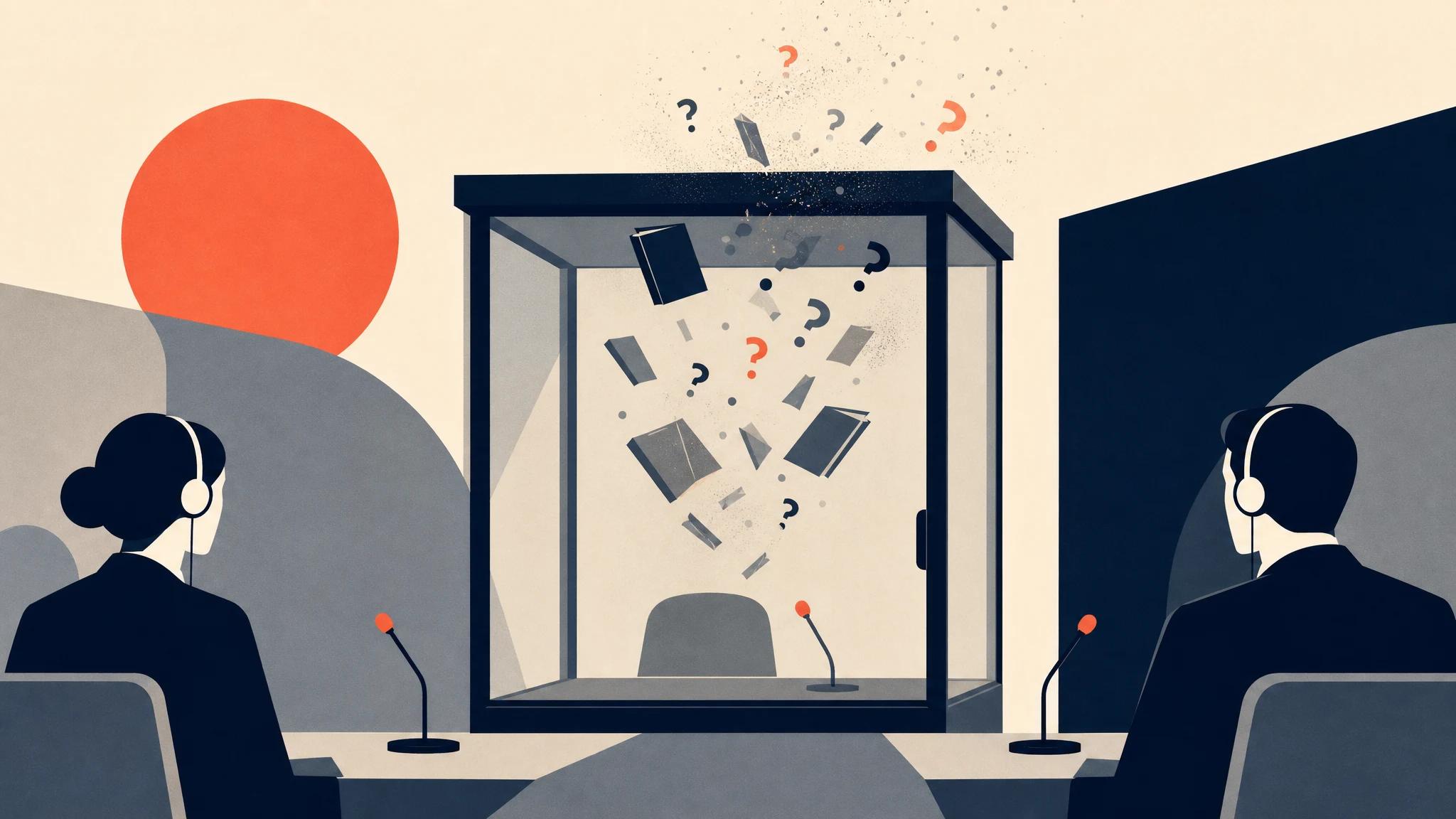
Early this year, a small commotion occurred at a European Parliament committee meeting. This wasn't news about human interpreters in simultaneous interpretation booths petitioning to protect their jobs. It was the opposite. When some members proposed incorporating an AI subtitle system into the official meeting records, it wasn't the interpreters' union but the legal advisory team that first applied the brakes. The reason was curious: "We have no way of knowing what the AI has omitted."
The missing words weren't the problem. The problem was not knowing that something was missing.
South Korea Reads This Scene as Convenience
When Korean readers encounter this news, they generally reach the same conclusion: the technology isn't sophisticated enough yet. Train it a bit more and we won't need interpreters either. In fact, domestic media coverage almost always frames real-time translation through the lens of "convenience." Foreign travel becomes easier, meetings get faster, you don't need to know foreign languages. The way Galaxy and iPhone compete with their interpretation features in advertisements operates within exactly this frame. The promise that barriers will disappear.
But the point where the European lawyer stopped wasn't the opposite of convenience—it was beneath it. What he saw was unverifiability. When a human interpreter makes a mistake, someone notices. They protest, make corrections, hold someone accountable. Before being a bridge between two languages, interpretation was a social promise that someone would be standing there to hold the bridge accountable when it proves faulty. AI subtitles build the bridge but place no one beside it.
South Korea is currently importing this function as a "tool that eliminates the need for foreign language learning." Overseas, a different question is already being asked: what is that something—not words—that disappears along with foreign language ability?
Foreign Languages Were Never Individual Skills
Here an invisible structure reveals itself. For a long time, we've treated foreign languages as individual credentials. TOEIC scores, a line on a resume, the domain of self-improvement. So when AI substitutes for that ability, it feels like pure gain. Because it's a reduction in labor.
But the social function that foreign language ability actually performed was something else. One is the distribution of trust. When an organization has multiple people who know a foreign language, if one person's translation seems dubious, another can verify it. Another is nuance negotiation. A single word in a contract, the tone of a diplomatic statement, the passive versus active voice in an apology. These things are determined not by dictionary definitions but through a tug-of-war among people who know the language in their bones. The last is the right to doubt. Only those who can read the original can doubt the translation.
When AI translation becomes routine, these three things are quietly outsourced. But the party receiving the outsourcing isn't human—it's a system whose source cannot be traced. To put it structurally, rather than quoting what a professor at a graduate school of interpretation and translation said privately: the problem isn't that translation quality declines. The problem is that the number of people who can doubt translations decreases across society as a whole.
Overseas, This Is Called 'Epistemic Dependency'
Media criticism in the U.S. and Europe has already connected this phenomenon to a larger debate. In the English-speaking world, an old philosophical term, 'epistemic dependency,' has been resummoned for the AI era. It's the phenomenon where the proportion of knowledge we cannot directly verify and must entirely trust increases. Translation is its most intimate case. A sentence written in a language I don't know is rendered by a machine I cannot verify, and I have no choice but to believe it.
Linguists warn from another angle. The old argument that foreign language learning is not merely a communication tool but 'training in entering another's way of thinking.' Learning another language means gaining the sense that the world can be carved up differently. Translation apps give you results but don't give you that sense. When we receive only results and lose the sense, we begin to mistake the translated world for a singular world. This is why overseas columns warn against "monolingual complacency."
A strong counterargument is possible here: isn't this elite nostalgia? For the majority who could never learn a foreign language, AI translation is a ladder connecting them to the world for the first time. Before talking about the right to verify, this technology is liberation for people who never even had the right to access. That's a fair point. So the answer isn't in rejecting the technology. Welcome the ladder, but society must intentionally keep people who can question where that ladder is bent. Everyone using translation apps and no one doubting translation apps are entirely different problems.
What Arrives Late Is the Question
The danger when South Korea understands this debate late is concrete. Say a trading company in Busan proceeds with a contract with a Southeast Asian partner using only AI interpretation. When a dispute arises, if neither side has anyone who can argue "that word didn't mean that," who bears responsibility? Model providers are behind liability disclaimers. This is an approaching legal vacuum, and overseas is already debating the 'verifiability' of interpretation in institutional language.
We received real-time translation as a new product feature. Overseas received it as a reorganization of trust infrastructure. What South Korea imports late isn't the technology. Technology actually arrives simultaneously, sometimes even faster. What arrives late is the question of what name to call that technology by: convenience, outsourcing, or epistemic dependency. What we call it determines what we'll protect.
The real loss in a country where translators have disappeared isn't the inability to speak foreign languages. It's the disappearance of people qualified to say a translation is wrong. And the work of deciding who will have that qualification—that is the final interpretive sovereignty that no translation app can replace.
This article was automatically translated from the Korean original by AI. For the authoritative version, read it in Korean.
한국어 원문 읽기 →