The Animal That Believes in Scarcity
For 13 consecutive days, money has flowed out of Bitcoin ETFs. People read this as market news. I read it as a report on what humans hold sacred. In the AI era, the most dangerous thing to outsource is not labor — it is the act of assigning meaning.
AI Summary
Using 13 consecutive days of Bitcoin ETF outflows as a lens, the author argues that humans are fundamentally meaning-making animals who assign value through collective belief rather than intrinsic utility. As AI commoditizes production and drives the price of making things toward zero, the distinctly human function — determining what is worth valuing and building consensus around it — becomes more precious, not less. Korea's education system, optimized for fast correct-answer production, is identified as particularly vulnerable to this shift, while Busan's logistics infrastructure, built on trust and agreed standards, is held up as a model for the transition ahead.
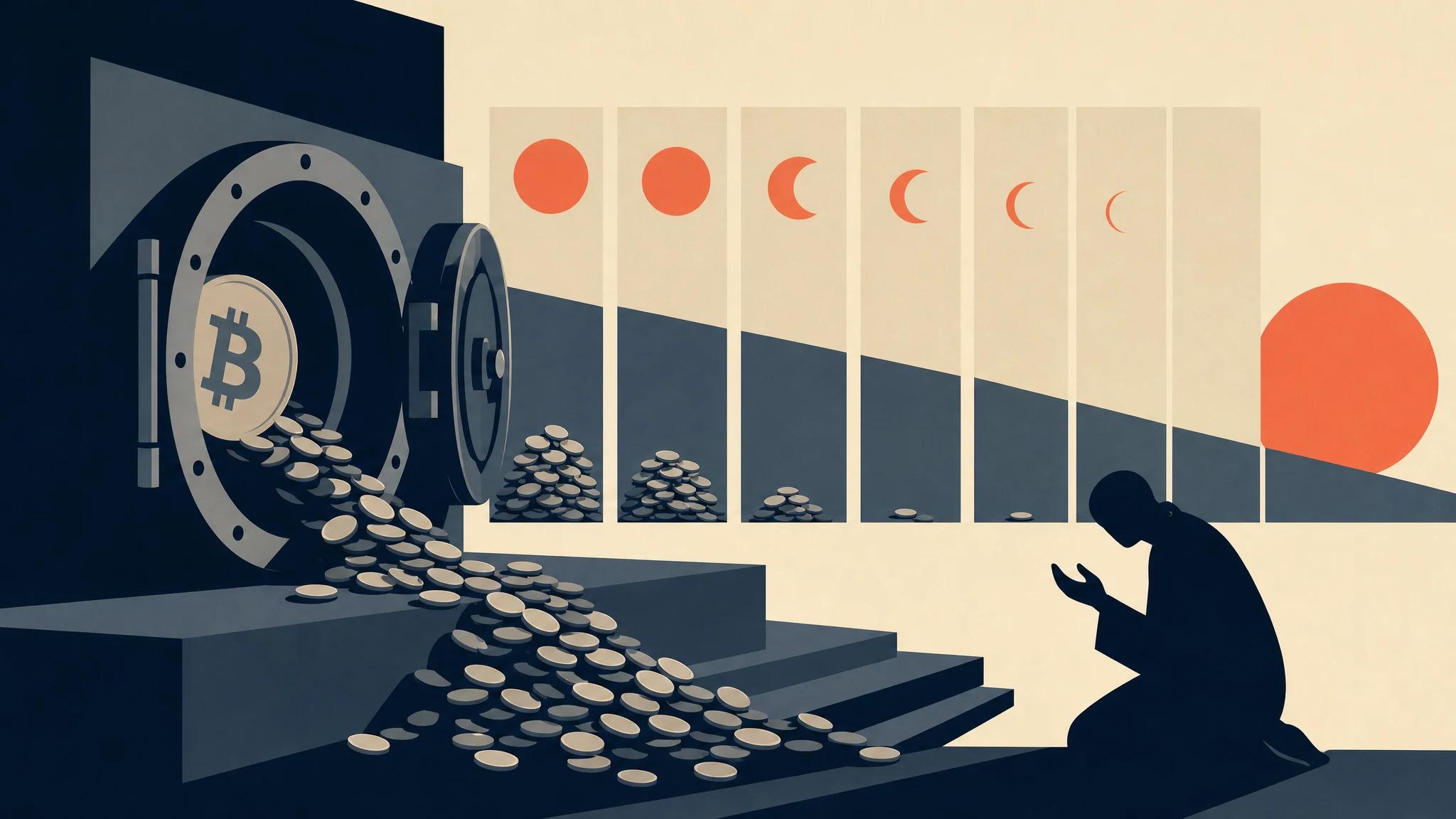
A nugget of gold does nothing by itself. You cannot eat it or wear it. Yet for thousands of years, humans have gone to war over this yellow metal. Why? Because it is scarce. More precisely, because we collectively decided to believe it is scarce.
Money has been flowing out of Bitcoin spot ETFs for nearly 13 consecutive days. Headlines explain it as risk aversion, interest rates, macroeconomic uncertainty. All true. But those explanations skip one thing: why people put real money into a number that someone coded to stop at 21 million.
The answer is closer to theology than to technology.
The core of Bitcoin is not speed or anonymity. It is finitude. The promise that no one can print more. In an era when central banks can expand the money supply without limit, humans have conferred sanctity on "that which can never be expanded." In the digital world, scarcity is not a gift from nature — it is something humans created by consensus. This shares the same structure as how religion invented sacred days and taboos.
The question I am raising here is not whether the price will rise. It is: where do humans draw value from?
The old answer went like this: value comes from labor. Sweat, time, skill. We believed the ability to make things was uniquely human. That belief is now being shaken from two directions at once.
On one side, AI churns out writing, images, code, compositions, and draft judgments almost infinitely and at near-zero cost. The scarcity of making collapses. The value of anything infinitely replicable converges to zero. On the other side, humans are wagering hundreds of trillions on pure promises like Bitcoin. On one side, the value of the ability to create falls; on the other, value attaches to that which was never made.
These two scenes are not separate. They are two sides of the same transition.
When intelligence becomes abundant and cheap, value migrates from "what you make" to "what you agree to believe." AI outsources production. What remains as the core human function is to assign meaning, allocate trust, and collectively determine what is truly precious. That is precisely what money has always done.
So Bitcoin reveals something deeper than the question of whether it is the future of money. It reveals that humans are meaning-making machines. Value is not contained in objects. It lives in the agreements between us. AI can produce objects without limit. It cannot produce agreements. At least not yet.
A strong counterargument emerges here: Bitcoin is simply speculative froth, not faith, and the capital outflows are a normal signal of a bubble deflating. The theological framing is overblown. Fair. But the word "bubble" itself reinforces my point. A bubble is a state in which the price that people's shared belief has placed on an asset exceeds the underlying reality. In other words, a bubble is also a form of faith — just fragile faith. The fact that what you believe, and how firmly you believe it, IS the price, remains unchanged.
This connects directly to labor and education. When intelligence is externalized, the value of producing correct answers quickly falls. That is precisely the capability schools have cultivated. What rises in value instead is the power to determine "which problems are worth solving," and the power to judge "whether the answer AI provides can be trusted." Accountability divides here as well. When AI stands in for judgment, responsibility does not stay with the code — it remains with the human who granted that judgment its trust. Those who allocate trust bear responsibility.
Korea is both particularly vulnerable to this transition and particularly well-positioned for it. Vulnerable because our education system and organizations have ranked people by the speed at which they produce correct answers — the first domain AI devours. Well-positioned because: look at Busan. In the port, the value of cargo comes not from the goods themselves but from trustworthy records and agreed-upon standards. We are already doing the work of designing what to trust. The question is whether we move that work to the center of our education system and institutions.
Preparedness is not about teaching more coding. It is training in the judgment of what deserves value, training in designing consensus, and training in taking responsibility for beliefs. Outsourcing production to machines, while keeping meaning in our own hands.
The 13 days of outflows from Bitcoin is not a tremor in one asset. It is a live scene of humanity renegotiating, in real time, what it has decided to hold sacred.
The real question of the AI era is not whether machines can create value the way humans do. It is: in a world where production is free, what will we reserve as ultimately human to decide? The authority to determine what is worth cherishing — that, at the very least, is not something to outsource. That is the last human work.
This article was automatically translated from the Korean original by AI. For the authoritative version, read it in Korean.
한국어 원문 읽기 →