The Gatekeepers Are Back
Goldman and Fidelity have begun running tokenized assets around the clock. This is not the death of decentralization — it is the moment digital assets first ascend to financial-market infrastructure. The next contest is not price; it is a trustworthy market structure.
AI Summary
Goldman Sachs has activated a permanent tokenized-asset trading desk and Fidelity has formally placed digital assets on its own books — structural moves signaling that institutional capital has finally found conditions it can defend internally. The real entry barrier was never price but a triad of safeguards — regulated custody, verifiable reserves, and deep settlement liquidity — that let fund managers say 'I followed procedure' even on a loss. Korea now faces a binary choice: build its own custody, issuance, and settlement infrastructure, or route domestic assets through someone else's gatekeepers.
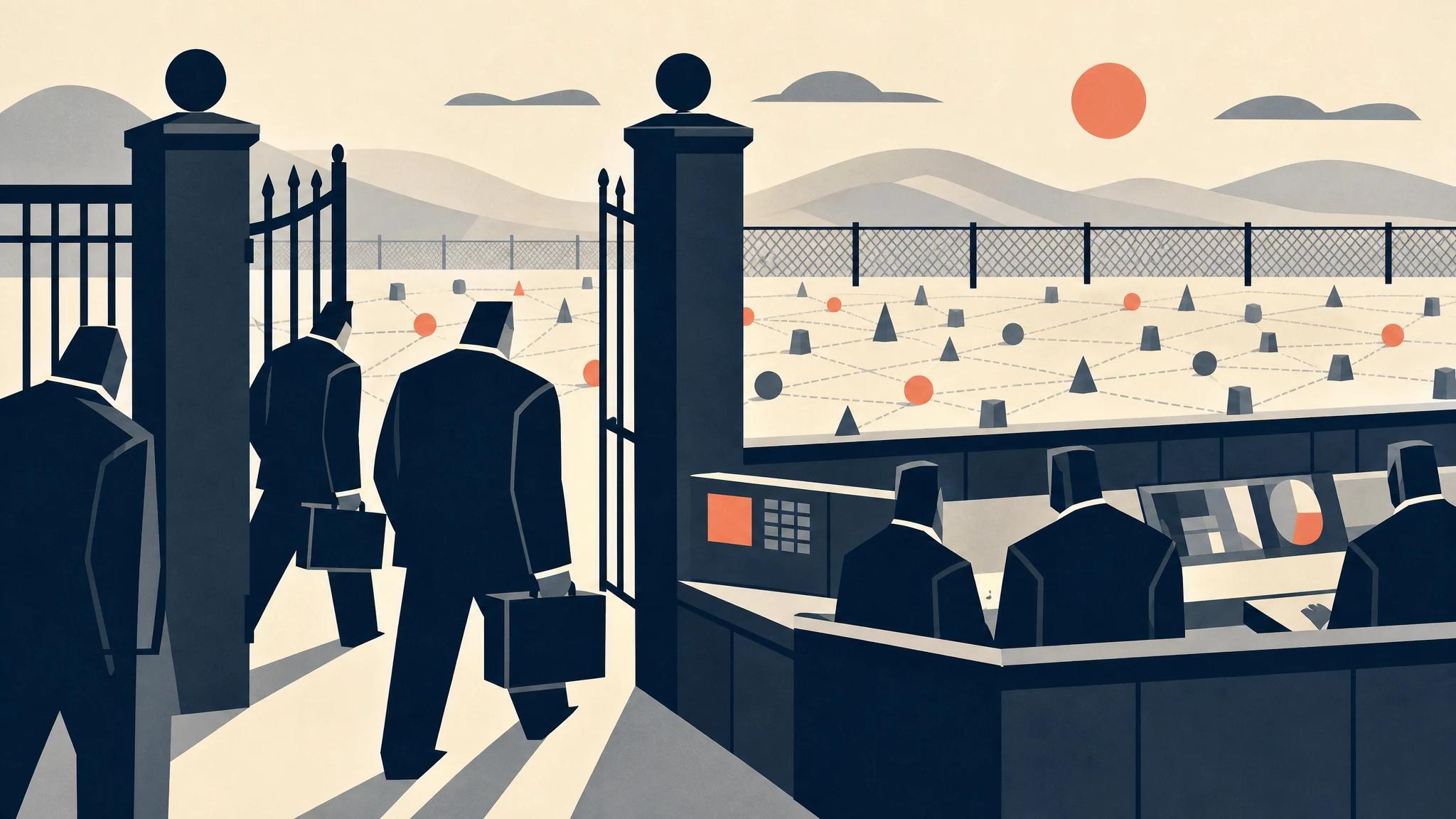
Another obituary for decentralization made the rounds. The news: Goldman Sachs has switched its tokenized-asset desk to permanent operation, and Fidelity has formally placed digital assets on its own books. Chart-watchers read it as a bullish catalyst. I see something else. This is not a price event — it is a structural event.
The question needs to change. Not whether coin prices will rise, but what conditions institutional money actually requires before it enters.
The answer is, surprisingly, mundane. It is not because prices are cheap. Institutions enter when a structure exists that gives them an excuse if things go wrong. Pension fund managers are not evaluated on returns. They are evaluated on whether they can say 'I followed procedure' when something breaks. The names of those procedures are custody, disclosure, reserves, and audits.
That is why the lesson of 2022 came at such a high price. FTX did not die because prices collapsed. Client assets and company assets were commingled in a single wallet, and there was no disclosure mechanism to verify otherwise. What collapsed was not the coin — it was the ledger. Because the market structure was hollow, the assets simply evaporated.
The real gate, therefore, is custody. Who holds the keys, and if that custodian goes bankrupt, are the assets ring-fenced? It is no coincidence that serious money only started moving after the United States revised SAB 121 and clarified the accounting treatment for institutional custody. Whether an asset can be custodied is, in practice, whether it can be invested.
Disclosure and reserves are the layers built on top. What was issued against what collateral must be provable on a daily basis. That is why the stablecoin-reserve debate never closes. Whether there is actually a real, isolated dollar behind a token labeled $1 — and whether an external party can verify that — is precisely what determines the credit grade of that asset.
Liquidity also deserves a second look. Institutions watch the exit price, not the entry price. Can $100 million be withdrawn in five minutes without crashing the market? No matter how elegant the chart, a thin order book makes an asset untouchable for institutional capital. Deep liquidity is infrastructure, not trading volume.
Here a paradox arises. Install all of these procedures and you get gatekeepers again: custodians, licensed exchanges, regulated issuers. New intermediaries queue up on top of the very technology that was supposed to eliminate intermediaries. The objection that institutionalization equals re-centralization is, for that reason, a sharp one.
It is half right. I concede that. Looking at where assets are stored and who issues them, digital assets are clearly converging once more toward a small number of licensed entities. Centralization at the point of contact is underway.
But the payment and settlement layer is a different story. The essence of tokenization is not who stores the assets — it is how transactions conclude. Traditional finance settlement still takes days, with a chain of intermediary institutions absorbing the counterparty risk in between. Tokenized assets complete payment and settlement simultaneously. The gatekeepers are back at the entrance, but the plumbing inside the building has changed.
An analogy: the internet ultimately centralized into a handful of giant cloud providers too. That did not mean the way packets travel reverted to the old model. Even as the entrance narrows, the way things are processed internally changes permanently. Digital assets are at exactly that inflection point right now.
Goldman's and Fidelity's entry is therefore not a defeat for decentralization. It is a signal that digital assets have, for the first time, risen to the status of an asset class in which one can say 'I followed procedure, even though I lost.' Capital itself has crossed the line that separates speculative assets from financial-market infrastructure.
Watching this from Busan, there are only two ways to read the scene: consume it as price news and move on, or read it as a signal in an infrastructure race. Korea must choose the latter. If only exchange regulations are woven tightly while the design of custody, issuance, and settlement infrastructure is left blank, domestic assets will ultimately have to pass through someone else's gate before reaching the market.
The order of design matters. Asset isolation before price protection. The legal status of institutional custody, the verification obligation for won-denominated stablecoin reserves, and settlement rules for tokenized securities — these three form the skeleton of Korea's digital-asset market. Trying to regulate charts is already too late; designing the plumbing is how you win.
The conclusion, then, is simple. The next battlefield is not price. It is who lays down a more trustworthy market structure first. Institutions come to buy a defensible structure, not cheap assets. The market that offers that structure takes the next wave of capital.
This article was automatically translated from the Korean original by AI. For the authoritative version, read it in Korean.
한국어 원문 읽기 →