Government Bonds Have Entered the Wallet
Tokenized government bonds now account for 14% of DeFi assets. It's not that blockchain got better — 4%-range interest rates have created gravitational pull toward cash-equivalent assets. While dollar liquidity gains a new pipeline called on-chain, Korean won assets carry one additional layer of discount in the form of exchange-rate risk.
AI Summary
Tokenized U.S. Treasuries now make up more than 14% of DeFi assets, driven not by blockchain innovation but by 4%-range Federal Reserve interest rates that have made cash-equivalent instruments attractive on-chain. Issuers like BlackRock (BUIDL), Franklin Templeton, and Ondo are bringing real yield on-chain, while U.S. regulators — the SEC and DTCC — are building the infrastructure to legitimize the sector by mid-2026. For Korea, this dollar-centric shift structurally disadvantages won-denominated assets, suggesting the country's real opportunity lies in tokenizing domestic instruments for internal capital efficiency rather than competing against global dollar-denominated yield.
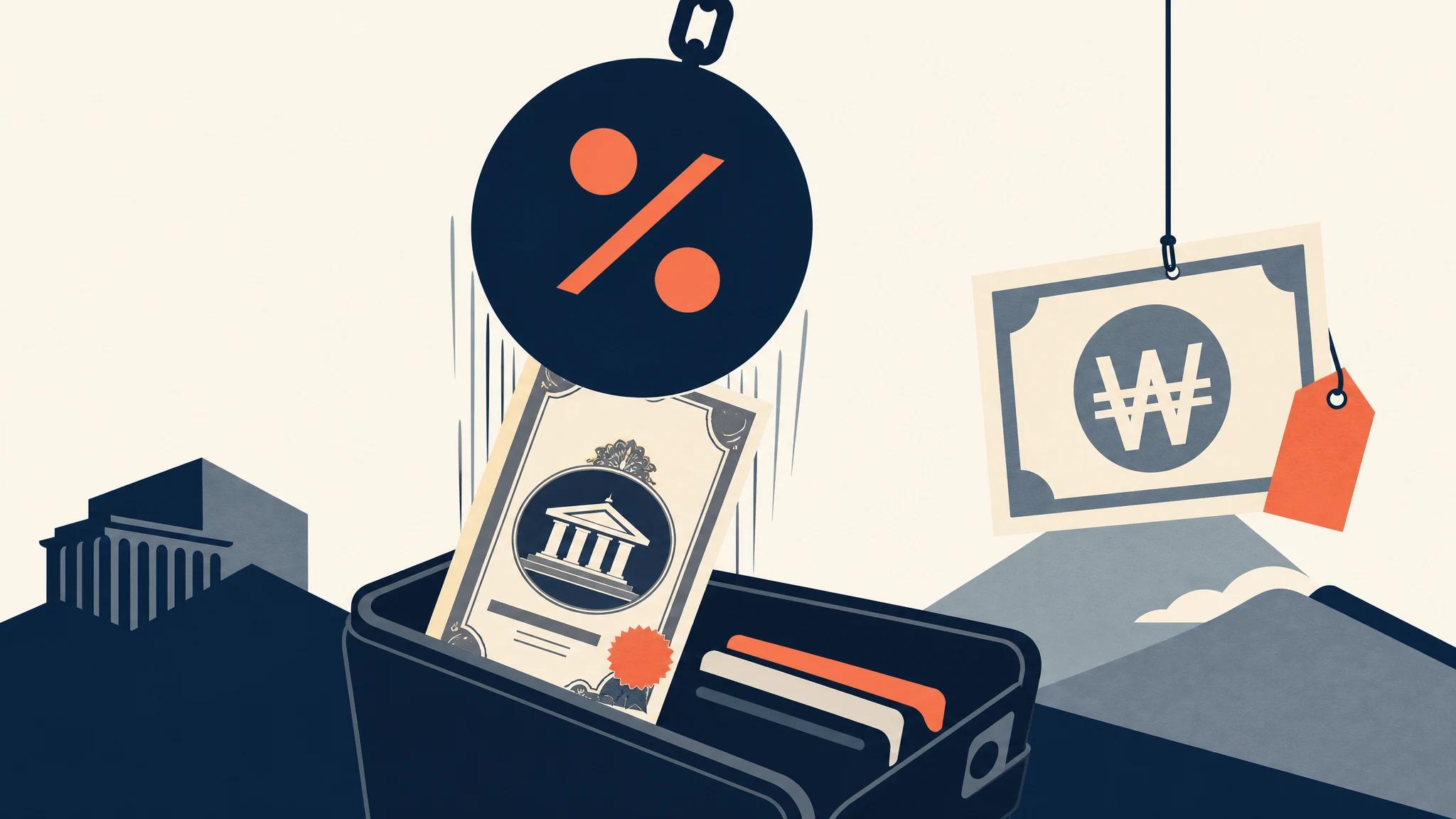
Government Bonds Have Entered the Wallet
Before the headlines, look at where the money is. Tokenized government bonds and private credit now account for more than 14% of assets locked in DeFi — a figure that was still in the single digits just one year ago. What makes this number interesting is not that the technology has become new, but that the character of the money flowing in has changed.
In the early days of DeFi, that 14% was self-referential liquidity — crypto collateralizing crypto to borrow more crypto. What fills that space today is the yield on short-term U.S. Treasuries and the interest on private loans. What BlackRock's BUIDL, Franklin Templeton's on-chain money market fund, and issuers like Ondo have packaged inside their tokens is an annual return in the 4% range from government bonds. This is not money waiting for coin prices to rise — it is money that came for the yield.
This is not a story of technology adoption. It is a story of capital reallocation.
The Gravity Created by 4%
Why now? The answer lies in the Federal Reserve's policy rate. In the zero-rate era, the risk-free return on-chain was zero, so people manufactured yield through volatility — which is why DeFi's double-digit interest rates looked attractive. But in a world where the policy rate sits at 4%-plus, risk-free government bonds become a genuinely competitive source of return in their own right. Tokenized Treasuries are simply the tool that moves that 4% into a wallet that runs around the clock.
The proposition that the cost of capital determines everything holds here too. When rates are high, assets that promise future cash flows get discounted. Growth stocks suffer, and coins whose payoff lies in the distant future suffer even more. Conversely, an asset that pays 4% right now commands a premium. Capital is pouring into tokenized Treasuries not because blockchain has improved, but because high rates have applied gravitational force to cash-equivalent assets.
Some argue that technology is independent of the cost of capital — that blockchain settles around the clock and crosses borders, placing it above the interest-rate cycle. The opposite is true. One hundred percent of the value that tokenized Treasuries carry is interest. When the Fed cuts rates, the yield on these tokens falls with them, and the rationale for capital that flowed on-chain weakens accordingly. Technology changed the vessel; Washington sets the temperature of the liquid inside it.
How the Dollar Is Gaining New Plumbing
Regulation has now joined the equation. The U.S. Securities and Exchange Commission, under Chair Paul Atkins, is pursuing an Innovation Exemption for tokenized securities — a regulatory sandbox that would allow tokenized securities to be issued and traded for 12 to 36 months without full registration. The more decisive signal is that the Depository Trust & Clearing Corporation (DTCC) will begin settling real transactions in tokenized securities starting July 2026. That means these instruments will move from the laboratory into the settlement infrastructure itself.
Translated into macro language, the combination reads as follows: the U.S. Treasury market — the deepest pool of liquidity in the world — is acquiring new plumbing called on-chain. Dollar liquidity always flows toward the safest and highest-yielding destination. Right now, one more channel is being added, and at the end of that channel sits not a volatile coin but the credit of the U.S. government. If stablecoins were Act One — moving dollar cash on-chain — tokenized Treasuries are Act Two: moving dollar yield on-chain.
The problem is that this flow is entirely centered on dollar assets. When global capital migrates on-chain, it flows toward U.S. Treasuries and U.S. private credit. Tokenization simultaneously expands global access to dollar assets and leaves non-dollar assets relatively more marginalized.
Where Does Korea Stand?
Viewed from Busan, this trend raises a single question: why does the Korean market trade at a discount?
The Korean won is not a reserve currency. The capital that tokenized Treasuries attract is money chasing dollar yields, and won-denominated assets carry one additional layer of exchange-rate risk on top. From the perspective of foreign capital, Korean assets are structured so that a weakening won erodes returns. Faster settlement through tokenization does not eliminate this currency discount. Technology reduces friction, but it cannot change the hierarchy of currencies.
Korea's opportunity therefore does not lie in replicating dollar-denominated tokenized Treasuries. In that race, Korea is structurally late and structurally discounted. The more realistic path is to tokenize short-term won-denominated money market instruments, corporate bonds, and real-estate-backed assets on domestic settlement networks to lower the cost of circulating capital internally. This is not a game of competing against the global dollar pool — it is a game of upgrading the plumbing for domestic liquidity. That is roughly the rationale behind the Korea Exchange and financial regulators having spent years laying the groundwork for a Security Token Offering (STO) framework.
The risk comes from the opposite direction. If the Fed moves to cut rates aggressively, the yield appeal of on-chain Treasuries will cool and capital will rotate back toward risk assets. The first beneficiaries of that rotation will again be dollar-denominated growth assets. Won-denominated assets will, as before, join the queue one beat late and one discount deeper.
Conclusion
Tokenized Treasuries crossing 14% of DeFi assets is not a triumph of blockchain. 4%-range interest rates generated gravitational force that pulled capital toward cash-equivalent assets, and that capital happened to discover on-chain as a new channel. Technology laid the pipe; rates set the direction.
Watch where the money flows, and the next phase comes into view. Right now it flows toward dollar yields, along channels validated by U.S. settlement infrastructure. Before marveling at the speed of the technology, ask the more important question: whose credit and whose currency sits at the end of this pipe? The answer to that question sets the discount rate on Korean assets.
Sources: SEC to propose tokenized stock framework; SEC Prepares Tokenized Stock Rules as Onchain Market Tops $1.4 Billion; SEC Readies Tokenized Stock Innovation Exemption
This article was automatically translated from the Korean original by AI. For the authoritative version, read it in Korean.
한국어 원문 읽기 →