The Dollar Entered Through the Pipes
Viewing stablecoins only as retail money misses the point entirely. The real battleground is the settlement layer through which corporate funds flow — the invisible plumbing of banking. The next contest will be decided not by price but by trustworthy market structure.
AI Summary
Stablecoins are quietly penetrating the invisible settlement layer of corporate finance — the 'plumbing' behind interbank transfers — rather than serving as retail payment instruments. JPMorgan's Kinexys and BlackRock's BUIDL signal that traditional finance is absorbing on-chain dollars, with tokenized deposits winning institutional adoption through clear custody, reserve backing, and regulatory standing. For Korea and Busan, the priority should be designing any permitting framework around mandatory reserve segregation, redemption rights, and public disclosure — because whoever lays the most trusted settlement infrastructure first will define the next decade of financial flows.
Look at the Pipes, Not the Screen
If you read stablecoins by their price, you see almost nothing. These are tokens pegged to one dollar, so there is nothing for the ticker to catch. That is why many people regard them as boring assets, or at best a quick transit stop when buying and selling coins on an exchange. What this view misses is that stablecoins are actually used not in personal wallets but in corporate cash flows — the settlement layer moving between corporate treasuries.
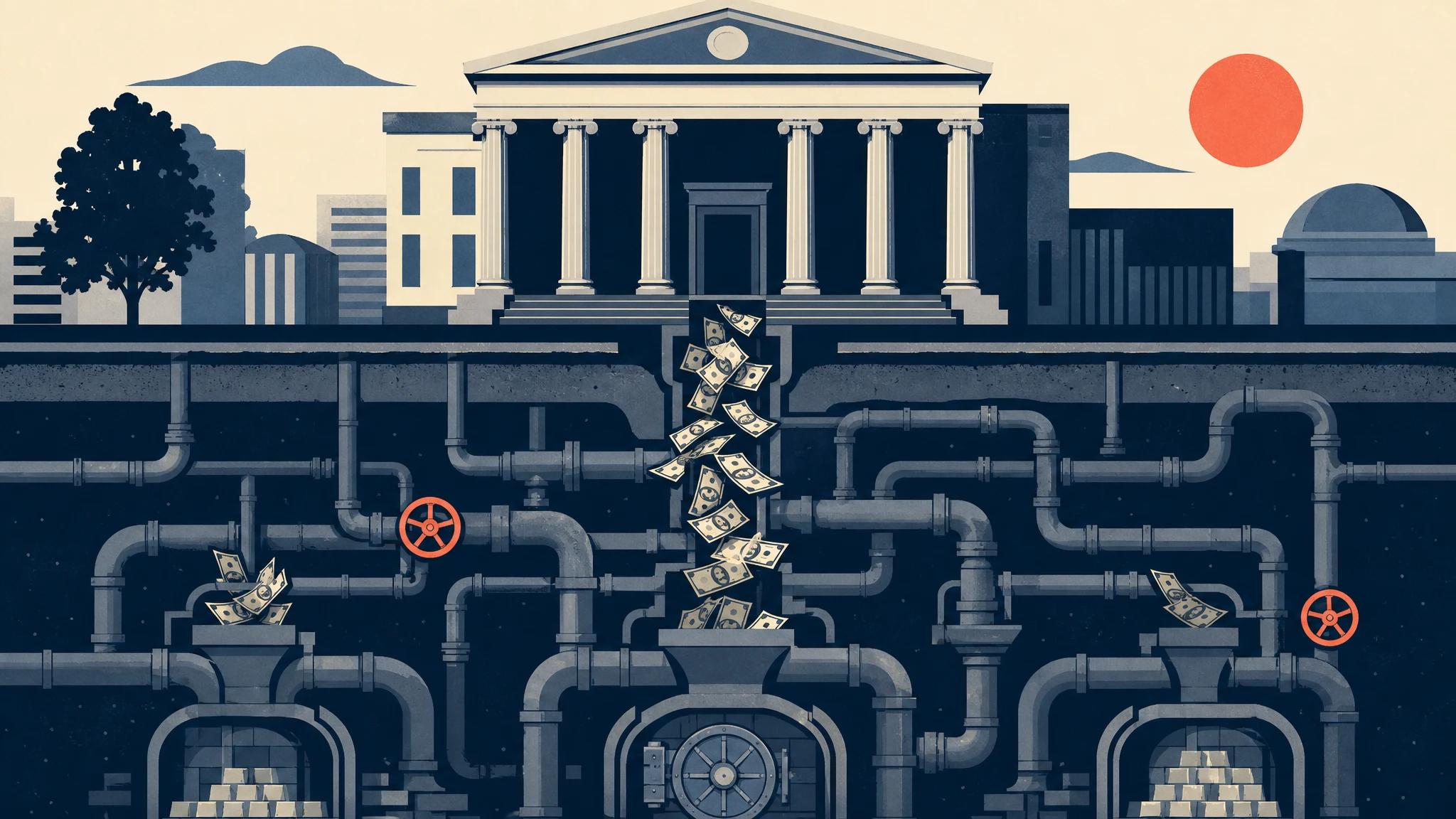
JPMorgan's Kinexys (formerly Onyx) makes this shift unmistakably clear. It is not a platform urging you to buy Bitcoin. It is a wholesale payment network that lets corporate clients tokenize dollar deposits and move them between accounts around the clock — on weekends, with no cut-off times. The transactions do not appear on charts because they happen inside the bank's own plumbing. Think of water pipes: we only see water coming out of the tap, never the pipe structure inside the walls. On-chain dollars are now taking their place inside those pipes.
We need to reframe the question. Is this market a speculative asset, or is it financial market infrastructure? The more the answer tilts toward the latter, the more our key metrics must shift from price to settlement volume, reserves, and custody structure.
Institutional Capital Doesn't Enter Out of Curiosity
The conditions under which institutional capital moves are simple. Not the expectation of gains, but the certainty of being able to exit without incident. What pension funds and corporate treasury teams look at are not yield curves but three questions: Who holds my assets? What backs their value? Who do I claim against if something goes wrong?
That is why tokenized deposits are being embraced in corporate treasuries before pure stablecoins. Tokenized deposits appear on the books as bank liabilities. The issuer is clearly identified, accounting treatment is identical to ordinary deposits, and they sit within regulatory oversight. Private stablecoins, by contrast — which rely on the issuer's credit and reserve composition — require one additional layer of verification. USDC's temporary depeg during the Silicon Valley Bank crisis in March 2023 illustrated this distinction precisely: it was not the token itself but where and how the reserves were held that determined stability.
| Tokenized Deposits | Private Stablecoins | |
|---|---|---|
| Accounting Treatment | Recorded as a bank liability | Dependent on issuer credit and reserve composition |
| Issuer | Clear, under regulatory oversight | Requires an additional layer of verification |
The GENIUS Act, passed in the United States in 2025, which enshrined reserve, redemption, and oversight requirements for payment stablecoins into law, follows the same logic. Capital scales up only after clear rules are in place. Rules attract capital — not the other way around.
Custody and Reserves Build Trust
A counterargument emerges here: interbank transfers already work well — what difference does tokenization actually make? It is a fair point. Moving Korean won domestically is already fast and cheap. The difference appears when crossing borders. At the intersections of national boundaries, currencies, business hours, and differing settlement systems, conventional plumbing can stall for days, with correspondent banks taking fees at every step and real-time visibility into where funds are sitting becoming nearly impossible. On-chain dollars reduce this friction because payment and settlement are completed almost simultaneously on the same ledger.
But this efficiency is not free. Who verifies that actual dollars back the token one-to-one? Are reserves — whether short-term Treasuries or riskier assets — disclosed daily? If the custodian goes bankrupt, are assets protected through segregation? Answering these questions is the job of custody arrangements, disclosure requirements, and reserve discipline. Infrastructure's reliability is invisible under normal conditions and exposed all at once in a crisis — just as no one asks about pipe materials before the water main bursts.
Where Traditional Finance and Digital Assets Meet
What is striking is that these two worlds are heading toward convergence, not confrontation. BlackRock's tokenized money market fund BUIDL, and Citi's and JPMorgan's tokenized deposit experiments, show traditional finance moving to absorb digital assets. Coins are not replacing banks; rather, banks' liabilities and assets are adopting a new format called a token. It is the settlement layer that is changing — not the entities that issue money.
At this convergence point, the contest is not about which token rises more in price. It is about which settlement network earns the trust of more institutions. Where liquidity pools, standards emerge; and whoever holds the standard lays the plumbing for the next decade.
What Institutional Framework Should Korea Design?
Korea is currently deliberating over whether to permit won-denominated stablecoins. The core question is not a binary of whether to open up issuance, but what infrastructure to open it on. Three requirements must be present: limiting reserves to assets eligible under Bank of Korea standards and mandating segregated custody; legally guaranteeing redemption rights; and requiring regular public disclosure of reserve composition. Without these three, efficiency is just another name for an accident waiting to happen.
Busan is a city that has embraced a digital asset exchange and a blockchain regulatory free zone. The right approach is to pilot won-denominated tokenized settlement there — but to design it around the safety of invisible pipes, not visible trading volumes. Verified standards at the B2B layer of trade settlement and intercompany payments become an asset for the entire industry.
The next battleground for crypto is not price. It is a trustworthy market structure through which institutions can move funds with confidence. Whoever lays the plumbing first will command the flow of the next decade.
This article was automatically translated from the Korean original by AI. For the authoritative version, read it in Korean.
한국어 원문 읽기 →