The Token Is Not the Collateral
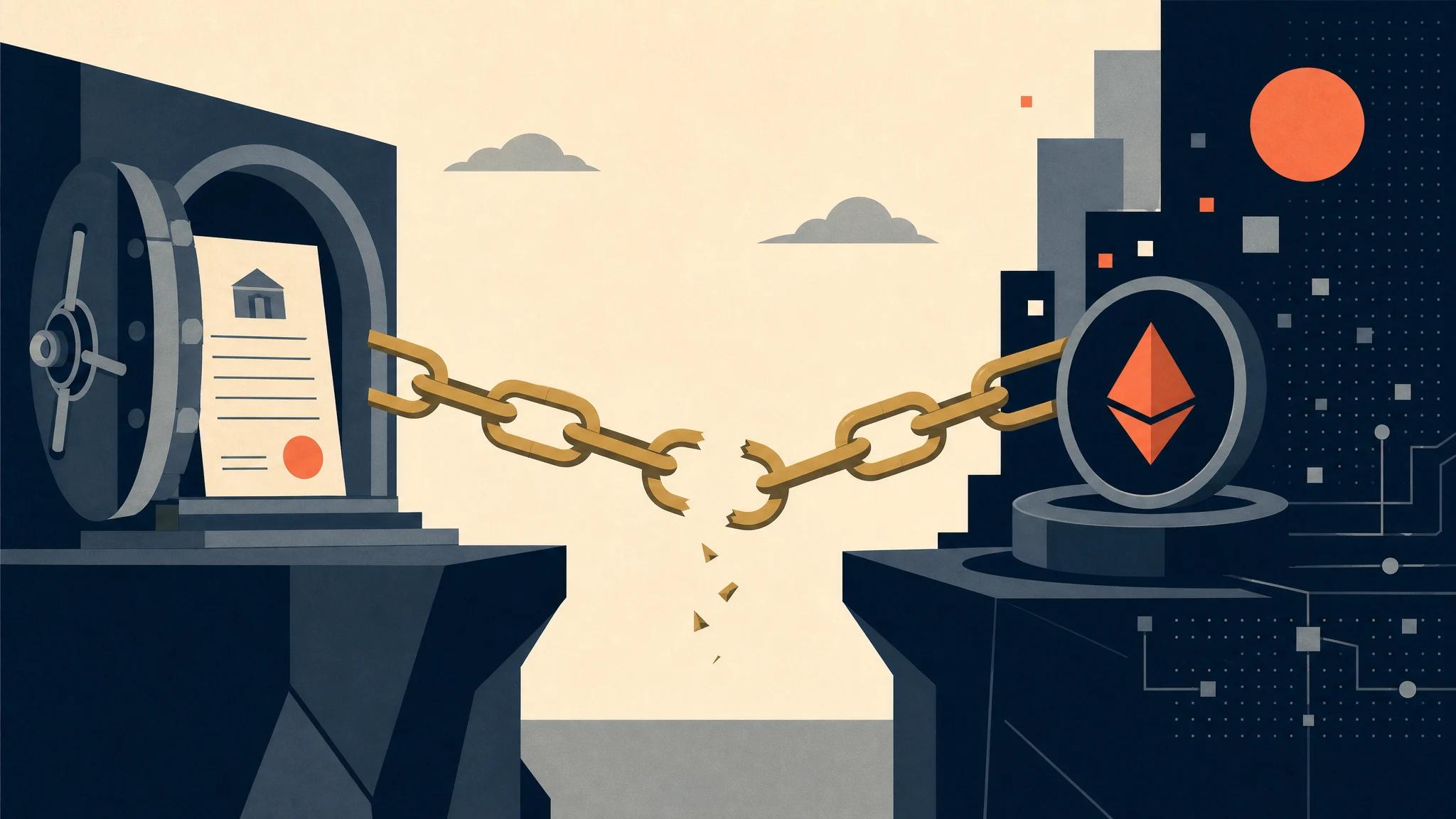
The RWA market has reportedly placed ₩31 trillion worth of assets on-chain. But who guarantees the legal rights those tokens point to? The bridge of trust doesn't break at the blockchain — it breaks beyond it.
AI Summary
Real-world asset (RWA) tokenization has surged past $31 billion on-chain, but tokens represent legal claims — not the assets themselves — leaving a critical gap between blockchain certainty and off-chain legal rights. As AI agents begin executing financial transactions autonomously at scale, this gap risks amplifying from isolated incidents into systemic risk. Korea's upcoming STO implementing regulations present a narrow window to encode machine-readable trust standards — covering bankruptcy remoteness, custodian identity, and redemption conditions — directly into tokens, potentially establishing a global benchmark.
The Trap of the $27 Trillion Figure
The RWA — real-world asset tokenization — market is swelling fast. On-chain tokenized assets excluding stablecoins grew from $6 billion in early 2025 to more than $31 billion in May 2026 (RWA.xyz). More than half of that is U.S. Treasuries and government-guaranteed products; tokenized U.S. Treasuries alone stood at approximately $12.8 billion as of April. People look at these numbers and say, "real-world assets have come on-chain."
Wrong. What came on-chain is not the asset — it is a pointer to the asset.
A single tokenized Treasury bond is not the Treasury bond itself. Some special purpose vehicle (SPV) or custodian holds the actual bond, and the token merely represents a claim against that holding. The chain tracks this pointer flawlessly — who held how much, down to the second. The question is whether the legal rights at the far end of that pointer, off-chain, are guaranteed as robustly as the chain itself. That is where the bridge breaks.
Where the Bridge of Trust Breaks
Structurally, the RWA stack is a bridge connecting two worlds. On one side is a world where code is truth; on the other, a world where contracts, jurisdictions, and bankruptcy law are truth. A token transfer is completed in the code world, but a transfer of ownership only takes legal effect with the approval of the other side. Passing the token does not automatically carry the legal right along with it.
The weakest point is the bankruptcy remoteness structure of the SPV. When an issuer collapses, does the token holder have priority over the underlying asset, or do they become just another unsecured creditor standing in line? That distinction is written nowhere in smart contract code. It depends on the trust deed, the jurisdiction's courts, and whether the custodian actually held the assets in segregated accounts. This is why trust companies have emerged as the backbone of RWA in the United States. Assets held solely in a trustee capacity are excluded from a debtor's bankruptcy estate — meaning it is law, not code, that guarantees the isolation.
The same applies to redemption. Some tokens offer daily buybacks; others impose notice periods and minimum amounts. The balance shown on screen is instant, but actual conversion to cash moves only as fast as the off-chain process allows. The Ondo founder-risk incident that rattled the market in May 2026 laid bare an old truth: the safety of a token is ultimately tied to the trustworthiness of the people and legal entities behind it.
When AI Agents Become the Trading Party, This Fracture Explodes
This is where the real problem begins. A view of Web3 limited to coins and exchanges misses the next act. Before long, the parties buying and selling tokenized assets will not be humans — they will be AI agents.
The signals are already there. Coinbase's x402 payment protocol revived the dormant HTTP 402 status code, enabling agents to pay in stablecoins the instant they receive an API response. As of late April it had logged 165 million cumulative transactions and 69,000 active agents — and the standard, with Google, Stripe, and Visa on board, has been handed to the Linux Foundation. Payments are unblocked. But a question that needed answering before payments remains: who is this agent, is it trustworthy, and who is liable when something goes wrong?
ERC-8004 'Trustless Agents,' deployed to Ethereum mainnet on January 29, targets exactly this gap. Three on-chain registries — identity, reputation, and verification — assign each agent an ERC-721 identifier and build a reputation from its interaction history. Forty-five thousand agents registered in the first month alone. Identity (ERC-8004) + payment (x402) + settlement (stablecoins, mostly USDC) + assets (RWA tokens). Viewed in isolation, these are buzzwords; combined, they form a single stack — the trust infrastructure for AI agents to transact as economic actors.
But at the very bottom of this stack, the asset layer carries the legal fracture described above. A human reads fine print skeptically and checks redemption terms carefully. An agent takes the claims written in token metadata at face value and settles hundreds of transactions per second. The gap between pointer and underlying asset — what was an accident at human speed — is amplified into systemic risk at agent speed.
Counterargument: Isn't That for Law to Solve?
The pushback is obvious: legal rights are the domain of courts and regulators, not protocol designers. That is half true. Law renders judgment after a dispute has already erupted — it does not tell you in real time, at the moment of a trade, how strong a claim actually is. An agent settling hundreds of transactions per second needs not a court ruling but a machine-readable trust standard available at the exact moment of the trade. Bankruptcy remoteness status, custodian identity, redemption terms, and audit proof must travel with the token itself in a verifiable form. If law guarantees the outcome, protocol must prove at the time of the transaction that the guarantee exists. That is not the law's job — it is a design problem.
Is Korea a User or a Designer?
Busan's blockchain special zone has been running regulatory sandboxes for years, but the standards have always been set elsewhere and imported. This time, a narrow window of opportunity has cracked open. Korea passed its Security Token Offering (STO) law in January 2026, with full implementation scheduled for January 2027. The twelve months of drafting the implementing regulations are the inflection point.
Two paths lie ahead: become a user that imports the identity, payment, and settlement standards built in the United States and issues tokens on top of them, or become a party that directly designs one piece of the trust standard in an area where Korea is strong. The tokenization of content IP rights, proof of genuine ownership for game items, and the structuring of claims for real estate project financing are rare fields where Korea controls both the assets and the data. If Korea mandates machine-readable standard metadata — covering bankruptcy remoteness ratings and redemption terms — to be embedded in tokens at the STO implementing-regulation stage, a Korean-origin 'RWA trust card' could become a global standard. Whoever writes the standard first holds the rules of the next ten years.
Conclusion
The real collateral behind RWA is not the token. It is the legal right behind the token, and a structure that proves that right at the moment of the transaction. In an era when AI agents are entering as economic actors, what we must design first is not the performance of the agents, but the trust standard that agents can rely on. Before faster cars, build the bridge — because without one, faster cars only fall harder at the break.
This article was automatically translated from the Korean original by AI. For the authoritative version, read it in Korean.
한국어 원문 읽기 →