Who Presses the Refund Button
Stablecoins shift the node of 'trust guarantee' from human contextual judgment to automated code execution. The real issue isn't price stability, but where in the organization the human position remains to take responsibility and stop things when exceptions occur.
AI Summary
Stablecoins automate financial transactions by replacing human judgment with code, eliminating exception-handling staff that banks employ to manage fraud and errors. While this reduces costs, it concentrates power in issuing companies who control freeze functions, leaving users to bear all risks when systems fail. The critical question for countries like South Korea isn't who gets to issue tokens, but who will take responsibility when the code breaks—establishing where the 'refund button' sits in the automated system.
A Night When Transfers Don't Stop
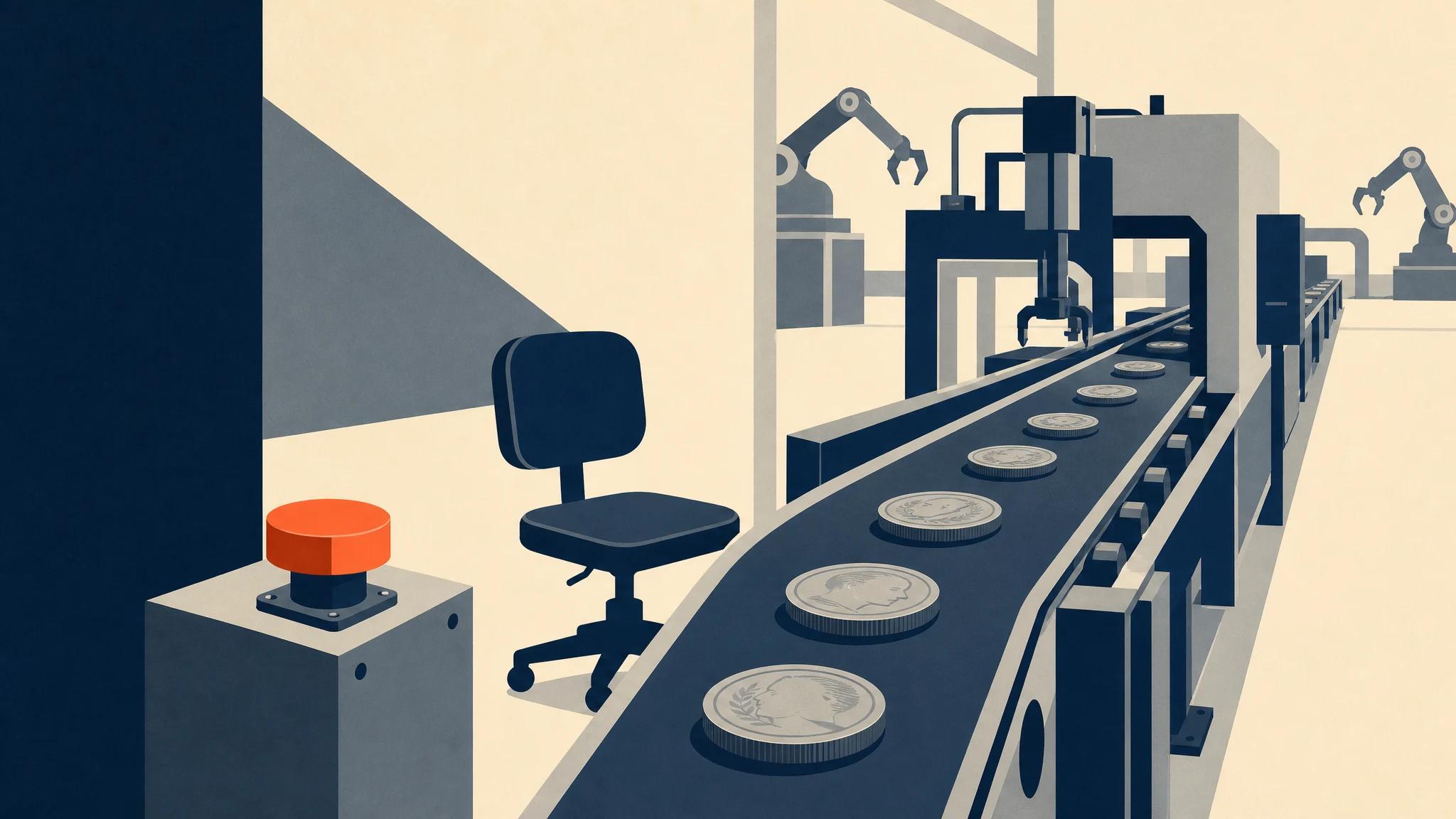
Even at dawn, people sit in bank computer rooms. When a large sum leaves an account, an alarm sounds, someone looks at the screen, and within seconds decides whether this is a normal transaction or fraud. It's a person who places a payment hold on suspected voice phishing transfers, and it's also a person who receives the apology call when that judgment is wrong and an innocent customer's money gets frozen. We take this scene so much for granted that we forget it's even a 'judgment.' At every junction where money flows, a human has been standing, looking at situations not written in the rules, and deciding whether to stop or send.
Stablecoins remove people from those junctions. When tokens pegged 1-to-1 to the dollar circulate on the blockchain, what approves transfers isn't a duty officer but a smart contract. If conditions written in code are met, funds move. If not met, they don't move. There's no 0.5 seconds of a human hesitating, thinking 'hmm, this seems odd.' People call this an innovation in speed and cost. 24 hours, no borders, fees nearly zero. All true. But speed and cost are the surface. What's really been transferred isn't money but judgment.
Currency is ultimately a promise. A promise that this piece of paper, this number, will hold value tomorrow. Making that promise stick has long been human work. The judgment in the conference room where the central bank governor sets interest rates, the furrowed brow of a bank employee reviewing loan documents, the investigation by a card company employee determining who's right when a payment dispute arises. The sum total of all these contextual judgments was compressed into the single word 'trust.' Stablecoins unpack that compression, detaching the node of trust guarantee from people and transplanting it into code.
Code Doesn't Judge, It Only Executes
Let's be honest here first. The statement that code 'replaces' human judgment is only half true. Code doesn't judge. Code executes predetermined rules. These may look similar but are completely different tasks.
Judgment operates when encountering situations not in the rules. When a customer tries to send ten times their usual amount at an unusual time from a different country, rules alone can't provide an answer. Block it and you're blocking a legitimate transaction; let it through and you're letting fraud through. Humans read context in this gray area. They remember the customer saying on the phone yesterday 'I'll send the house deposit tomorrow,' or recall that their voice was shaking. Code has no such memory. For code, gray areas don't exist. If a condition is true it's 1, if false it's 0. If input falls within the rules, it executes unconditionally. Whether it's fraud or a mistake.
Stablecoin designers know this too. So they build a 'freeze' function into the code. A backdoor allowing issuers to freeze specific wallets or seize assets. Both Circle, which issues USDC, and Tether, which issues USDT, have this function, and cases of freezing wallets at law enforcement requests have been publicly disclosed. What does this mean? It means that at the end of automation, the moment eventually returns when someone human must judge 'this transaction must stop.' Judgment hasn't disappeared. It's just that the judgers who stood one at each junction have condensed into the compliance team at a single issuing company.
Here's the first surprise. We believe stablecoins are 'decentralized' and no one can control them, but in reality it's the opposite. The thousands of distributed judgments scattered across junctions have concentrated into the hands of the few holding freeze keys. Who holds the bottleneck and collects the toll? The issuer. Code normally removes people, but the moment an exception occurs, it calls people back—specifically the single most powerful person. Where that person sits determines everything.
Exceptions Will Always Come
The most common misconception about automated systems is the belief that if built well, exceptions won't occur. The opposite is true. Exceptions aren't bugs in the system but the system's essence. Reality is always broader than rules, so no matter what rules you code, situations outside the rules will inevitably arise. The difference between good and bad systems isn't whether exceptions exist, but whether the person to handle them is in place when they occur.
Bank systems lay out a massive human organization to handle these exceptions. Call centers, dispute resolution offices, payment monitoring teams, and ultimately the financial supervisory authority and deposit insurance corporation. Behind the refund button you press when you send money to the wrong place, a long chain of people stretches out to determine if that refund is justified. Much of the money we begrudge as bank fees was actually labor costs for this exception-handling staff. This is also why stablecoins can make fees close to zero. They removed that staff.
The problem is that even when staff is removed, exceptions still come. Wrongly sent transfers, hacked wallets, algorithm errors, issuer reserve deficiencies. What we saw when Terra-Luna collapsed in 2022 was precisely this scene. The moment the promise that the algorithm would maintain the dollar peg broke, there was no person in the system to stop it. The code worked as designed. Working exactly as designed, it drove the value to zero. No one was sitting anywhere to press the refund button. Hundreds of millions of people's money evaporated following the code's flawless execution.
Here we must honestly address one strong counterargument. 'Isn't this just ordinary progress in payment technology? Credit cards also had fraud risks when they first appeared, but were eventually absorbed by insurance and dispute resolution systems. Stablecoins will similarly have institutions follow over time.' True. And that's precisely the key point. The real innovation of credit cards wasn't the magnetic strip but the chargeback system. That human node where when a transaction goes wrong, consumers can object and the card company judges and reverses it. Credit cards gained trust because they redesigned a place for responsible humans on top of the technology layer. While stablecoin debates obsess over maintaining price pegs, the design of who will handle the responsibility equivalent to chargebacks and how remains empty. The technology is in 2025, but the responsibility design hasn't arrived yet.
Where Did the Eliminated Labor Costs Go
Tracking money flows reveals hidden transfers. Banks collected the cost of exception-handling staff as fees. Those fees seemed expensive, but mixed in was an insurance premium for 'someone takes responsibility when things go wrong.' Stablecoins eliminate that labor cost to make fees zero, and take that difference as issuer profit. Issuers put the dollars users deposit into U.S. Treasury bonds and pocket the interest. This is the structure behind Tether reporting profits of several billion dollars in recent quarters. Users don't receive interest; issuers take all of it.
| Banking System | Stablecoin | |
|---|---|---|
| Exception handling personnel | Call centers · dispute resolution · regulators | Mostly eliminated |
| Fees | Include labor costs · insurance premiums | Close to zero |
| Loss when exceptions occur | Spread thinly across society | Borne entirely by individual users |
So has the eliminated exception-handling cost disappeared? No. Risk doesn't disappear, it only transfers. When exceptions occur, users now individually bear the entire loss. Wrongly sent transfers don't come back, drained wallets aren't restored, and if issuers collapse, tokens become worthless. The risk that bank systems spread thinly across society, stablecoins pile back onto individual shoulders. Profits concentrate with issuers while risks distribute to individuals—this asymmetry is the real balance sheet of this structure.
Looking at it from organizational and labor dimensions makes it clearer. People who handled exceptions at banks were 'judgment workers.' They didn't memorize and apply rules, they read beyond rules and made decisions. Not the simple repetitive tasks that seem like they'd disappear first when automation comes, but precisely those judgment positions transfer to code. Yet they don't transfer completely. As we saw, compliance teams holding freeze keys are still necessary. The result is peculiar. Thousands of distributed judgment jobs disappear, and in their place a few high-salary judgment jobs appear at a single issuing company. Labor doesn't disappear; it condenses into an extreme minority while the rest evaporates. This is a microcosm of what AI and automation do to labor. Not eliminating work, but sucking the power of judgment into a few nodes.
Where Will Korea Sit
Let's fix Korea's position on the world map. The U.S. passed the GENIUS Act stablecoin regulatory bill in 2025, essentially embracing dollar-based tokens as a digital dollar expansion strategy. While bringing issuers inside the system, it legally nailed down reserves, freeze authority, and positions of responsibility. In other words, the U.S. chose the path of having the state design 'who holds the freeze key of that code and what responsibility they bear' while transferring judgment to code. Europe imposed clear responsibilities on issuers through MiCA regulations. Both sides' core question wasn't price stability but location of responsibility.
Where along the adoption curve is Korea? Discussion of won-denominated stablecoins has just risen to the political agenda, and banks and fintech are beginning turf battles over who will issue. But this fight mostly concentrates on power distribution—'who gets the issuance license.' The truly empty questions are separate. Will freeze functions be included in won tokens, if so who holds that key, where on whose desk in which organization will the refund button sit to reverse wrongly sent transfers? When regions like Busan that brandish blockchain special zones try to attract token issuance, what needs attracting isn't issuance authority but responsibility infrastructure to handle exceptions. Issuance is done by code, but when accidents occur, who in which Busan office will answer the phone? If we can't design that position first, Korea becomes a periphery that only pays tolls under freeze keys laid down by U.S. issuers.
If a Korean reporter covers the same beat tomorrow, the questions to ask are clear. Don't ask who gets the issuance license; ask this instead. Does this token have a freeze function? If so, in whose hands in which organization is that key, where is the criteria by which they judge freezing and the responsibility when that judgment is wrong written down? Does an actual person exist whom users can call when they have an accident? An issuance plan that can't answer these questions is a payment system without a refund button.
What Will We Leave as Human Work
Looking at stablecoins reveals a miniature model of the entire AI era. We keep asking: Can machines do as well as humans? Can code replace judgment? Wrong question. Code handles 99.9% of normal situations faster, cheaper, and more accurately than humans. That battle is already over. The real question is the remaining 0.1%, in the gray area where rules break down, who will take responsibility and stop things?
The deeper automation goes, what remains for humans isn't the work of normal times but the work of exceptions, not the work of execution but the work of responsibility. While code runs smoothly, humans are invisible. Then the moment something breaks, a hand is needed to press the refund button. Civilization has repeatedly redesigned where to place that hand. Stablecoins first remove that hand, then quietly concentrate it into a single issuing company. What we should examine isn't whether that hand disappeared, but whose hand it is now and whether we can see it.
What will humans leave as human work? The answer stablecoins offer is cold but precise. What humans should leave isn't smooth execution, but the position to take responsibility and stop things when smoothness breaks. A society that fails to clearly create that position outside the code ends up using currency without a refund button. And currency without a refund button is ultimately a promise no one takes responsibility for.
This article was automatically translated from the Korean original by AI. For the authoritative version, read it in Korean.
한국어 원문 읽기 →