The Question After Memory
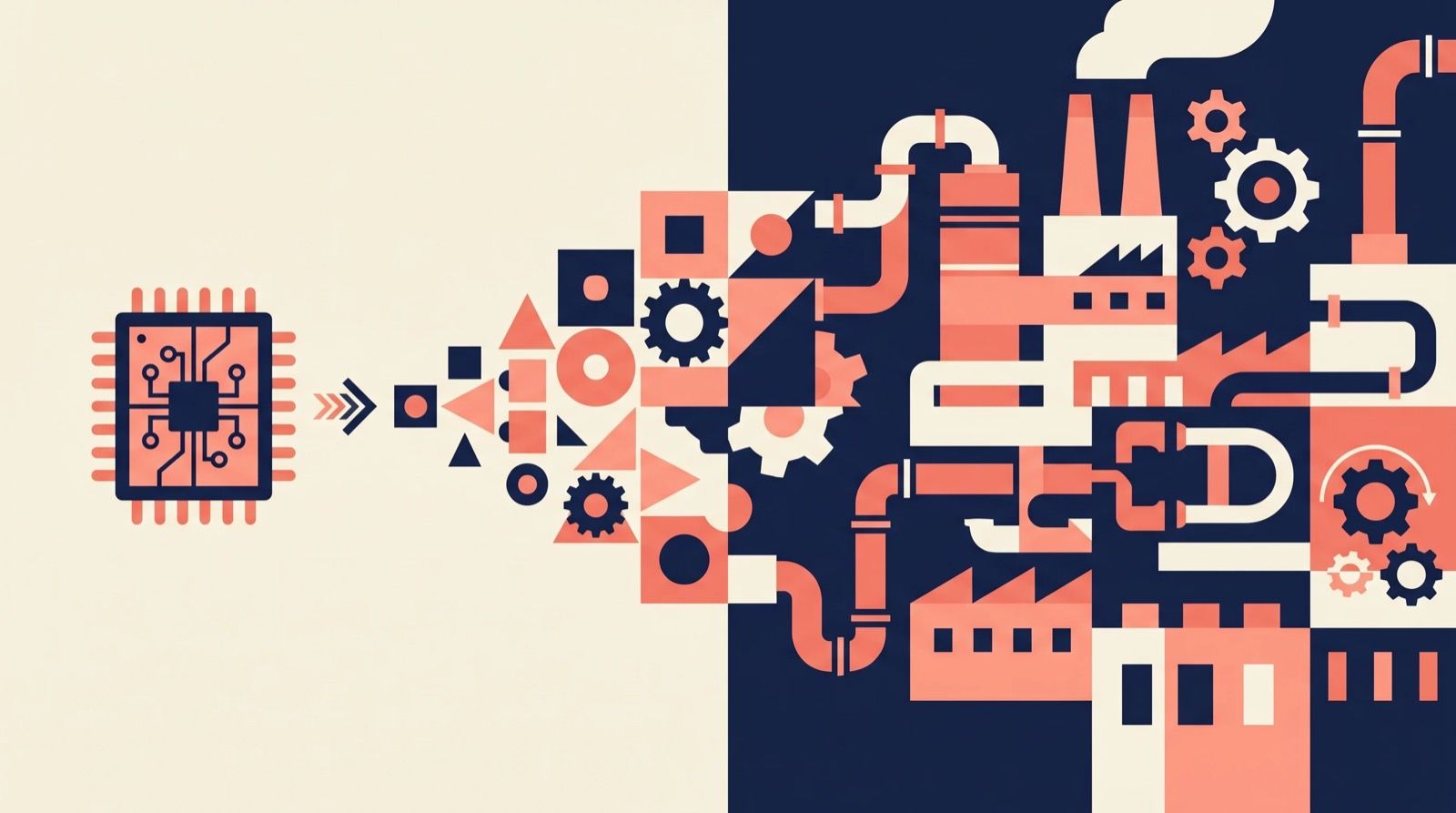
The arena of AI competition has shifted from individual GPUs and HBM chips to 'AI factories' that bundle manufacturing AI, robotics, and cloud infrastructure. The path from being number one in components to becoming an ecosystem architect runs on a very different timetable.
AI Summary
South Korea's dominance in HBM memory chips masks a structural vulnerability: Korea excels at making world-class components but has no seat at the table where system architectures are designed. As the AI industry consolidates into vertically integrated 'AI factory' ecosystems controlled by companies like Nvidia and Tesla, Korea's fast-follower manufacturing model reaches its limits. To become an ecosystem architect, Korea must build pipelines that convert manufacturing data into AI models, create organizational structures that reward long-term perseverance through failure, and develop hands-on system integration experience — not just superior components.
The Unsettling Picture Behind HBM Supremacy
The most dazzling number in Korea's semiconductor industry over the past year has been HBM. SK Hynix effectively claimed the first slot filling the high-bandwidth memory in Nvidia's accelerators, with Samsung Electronics and Micron chasing behind. Relief spread that Korea had once again beaten the world in memory.
Yet look closely at those shining numbers and an unsettling picture emerges. HBM is only assigned value within the system Nvidia has designed. When Nvidia decides how many layers to stack memory in its next-generation architecture, or which standard to adopt, Korean companies redesign their production lines to match those specifications. We make the most difficult components better than anyone. But we have no seat at the table where it is decided where, how, and for what those components will be used. Being number one in a component and being a system architect are not the same thing.
The fact that Nvidia has recently begun calling itself not a chip company but a company building 'AI factories' is evidence of this. It no longer sells a single GPU; it sells accelerators, networking, software stacks, and data center power design bundled together as one unit. The unit of competition has risen from individual components to integrated systems.
Where Fast Catch-Up Stops
Korean industry has been skilled at catch-up. In markets that others opened first, it made processes more precise, yields higher, and unit costs lower until it caught up. Memory, displays, and batteries all grew the same way. Advanced countries posed the problems themselves, and Korea solved those problems faster than anyone.
This model has now reached its stopping point. AI factory competition is not an exam with right answers — it is an open space where no standard has yet been set. There is no agreed answer on how to convert manufacturing floor data into models, what architecture to use for training robot movements, or in what ratio to bundle accelerators, memory, and power. Where there are no right answers, the ability to follow quickly loses its usefulness. Because what there is to follow is still being built.
This is why vertical integration has emerged. The reason Nvidia bundles chips all the way through to data centers, and Tesla wants to place vehicles, factories, and robots inside a single learning loop, is that when no one knows where the right answer lies, it is advantageous to hold the entire system and iterate through trial and error. A company that excels at making components merely supplies parts to someone else's trial and error — it cannot accumulate that trial and error as its own asset.
Accumulation Is a Structure That Turns Failure into Assets
The essence of frontier technology is not a single success, but a structure in which failure is preserved. Manufacturing AI only becomes useful once defect data from thousands of processes has accumulated; industrial robots only stabilize atop a record of countless falls. This data and experience cannot be purchased all at once with money. It can only be internalized through repeated work in the same environment over time. Accumulation means a system that does not discard that repetition but converts it into assets.
This is where the timelines of advanced nations and Korea diverge. American big tech poured money into models and infrastructure for more than a decade even when it generated no profit. Germany laid integrated automation standards across its entire industry over 20 years. These players invested with an eye on next-generation standards, not immediate quarterly results.
Korea's performance-driven culture makes it hard to endure that kind of time. Research that does not generate revenue within three years gets shelved; executive evaluations run on quarterly cycles; and data from failed projects is discarded along with the final report. There is almost no room in organizations for a single engineer to spend ten years on the same problem and accumulate failures. The fact that Busan's shipbuilding and machinery industry possessed abundant field data yet could not convert it into models — letting it all slip away — is the shadow of the same structure. The data existed, but there was no system to accumulate it over the long term.
A counterargument is possible: Korea climbed to number one in the memory world through fast catch-up, so why not catch up on AI factories at the same speed? But catch-up only works when the target is fixed. In a domain where the target is moving and standards do not yet exist, the ability to run fast only sends you racing faster in a direction that someone else has set. Speed cannot substitute for direction.
What Must Be Accumulated
For Korea to become an ecosystem architect, what it needs to accumulate is not better chips but three other things. First, a pipeline that converts manufacturing floor data into models without discarding it. The process data generated every day from shipbuilding, steel, refining, and semiconductor lines is an asset that no other country in the world possesses — yet most of it is currently thrown away. Second, a talent structure in which failure is recognized as career capital. Accumulation cannot begin unless there is evaluation and compensation that does not penalize the person who spent ten years on the same problem. Third, direct experience designing components and systems together. Making memory well and designing the system that memory fits into are different muscles, and those muscles only develop when you actually integrate them yourself.
This is not a question of larger R&D budgets — it is a question of time. The same money, if spent in quarterly increments, yields only incremental component improvements; pooled over ten years, it accumulates as system design experience. What Korea lacks is not capital or talent, but a structure of patience capable of keeping that capital and talent anchored in one place for a long time.
From Answers to Questions
In the catch-up era, the countries that found right answers quickly won. Korea was the top student of that era. HBM's number-one ranking may be the last perfect-score answer that top student will ever receive.
The frontier era asks something different. Not who finds someone else's problems fastest, but who creates problems that no one has yet thought to ask. Who writes the standards for the empty space called the AI factory will be decided not by speed, but by accumulation. Does Korea have a structure for accumulating this technology over the long term? Does it have a system in which failure is preserved as experience? If these two questions cannot be answered, we will once again find ourselves making the most difficult components while being excluded from the most important decisions. We must become not a country that finds answers quickly, but a country that creates questions first.
This article was automatically translated from the Korean original by AI. For the authoritative version, read it in Korean.
한국어 원문 읽기 →