Robots Don't Know Our Streets
Humanoids and autonomous delivery robots are leaving factories and heading into cities. But the street is not a conveyor belt. Does Korea have the structure to accumulate this technology over the long term?
AI Summary
Korea's industrial robot sector, built on controlled factory environments, faces a fundamental challenge as humanoids and delivery robots move into unpredictable urban streets. The fast-follower model that propelled Korean manufacturing in semiconductors and batteries has no blueprint to copy at the robotics frontier, where direction must be discovered through trial and error. The article argues that Busan and Korea must restructure their approach — retaining failure data, codifying tacit on-site knowledge, and shifting to long-term funding cycles — to compete in the age of street-level autonomy.
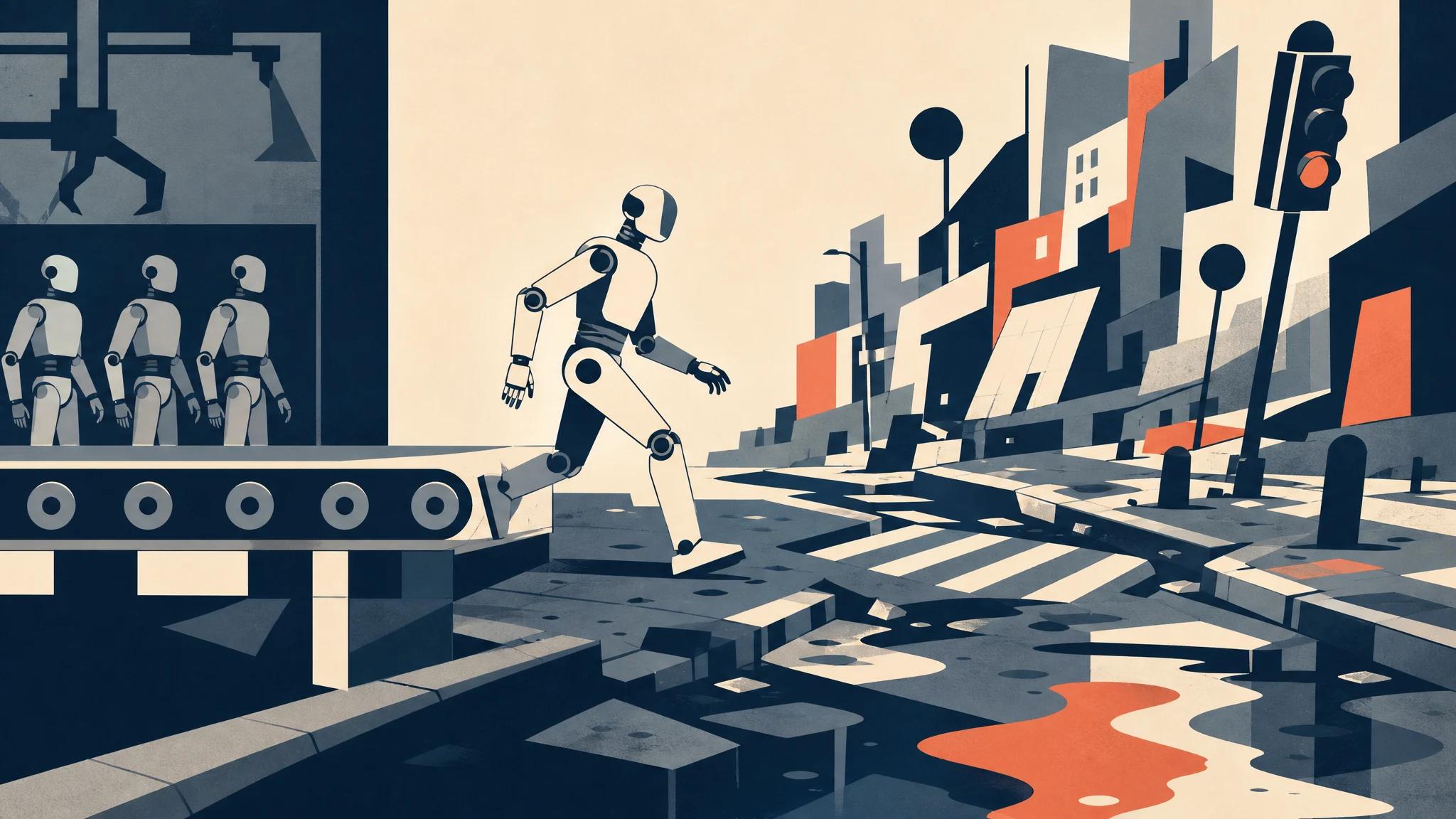
For the past several years, Korean robots have been good at one thing: repeating fixed coordinates. Along automotive paint lines, semiconductor cleanrooms, and beside conveyor belts in logistics centers. In environments where conditions are fixed and variables controlled, industrial robot density has risen to among the highest in the world. But that very strength is now producing an unsettling picture. Companies like Tesla and Figure are taking humanoids out of factories, and delivery robots have begun rolling along sidewalks and crosswalks. The stage has changed. In places where fixed coordinates disappear, pedestrians suddenly cut in, and paving stones are uneven, the capabilities Korea believed it excelled at suddenly become far less useful.
Why the Factory's Champion Becomes the Street's Underdog
Manufacturing automation and service labor replacement may look like the same robot, but they are different industries. Factory robots solve the world by simplifying it. Fix the lighting, standardize parts placement, push people outside the safety fence. The core technology was stripping complexity from the environment to make problems easier to solve. Street robots are the opposite. You cannot strip away the environment. A rainy evening in the alleys of Busan's Nampo-dong, a pedestrian carrying a load, an illegally parked truck — all of it must be accepted as-is and judged in real time.
This is where the limits of the fast-follower model become apparent. Korean manufacturing rose to the top of the world by solving problems others had defined, faster and cheaper. In domains where answers existed and processes could be copied, that model was unbeatable. But when it comes to humanoids replicating human hand movements, there is no answer to copy. The fine-grained force calibration of a hand gripping a cup, the generalization of picking up an object never seen before, the correction after a failed grasp — these are built not from blueprints but from data and time alone.
A System Where Trial and Error Becomes an Asset
The essence of frontier technology lies in how failure is accounted for. Robot research in the United States and Japan has long operated structures in which failed attempts are stored as data, and that data becomes the asset for the next model. Boston Dynamics filming robots falling for more than 20 years, Toyota Research deliberately grappling with the uncontrollable environment of domestic labor — these are not inefficiencies but acts of accumulation. The number of times a robot falls is itself capital.
Korea's short-termism is weak precisely at this point. Quarterly earnings targets, within-the-year commercialization deadlines, one-year performance reports for government projects. In a system where failure equals a deduction, you cannot collect data on falling. The project ends before the data can even be gathered. A strong counterargument exists: Korea caught up in semiconductors and batteries through rapid following, so the same approach should suffice for robots. But in semiconductors there was a clear direction — process miniaturization — and a leader to copy. For humanoid manipulation and urban autonomous driving, those leader coordinates do not exist. In a domain where direction itself must be found through trial and error, an organization optimized for catching up does not know what to catch up to.
What Busan Must Accumulate
So what should be built up? Busan, perhaps surprisingly, has an excellent testing ground. The automated terminal at Busan Port, logistics flowing through the heart of the city, steep hillside roads and deteriorating sidewalks. Not a sanitized campus, but messy and uncontrollable reality. And it is precisely that messiness that is the data street robots must consume.
There are three things that must be accumulated. The first is infrastructure for retaining failure data without discarding it — a pipeline through which every moment a robot falls, stops, or misidentifies on a Busan sidewalk flows into the next model. The second is the codification of on-site knowledge: the unloading techniques port workers carry in their bodies, the alleyway pitfalls local delivery riders know by instinct — translating this tacit knowledge into robot training data. This work does not finish quickly. The third is capital and institutions capable of holding out for the long term: the patience to keep filming falling robots for five years with no revenue. It requires a structural shift — designing government projects on seven-year timescales rather than one-year cycles, and measuring outcomes not by commercialization but by the depth of accumulated data.
A Country That Forms the Questions First
This moment, as robots leave factories and move into streets, is a test of Korea's industrial model. Beside the conveyor belt, we solved problems others posed faster than anyone in the world. On the street, no such problem sets are handed out. What robots will move through Busan Port, in what order, replacing what functions — those questions themselves are ones we must create.
In the age of catch-up, the country that found answers fastest won. In the age of the frontier, the country that forms the questions first wins. What Korea needs now is not faster robots, but the time for robots to keep falling — and a ledger that records every fall as an asset.
This article was automatically translated from the Korean original by AI. For the authoritative version, read it in Korean.
한국어 원문 읽기 →