Companies Where Users Become Shareholders
Startups raising capital and users simultaneously with tokens and points instead of equity are on the rise. The real question isn't the coin price, but who governs a company whose equity is distributed to users and how.
AI Summary
Token-based startups are merging capital raising and user acquisition by distributing equity to early users through tokens and points, fundamentally restructuring corporate governance rather than just financing. While this model faces challenges around decision-making with distributed ownership, it creates strong lock-in effects for network-based businesses where user engagement directly equals value. Success requires a trusted infrastructure stack including stablecoins for accounting, automated payment protocols like x402, on-chain reputation systems, and tokenization of contributions.
The Illusion of Seeing Companies as Coins
When people hear about token funding, they first think of exchanges. Listings, pumps, dumps. Through that frame, token startups look like junk stock issuance trying to evade regulation.
This view is only half right. It's true that such tokens made up most of the market. But the essence of tokens isn't assets—it's ledgers. They're settlement rules written in code that record who contributed what and what they're entitled to receive in return. Price is merely a byproduct attached to that ledger.
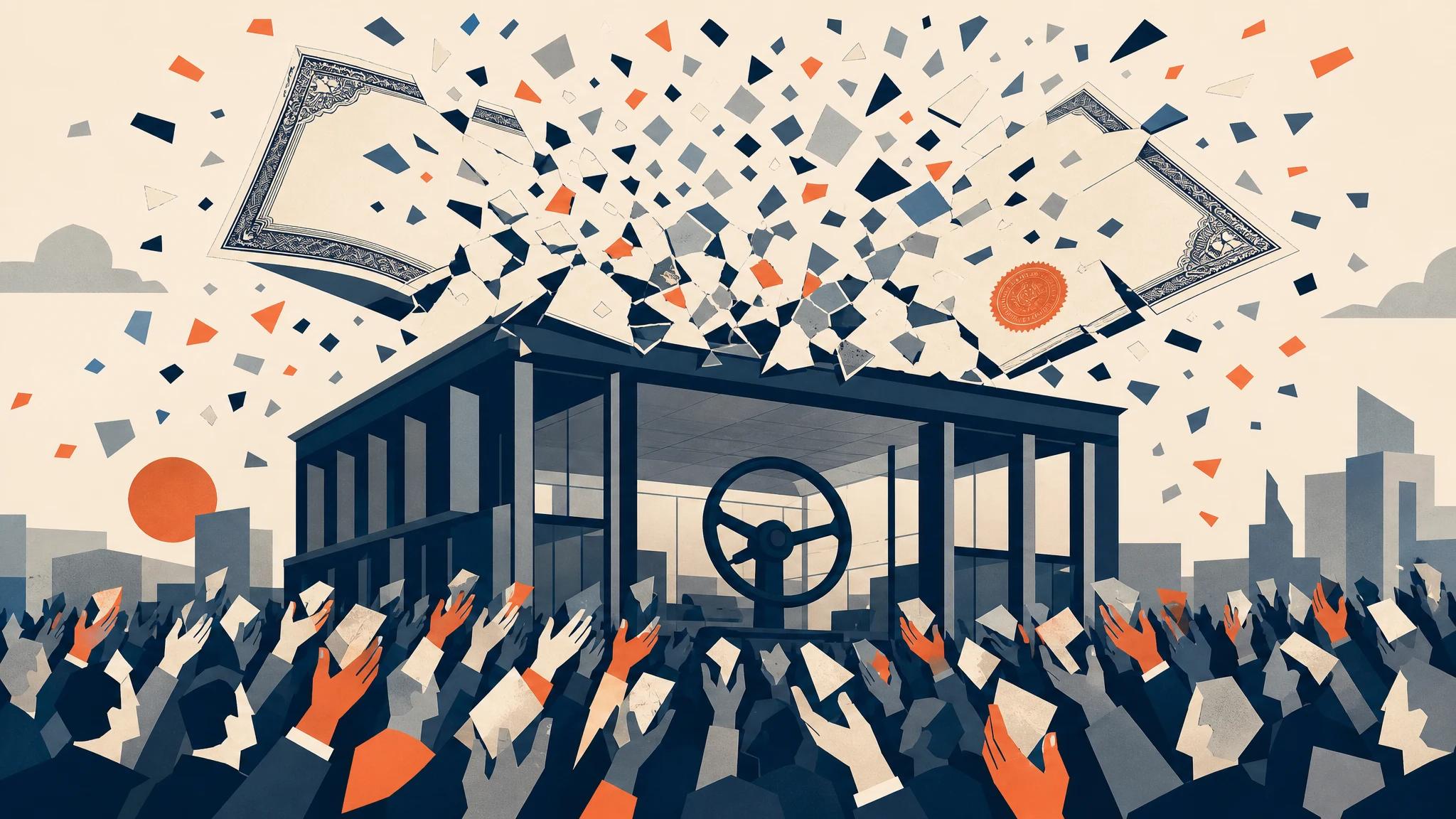
We need to reframe the question. What token-funded companies truly restructure isn't capital raising but governance. The moment users rather than shareholders hold equity, the decision-making structure of the corporate entity itself is shaken.
Capital and Users Stand on the Same Line
Traditional startups raise twice. First they sell equity to VCs to raise capital, then use that money to buy users. Those who provide capital and those who use the product stand on different lines. Their interests frequently diverge. Investors want returns, users want free.
Token-based startups collapse these two lines into one. Early users come in receiving tokens or points, and those tokens become both company equity and usage rights. Those who came early and used heavily hold the largest share. Capital raising, marketing, and loyalty are compressed into a single action.
In the US, this structure has already passed the validation stage. Uniswap retroactively distributed governance tokens to all wallets that had used the protocol before token issuance. Rather than spending on advertising, they converted usage records themselves into equity. There are many cases like Helio and Friend.tech that collapsed from overheating, but the way they collapsed actually reveals the core. What failed wasn't the settlement ledger but price expectations.
When Users Become Shareholders, Who Governs?
This is where the real problem begins. Who operates a company whose equity is scattered across tens of thousands of wallets?
Shareholder meetings have fixed registries. Token holders change every block. If yesterday's user sells their tokens today, they're no longer an owner. The subject of governance flows like liquid. This liquidity is both the weakness and essence of token governance. It's why DAO voter turnout remains in single digits and ultimately a few whales dominate decisions. Distributing votes didn't distribute power.
There's a counterargument. If that's the case, isn't a traditional corporation better? Decision-making slows down, accountability blurs—what's the actual benefit of token distribution?
It's a valid point, and it applies to most DAOs as-is. But there's one dividing line. In networks where usage volume equals value—payment networks, content platforms, or game economies—user exodus equals asset destruction. In such businesses, binding users as shareholders isn't ideology but survival design. They stay because leaving kills their own equity. It's a lock-in that corporate structure can't achieve. The key isn't distribution itself, but that there are specific businesses where distribution is rewarded.
One Stack That Binds Scattered Trust
For token governance to work, common infrastructure that scattered holders can trust must be laid first. This is the layer I call the protocol economy.
First, the unit of settlement must be stable. A company's actual revenue and costs can't be recorded using only highly volatile native tokens. That's why stablecoins like USDC enter as accounting currencies. Next is payment automation. x402 revives the HTTP 402 response code, creating a payment protocol where machines pay directly without human approval. It's a structure where agents settle on the spot while calling APIs. Identity and reputation are layered on top. ERC-8004 is an agent identity and reputation standard under discussion in the Ethereum ecosystem, though it should be clear that it's closer to a direction than an agreed final specification. Finally, there's tokenization that solidifies contribution records as assets.
If these five operate separately, they're just noise, but when stacked as one unified system, the meaning changes. Stablecoins handle accounting, x402 handles payments, on-chain reputation handles trust, and tokenization handles ownership. This is why companies that distribute equity to users don't collapse. Who contributed how much and how to compensate for it gets recorded on the ledger without human mediation.
Is Korea a User or Designer?
Who solidifies this stack as a standard will determine the coordinates for the next 10 years. US Big Tech is trying to dominate payment infrastructure, the Ethereum ecosystem is trying to preempt identity and reputation specifications. Global payment networks are placing stablecoins on their own rails.
Korea usually ends up as a user of these standards. We've been skilled at importing and localizing specifications others created. However, the most validated experimental ground for token governance has actually been in Korea. Games. The experience of tens of millions trading in-game goods, operating DAOs called guilds, and claiming ownership of items is thicker than in any other country. Few places have three strengths—content IP, financial infrastructure, and game economy design—overlapping in one society.
I think of Busan. This city where gaming industry and blockchain special zone discussions coexist isn't a bad coordinate for testing standards for a content economy where users become shareholders. The issue isn't the courage to issue tokens, but the will to design a ledger where those tokens are settled honestly.
Before Performance, Standards of Trust
If you read token-funded companies as coin issuance, you only see bubbles. If you read them as settlement ledgers, you see governance redesign. The structure where users become shareholders is spreading not because it's more democratic, but because in businesses where usage volume equals assets, it's the most solid way to retain users.
When AI agents enter that user position, the game expands once more. In companies where machines contribute, settle accounts, and vote, what we need to design first isn't agent performance. It's standards of trust—making it possible to agree without dispute on who contributed what and what they're entitled to receive. That comes first.
This article was automatically translated from the Korean original by AI. For the authoritative version, read it in Korean.
한국어 원문 읽기 →