The Hidden Census Behind a Solo Hundred-Billion-Won Business
The narrative of 'a hundred billion won in solo revenue with AI' claims to have eliminated employees. But in reality, it has merely moved employees outside the accounting books. What has disappeared is not labor, but the name of labor.
AI Summary
The so-called '1-person unicorn' business model does not eliminate labor but externalizes it—outsourcing work to platform workers, crowdsourced freelancers, and AI models trained on unconsented data. This piece argues that South Korea needs new regulations to make invisible labor visible again, establish creator rights over training data, and demand statistical honesty about how many workers actually contribute to these 'solo' revenues.
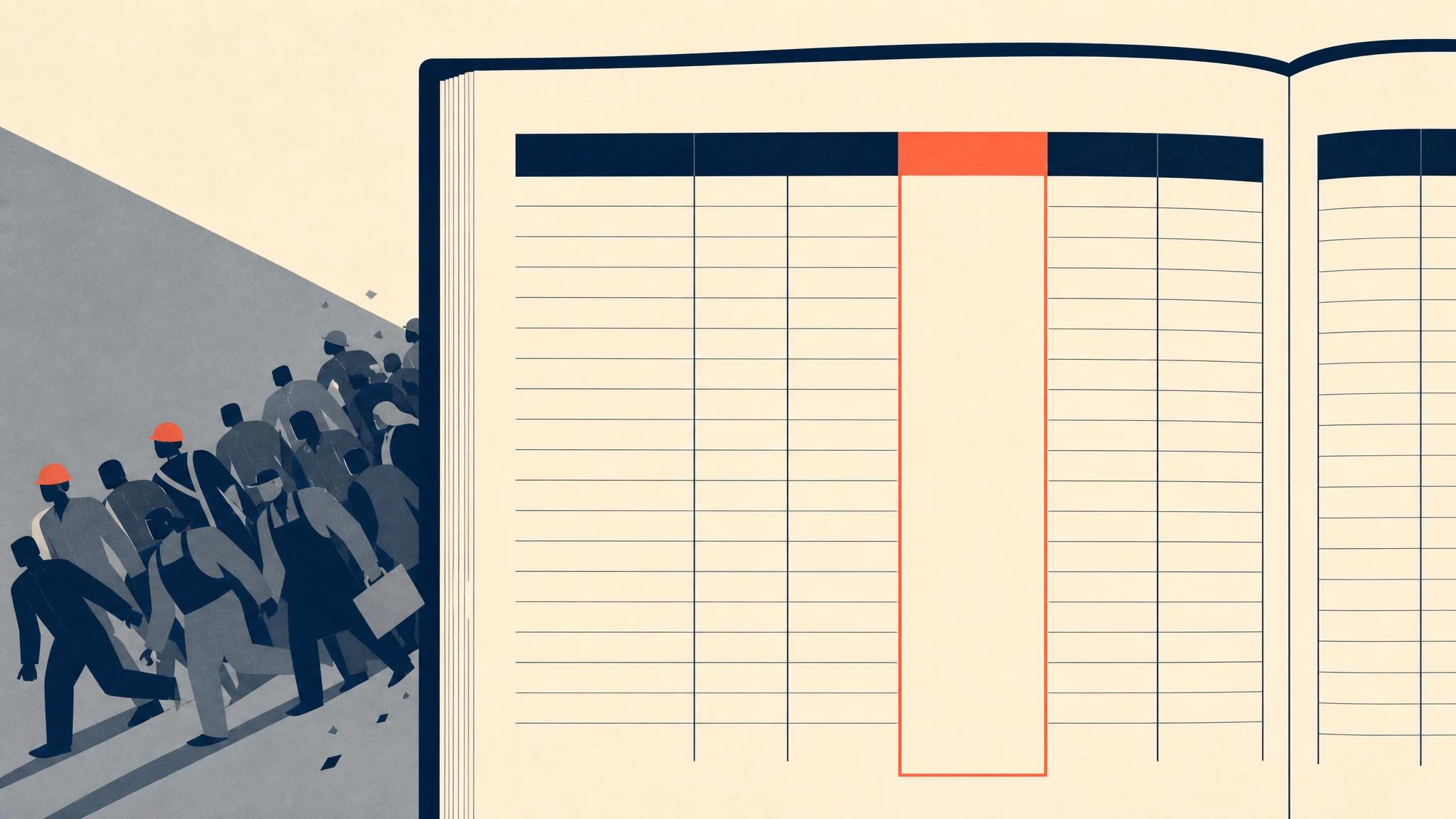
A founder takes the stage. No employees, yet annual revenue approaches a hundred billion won. The entire company fits on one slide. Just one photo of the founder. The audience applauds. It looks like the pinnacle of efficiency. Value rises without labor costs, meetings, or organizational charts.
But what's missing from this scene is not labor costs—it's the census. If a company generates a hundred billion won, that hundred billion won's worth of labor definitely happened somewhere. What disappeared is not the work, but the name of the work. The '1-person unicorn' is not a model that eliminated labor, but one that moved labor outside the accounting books.
The Coordinates of Costs That Efficiency Relocated
When we measure efficiency, we usually look at only one ledger. The founder's costs decreased. Employee salaries, four major insurances, office rent, management burden—all converge toward zero. The narrative on stage ends here.
Open the other ledger and the same labor reappears. Customer service is outsourced to call centers in Manila or Davao, design goes to $5-per-task crowdsourcing platforms, data labeling to click workers in Kenya and India, video editing to underpaid Korean freelancers. And the largest share goes to the AI model itself. That model is the result of training on the writing, drawings, and code of hundreds of thousands of people without consent. Labor hasn't disappeared—it has been fragmented into forms that don't require payment.
Economics has an old name for this kind of transfer. Externalization. Just as a factory dumps wastewater into a river, passing treatment costs to downstream residents, the 1-person unicorn passes employment stability and bargaining power to platform workers. Instead of river water, people's time flows downstream.
The Pyramid That the Word '1-Person' Obscures
Let's pinpoint the key here. '1-person' is not a unit of labor but a unit of value claim. That one person is not someone who did all the work, but someone who holds the right to consolidate the results of dispersed labor in one place.
The pyramid of traditional companies was at least visible. There were organizational charts, job titles, and ledgers recording who contributed what. That's why unions, collective bargaining, and labor standards laws could operate on top of that pyramid. The 1-person unicorn keeps the same pyramid intact but erases the blueprint. The hundreds who contributed are scattered, each holding a contract stating they're independent contractors. They don't know each other, don't even know they contributed to the same output. Without colleagues, there's no negotiation.
The disputes surrounding Coupang logistics and delivery platforms over the past few years have revealed exactly this structure. Algorithms distribute work and set rates, but the employer to hold accountable is legally blurred. The '1-person unicorn' is a scaled-up version of this blurriness. Control concentrates in one person while risk disperses among an invisible multitude. Control and costs flow in exactly opposite directions.
Data: The Second Outsourcing
It's not just labor that's externalized. The real employees of a 1-person company are AI models, and the real workers of those models are the people who created the training data. People who wrote blogs, posted photos, answered questions. They are not notified that their creations went into someone's hundred-billion-won revenue. Once made public, creation becomes an infinitely replicable raw material, and raw materials don't come with royalties.
There's a likely counterargument here. Efficiency ultimately benefits everyone; when cheap tools are released, anyone can start a business and the pie grows. It's partly true. Barriers to entry have clearly lowered. But the pie growing and how that pie is sliced are different questions. The cheaper the tools, the more the source of differentiation shifts from the tools to the data that trained them, and to the platforms that gather that data. Even solo founders are ultimately tenants bound to a few model providers. Efficiency is not an alibi for distribution. Who claims the fruits of efficiency is a political matter designed separately from efficiency itself.
Rules South Korea Must Set
This isn't about stopping technology. There's no reason or method to prevent someone from generating large revenue alone with AI. What needs to be determined is whose rules that model operates under.
Three things can be starting points. First, putting invisible labor back on the books. Making platforms disclose the algorithmic basis for worker rates and making it possible to trace the outsourcing chain that contributed to each output. South Korea has already begun discussions on protecting platform workers, but the new guise of the '1-person unicorn' quickly escapes into blind spots those discussions can't reach. Next is creators' claim rights over training data. Revenue built on models created without minimum standards of consent and compensation carries unsettled debt. Finally, statistical honesty about the '1-person' myth itself. Without metrics measuring how many people's labor hours actually went into the revenue, we'll continue to see off disappeared populations with applause alone.
The fact that a young person running a 1-person content company in Busan is linked in one chain with Manila call centers and Kenyan labelers shows how far efficiency's shadow extends. Within the same chain, some hold claim rights while others receive only rate sheets.
Ultimately, the question converges to one. The 1-person unicorn is not a miracle created by technology, but an accounting choice that technology made possible. Will we push labor outside the books, or call it back inside? This isn't about stopping technology. It's about determining by whose rules we'll count the hundreds hidden behind that one name.
This article was automatically translated from the Korean original by AI. For the authoritative version, read it in Korean.
한국어 원문 읽기 →