Pokémon Cards Are Not a Card Game
More precisely, they are a machine that converts emotion into scarcity.
AI Summary
Pokémon cards function as an "emotion-scarcity machine" that channels genuine childhood nostalgia and personal attachment into collectible value and market prices. The system — spanning pack openings, community recognition, social media hype, and reseller markets — is engineered to feel entirely natural, blurring the line between authentic fandom and consumption anxiety. The healthiest way to engage with the hobby, the author argues, is to stay anchored to intrinsic reasons for collecting rather than external market signals.
People often ask about Pokémon TCG: Is it a strategically deep game? Is it better designed than Magic: The Gathering or Yu-Gi-Oh? But those questions miss the point slightly. The real question is something else entirely: Why do people pour money, time, memories, and emotion into a single sheet of paper printed with characters?
Of course, Pokémon cards are a game. You build decks, battle, read the meta, and compete in tournaments. But it is hard to explain how Pokémon cards grew this large through gameplay alone. The entry point into Pokémon cards is closer to collecting than to battling.
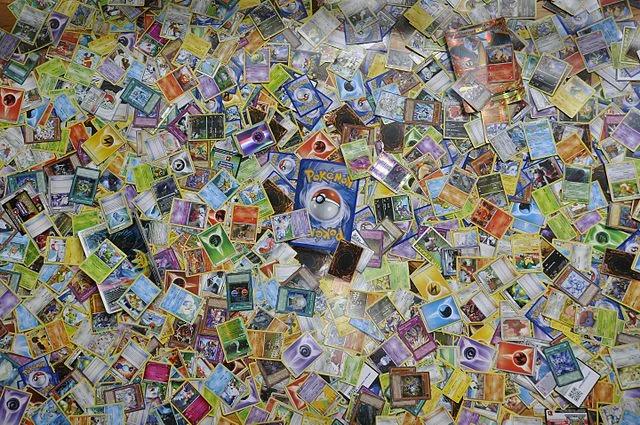
The flow has always been this way. You have a favorite Pokémon you want to see as a card, so you want to own it, so you buy a pack, you open it and collect, you trade with friends, and eventually you build a deck. The rough sequence runs from collection to attachment, and then to battling. Battle is less a starting point than a way to play with attachment that has already formed.
That is why a single Pokémon card is not just a game piece. During play it is a tool; inside a binder it is a collectible; for a fan it is a memory; and within a community it becomes a form of self-introduction. What cards someone loves reveals their taste. There are people who chase only Charizard, people who collect Pikachu across every generation, people who buy based on the illustrator, and people strangely drawn to Pokémon nobody else wants — they are all different.
The real playing field of Pokémon cards is not only on the table. The bigger playing field unfolds between your own memories and other people's recognition. A Pokémon you loved as a child gets a card, the card is beautiful, people recognize it, and it acquires a market price. At that moment, a single sheet of paper is no longer just paper.
Scarcity Doesn't Arise on Its Own
Add scarcity to this and things escalate. The interesting thing is that Pokémon cards are printed in enormous quantities. Yet some cards always seem to be in short supply, some packs feel like you have to buy them right now, and some sets feel as though you will never find them again if you miss them. This is not simply a matter of limited supply.
Scarcity does not just happen. There is production volume, distribution, resellers, YouTube unboxing videos, the mood on social media, a character's popularity, and childhood memories. Add to that the thought that prices might rise later. At that point, cards become not a hobby but a timing game.
What makes Pokémon cards unsettling is not that they openly deceive people. It is actually the opposite. People buy them because they genuinely love them, because they have real memories tied to them, because they are genuinely beautiful, because they genuinely want them. That is what makes it harder. The problem is that those genuine emotions are all too easily converted into price tags.
A Machine That Links Emotion and Scarcity
So I see Pokémon cards as an emotion-scarcity machine. First it creates attachment, then it adds scarcity, then it builds tension around opening a pack, then it creates an atmosphere where others recognize your collection, and then it attaches market prices. And the person goes back to the next pack. The cycle is too seamless.
The digital version, TCG Pocket, is a compressed iteration of this structure. In the past, buying cards meant going to a store, selecting a pack, paying, tearing open the packaging, and storing the cards. On mobile, that process nearly disappears. Opening a pack becomes just another daily routine.
The pleasure of opening a pack is stronger than you might expect. You do not know what will come out, and there is a brief tension because a rare card might appear. If it does not, it does not quite feel over — because there is another pack waiting. Calling this gambling outright might be too strong, but it is difficult to deny how closely it resembles probability-based reward systems.
What makes Pokémon cards more complicated is that they are not cold probability products. Inside them are Pikachu, Charizard, and Bulbasaur; elementary-school memories; the moment of trading cards with a friend; cuteness; and generational fandom. Consumption enters wearing the face of affection. That is why it works so well.
So calling Pokémon cards pure marketing is too shallow, but calling them a purely innocent hobby is too naive. Both are right and both are incomplete. Pokémon cards are something that commercially amplifies genuine attachment very effectively. That is the true power of this product.
In the End, There Is Only One Thing to Look At
Ultimately, what matters is not making a lot of rules for yourself. You only need to look at one thing: Is the reason I want this card inside the card itself, or is it inside the price tag? When that starts to blur, collecting quickly becomes a chase. You buy because others are buying, you buy because prices might rise, you buy because it might sell out, you buy because not buying feels like a loss. That is when a hobby becomes anxiety.
Good collecting is different. You buy because you love that Pokémon, because the artwork speaks to you, because you have childhood memories tied to it, because you want to put it in your deck, because you want to talk about it with friends. When the reason lives inside you, collecting becomes taste; when the reason lives only in the market, collecting becomes speculation.
What makes Pokémon TCG remarkable is not just that it is a strategy game. It converts memories into cards, cards into the desire to collect, the desire to collect into scarcity, scarcity into market prices, and those prices back into community recognition. The cycle is too natural. That is why Pokémon cards have transcended the simple card game.
I do not want to simply condemn Pokémon cards. They are a well-made product, a genuinely well-crafted hobby, a remarkably powerful IP, and the way they handle people's memories is clever. But they are a little too well made. They touch emotions, add scarcity, create the tension of opening a pack, draw in others' recognition, and even attach a price tag.
So the way to enjoy Pokémon cards in a healthy way is surprisingly simple. It is not about having more — it is about knowing why you want to have. Whether you genuinely want this card because you love it, or whether you want it because others want it too. Lose sight of that difference and Pokémon cards become, at some point, not a hobby but an anxiety.
This article was automatically translated from the Korean original by AI. For the authoritative version, read it in Korean.
한국어 원문 읽기 →