The Public Square Exists Outside the Screen
PC bangs, arcades, and G-STAR venues are the last remaining offline communal spaces in the digital age. The real reason Busan is a gaming city lies in its physical sense of place.
AI Summary
While digital experiences increasingly happen alone, gaming venues like PC bangs, arcades, and G-STAR create rare physical gathering spaces in modern cities. Despite the rise of mobile and cloud gaming, people still seek physical locations to share gaming experiences together. Busan's identity as a gaming city depends not on event numbers but on fostering these small-scale physical nodes where people with coordinates can gather.
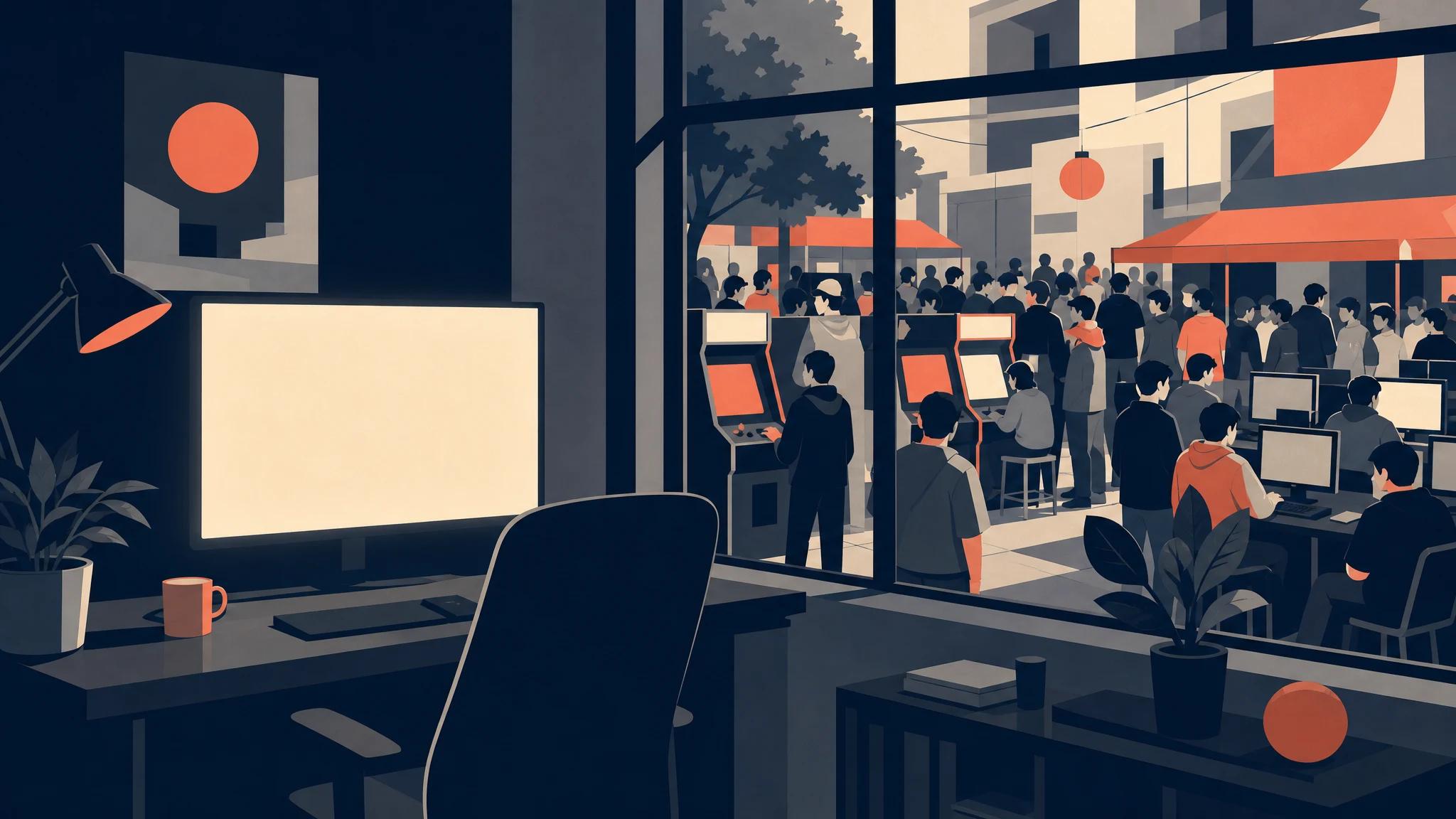
2 AM, Light in Seomyeon's Underground
Descend into a Seomyeon alley and you'll find dozens of monitors glowing even at 2 AM. People sitting in a row are strangers to each other. Yet inside the same game, they're on the same team. When the person next to you curses, it means their on-screen character died; when someone pushes back their chair and stands up, it means a round has ended. Without exchanging words, they share the same air.
Through the eyes of someone who builds cities, this is a rare scene. We increasingly design for solitude. We solve meals through delivery, pay at unmanned stores, and work from home. The physical spaces of gaming fill the void left by disappearing communal spaces. The PC bang is urban infrastructure invented by Korea. Cheaper than cafés, noisier than libraries, more lucid than bars.
Tourist Lists Miss the City
Articles introducing Busan always end with the same list. Haeundae, Gwangalli, Gamcheon Culture Village, Huinnyeoul-gil. The photos are pretty, but they contain neither people who work there nor people who pass through daily. Viewing a city only as a tourist list means missing what matters most—places where people actually gather, where they spend money and time doing something together.
The sense of place in gaming exists precisely at that point. Consider G-STAR, held annually at BEXCO. Busan's long retention of this event isn't merely an attraction achievement. For several days, the entire city transforms into a massive offline public square mediated by gaming. People stand in line to try new releases, cheer with strangers in front of the same booth, and ride the subway carrying merchandise. Experiences that could have ended on-screen deliberately gather in one city with physical bodies. Builders need to see this moment. Even in an era when everything can be done digitally, people still deliberately gather. Those who design excuses for gathering build the city.
There's a strong counterargument here: gaming is fundamentally a medium becoming individualized and online, and cloud gaming and mobile will eventually erase physical locations. It's a valid trend. Yet while everyone has said for over a decade that mobile would consume everything, PC bangs haven't disappeared. Only their form has changed. Seats have decreased while specs have increased; they've combined with restaurants and become spaces for watching competitions. The more individualized the medium becomes, the more people want physical places to collectively confirm those experiences. Like a movie watched alone that only ends when you chat about it with someone.
Why Are Arcades Still Alive?
Think of the arcades in the back alleys of Gwangalli or Haeundae. These spaces mixing claw machines, rhythm games, and punching machines can't be explained by efficiency. Even though you can play with better graphics more cheaply at home, people deliberately go there. The reason is simple: someone watches from the side. The moment a score gets stamped on screen, a stranger glances over. A game played alone and a game watched by others are completely different events.
The arcade's survival secret isn't the games but the stage. It briefly makes people the protagonist. For those designing urban spaces, this is directly useful insight. Good spaces don't provide content—they display people. Like why cafés have glass walls, why plazas have stairs. Places where seeing and being seen happen simultaneously attract people.
If Busan wants to grow its gaming city identity, it must grasp this sensibility over event attraction numbers. Workspaces where new studios can gather, small stages where indie developers first launch their games before strangers, neighborhood-level venues for watching competitions. These nodes make a city a gaming city more than one grand game center. Even if content lives in the cloud, people gather where there are coordinates.
What Remains Outside the Screen
If you see gaming only as something inside screens, all of this becomes invisible. From the perspective of those who work and create, gaming is one of the few remaining excuses for people to deliberately gather with their bodies in the digital age. Dawn seats in Seomyeon's underground, days at BEXCO, arcades in Gwangalli's back alleys—all are public squares with physical coordinates. What builders must create isn't better screens but places that gather people in front of those screens. A city is the sum of excuses for people to gather.
This article was automatically translated from the Korean original by AI. For the authoritative version, read it in Korean.
한국어 원문 읽기 →