AI Learns by Copying Humans, Then Teaches Them Back
Reinforcement learning agents don't stop at defeating humans. They return moves never before played by humans back into human culture. What happens on the game board is a rehearsal for what humans will ultimately keep as their own work.
AI Summary
AI systems like AlphaGo have not only defeated humans at complex games but have fundamentally expanded human creativity by introducing novel strategies that humans then adopt and integrate into their own play. Rather than replacing humans, AI has become a tool that broadens the possibility space of human culture, shifting human work from finding answers to selecting, interpreting, and taking responsibility for them. South Korea, having experienced the AlphaGo shock firsthand in baduk, offers lessons on how society can adapt by treating AI as a learning tool rather than a threat.
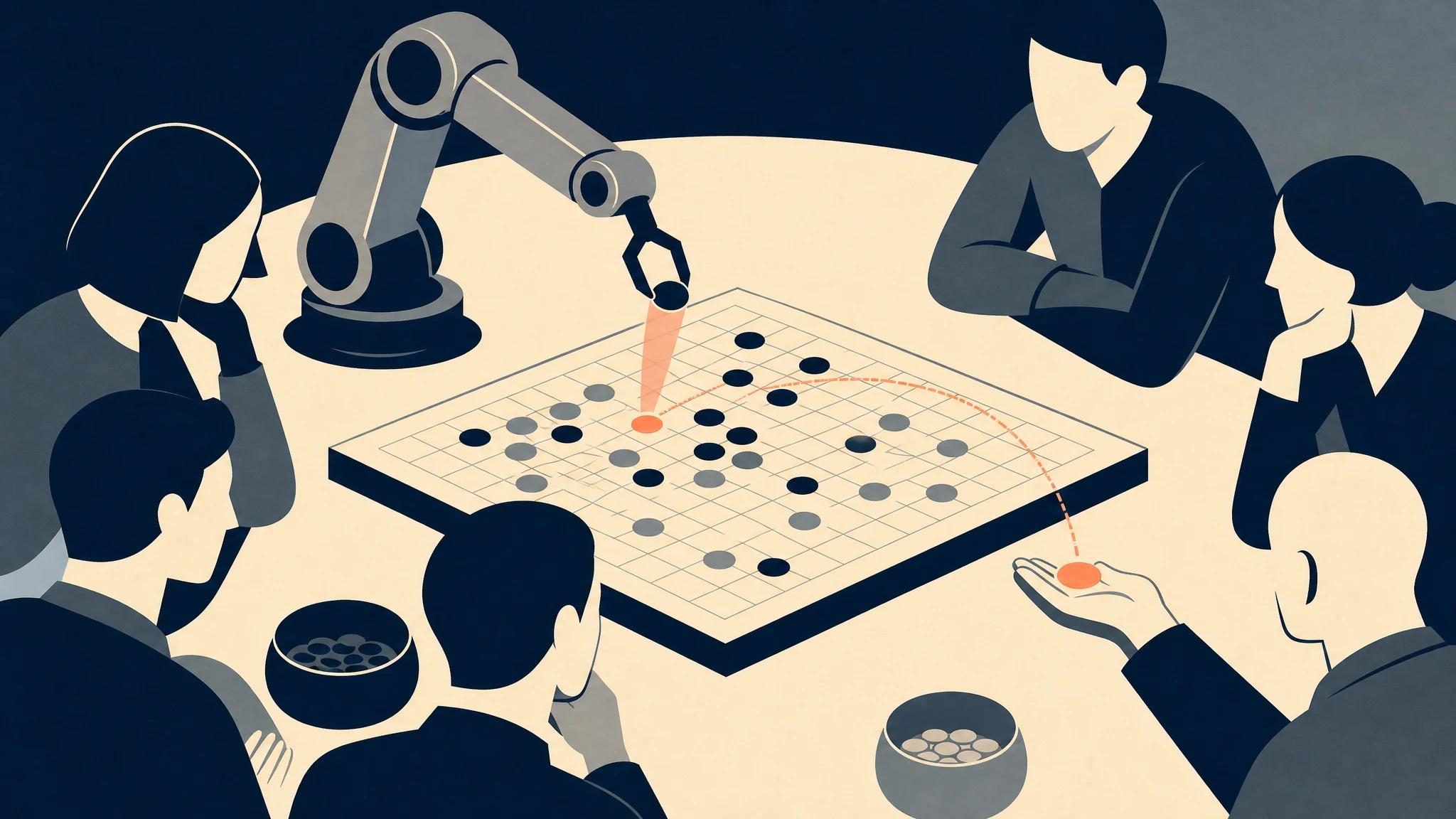
Let's start with one point on a baduk board. Move 37 that AlphaGo played in its 2016 match against Lee Sedol was a position that professional players at the time regarded as almost a mistake. Throughout thousands of years of human game records, few had placed a stone in that location. Yet within a few years, that move became a choice close to standard theory. This is not a story of humans defeating AI. It's a story of how a single AI move changed human aesthetic sensibility itself.
The story typically stops here. The machine surpassed humans, even human intuition was ultimately just calculation—that sort of thing. That interpretation is only half right and misses the more important half. The key point is not that AI defeated humans, but that the moves AI created were then handed back to humans to become material for new creativity.
Intuition: The Last Sanctuary
For a long time, we considered intuition humanity's last sanctuary. Even if we surrendered calculation to machines, we believed the sense of reading the entire board at a glance and making an inexplicable move belonged to humans alone. Games like baduk, StarCraft, and Dota were laboratories for that belief—domains thought to have more possible positions than atoms in the universe, unsolvable by brute-force calculation and navigable only by intuition.
Reinforcement learning agents passed straight through that domain. DeepMind's AlphaZero learned baduk, chess, and shogi purely by playing against itself, without looking at a single line of human game records. Starting outside the culture humans had accumulated, it walked down paths humans had never taken. OpenAI Five, which played Dota 2, and AlphaStar in StarCraft 2 share the same character. They presented as new correct answers the strategies humans had dismissed as inefficient.
Up to this point, it's a narrative of replacement. The bitter conclusion that even intuition was a learnable pattern. But what actually happened in gaming communities was different.
Not a Tool for Winning, But for Creating
Professional gamers and experts, after losing to AI, began studying it. They dissected AI game records, replays, and build orders, transplanting them into their own play. New baduk joseki, fresh StarCraft builds, and re-evaluated chess openings were absorbed into the human meta this way. AI shifted position from an opponent that defeated humans to a textbook humans reference.
The meaning of this transition must be precisely identified from the game's perspective. AI did not replace humans. It expanded the very space of possibilities that human culture explores. Just as a painter who gains new pigments can create more paintings, players obtained through AI a dictionary of moves that had never existed before. The real event was not the wins and losses, but that AI became a supplier of raw materials for human creativity.
That's why viewing AI as a simple work assistance tool misses the most important change. An assistance tool only does what I was going to do more quickly. But AlphaGo didn't play Lee Sedol's intended move faster. It added moves to the human dictionary that Lee Sedol couldn't even imagine. The tool didn't raise productivity; it redrew the boundaries of what humans can create. This is not a question of efficiency but of roles.
Externalized Intelligence, Redefined Human Work
What happened on the game board is a miniature model of society. When intelligence flows outward, humans must redefine their work. The work of baduk players shifted from 'finding the best move' to 'understanding, interpreting, and integrating into one's own style the moves AI presents.' It became not the work of producing answers, but of handling answers.
This shift is happening identically outside games. Writing a line of code, drafting a report, selecting initial diagnostic candidates—these are increasingly externalized. So what work remains for humans? The judgment of choosing what fits this situation from among the many candidates AI presents, the work of taking responsibility for that choice, and the work of translating the possibility space AI has expanded into one's own context.
A counterargument is possible here. If AI plays better moves than humans, wouldn't it be rational to entrust even judgment to AI? In games, things are actually flowing that way to some extent. But one thing remains. AI answers what a good move is, but it doesn't answer the standard by which we call something good. Is the strategy with a 99 percent win rate the most beautiful baduk, the most enjoyable game? Answering that question remains human work. The answer to where responsibility lies is the same. Even if judgment is externalized, responsibility for adopting that judgment is not externalized.
Korea: Lessons from the Land of Baduk
Korea is a society that experienced this change before others. Baduk was a cultural asset of Korea, China, and Japan, and Korea took the AlphaGo shock head-on. The scene of a young player reviewing games with AI analysis software at a baduk institute in Busan is now everyday life. What's interesting is the fact that Korean baduk did not collapse. Rather, the players who most quickly accepted AI as a learning tool rose back to the top ranks. Those who were not ashamed of losing to AI and retrained their own intuition using AI as a textbook survived.
Education and labor must take the same path. Training to produce correct answers quickly is already done better by AI—that ability Korean education has long clung to. What remains is training to doubt, compare, select according to context, and take responsibility for the answers AI produces. Just as game experts watch AI replays asking 'why this move?', the next generation must know how to ask 'why this answer?' about AI's outputs.
The question of the AI era is not whether machines will become like humans. The game board tells us that question is already outdated. Machines defeated humans, then became their teachers. The real question is this: In the space where intelligence has flowed outward, what will humans keep as human work to the very end? Not the work of finding answers but of selecting them, not the work of making moves but of deciding what to call those moves. AlphaGo's Move 37 was not a move that defeated humans, but the first move that posed that question to humanity.
This article was automatically translated from the Korean original by AI. For the authoritative version, read it in Korean.
한국어 원문 읽기 →