Game Pass Is Following Music's Path
Subscription catalogs are not product innovation but a transplant of settlement structures. The same Silicon Valley logic that Spotify imposed on music creators is now being replicated on game studios. This is a signal Korean developers must read before being locked in as suppliers.
AI Summary
Microsoft's Game Pass is replicating the subscription model that transformed music streaming, where platforms like Spotify shifted pricing power away from creators through pooled revenue distribution based on play time rather than individual sales. Korean game studios, unlike musicians, have built direct payment platforms and live service infrastructure, giving them leverage to resist becoming mere content suppliers—but only if they maintain control over their settlement structures rather than succumbing to global subscription layers. The real cost isn't price increases but losing the ability to set one's own game value as decision-making power quietly transfers to platform algorithms.
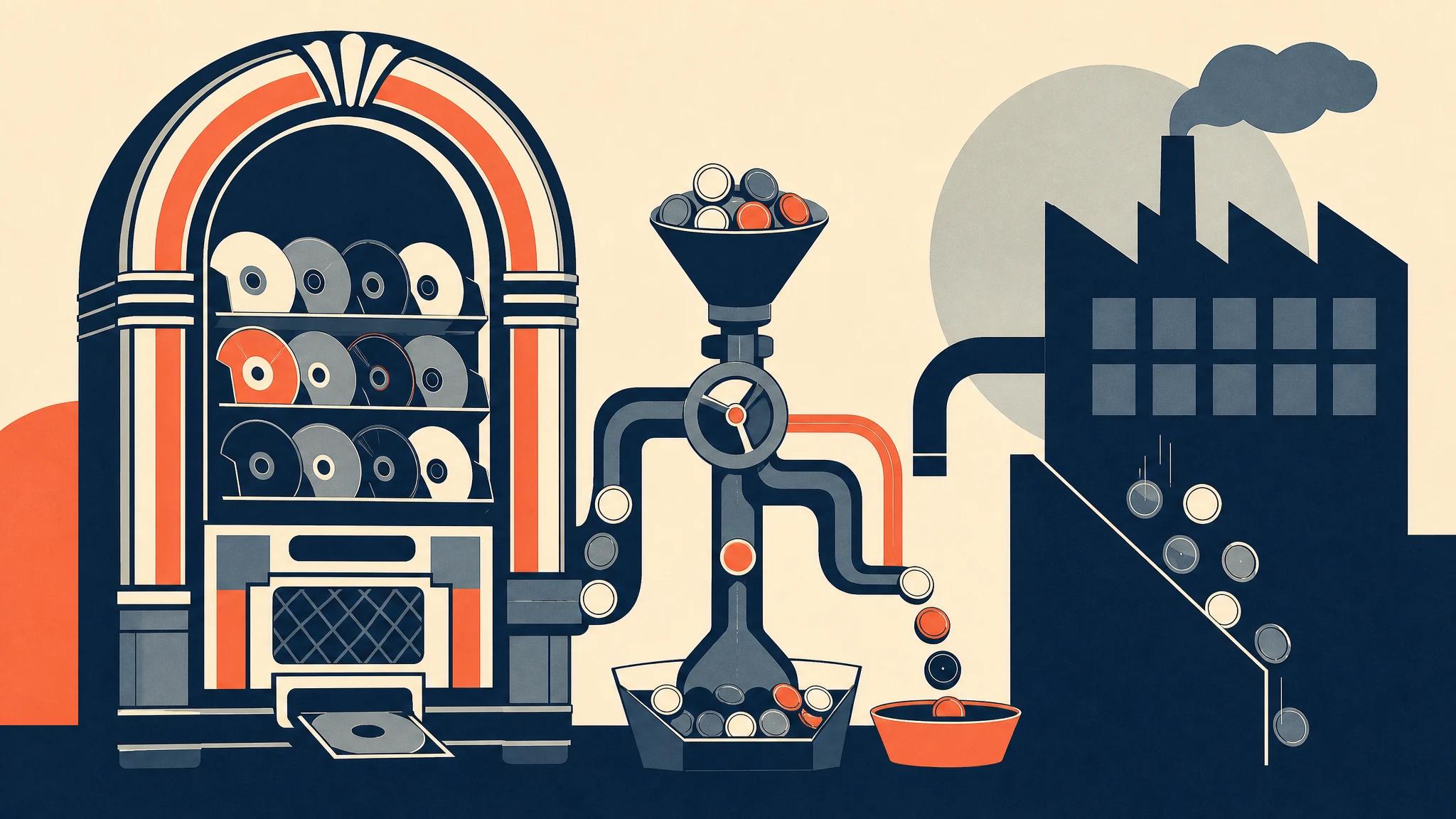
The Question Hidden Behind $17.99 a Month
Microsoft raised the price of Game Pass Ultimate while expanding its catalog. On the surface, it's typical subscription increase news. Gamers were angry about the price, and media ran headlines saying "Call of Duty available from day one." Stop there and it's just product news.
But overlay this scene with music and a different picture emerges. Spotify in 2008 started exactly the same way. Unlimited catalog, monthly flat rate, heaven for consumers. Fifteen years later, creators now receive between $0.003 and $0.005 per streaming play. When you bought an album, the artist's share was paid in one lump sum, but streaming broke up that revenue and redistributed it through a pool system. Who gets how much is determined not by the song but by the platform's distribution algorithm.
| Music Streaming | Game Subscription | |
|---|---|---|
| Distribution Method | Pool playtime share | Upfront guarantee + playtime pool |
| What Disappeared | Per-track unit price | Per-game copy unit price |
| Favored Content | Short, frequently played tracks | Live services with long retention |
| Gatekeepers | Apple, Spotify, Big 3 labels | MS, Sony, Valve |
What Game Pass is copying right now is not games but precisely this distribution structure.
Catalog Economics Hides Settlement
The core of subscription catalogs is that individual purchase prices disappear. When a packaged game sold for 60,000 won, developers took a percentage. The unit price was clear. In subscriptions, that unit price vanishes. Microsoft either pays studios upfront guarantees or divides the pool based on play time. Either way, what a game actually sold for becomes a number that no longer exists.
This is exactly what happened with Spotify. The moment a song's value was converted to share of play time, pricing power left creators' hands. Short, frequently played songs beat long, deep ones. Games are heading in the same direction. Designs that survive within subscriptions ultimately become games that retain players longer. Because play time is the denominator of settlement. Live services that keep players engaged endlessly have an advantage in the pool over self-contained 40-hour single-player games.
A strong counterargument arises here: doesn't subscription give unknown studios exposure opportunities, don't people at least download games that wouldn't have sold? That's true. Spotify drew in indie musicians with exactly that logic. But exposure and settlement are different issues. In a pool system, even when exposure increases, unit prices melt together. A structure where you get discovered but can't make a living—music has already passed through this path.
Capital Goes Not to Catalogs But to Chokepoints
Where is Silicon Valley spending money now? Not on catalogs themselves. On the subscription layer that bundles catalogs, and on the infrastructure that runs it. Microsoft's $68.7 billion purchase of Activision Blizzard wasn't buying a game company—it was buying a content dam that has no choice but to feed the subscription pool. Sony reorganizing PS Plus in tiers and Netflix buying up game studios are the same motion. They're all not trying to make games but to erect tollgates at the chokepoints where games flow in.
Just remember who held these tollgates in music. Apple, Spotify, and the Big Three majors controlling distribution. Creators were suppliers beneath them. In games, Microsoft, Sony, and Valve are now fighting over those tollgate positions, while Amazon and NVIDIA are clashing on the cloud side. Capital moves not to content but to positions that collect tolls on content. Just a rehash of Silicon Valley platform logic, nothing new.
Is Korea Being Pulled in as a Supplier?
So are Korean companies suppliers, customers, or standard designers? Looking at it coldly, the current flow is pushing Korean studios into the supplier box.
However, Korea's game industry has one card critically different from music. Korea built live services and proprietary payment platforms early. Nexon, NCSOFT, and Krafton are companies that have directly settled their own games through their own channels. In music terms, it's like having your own streaming service instead of handing songs over to Spotify. Looking at the indie developers gathered in Busan and the G-Star ecosystem, Korea has muscles that don't hand over distribution to others.
The problem is that global subscription layers bypass those muscles. The moment you enter Game Pass, settlement standards become Microsoft's pool formula. If Korean studios decide whether to enter based on desperation for exposure, they walk the exact path music creators walked. Conversely, if they hold onto proprietary platforms and direct billing to the end, they preserve pricing power. The choice splits not on content quality but on who designs the settlement structure.
The Cost of Waiting and Watching
Read Silicon Valley's subscription increase news as someone else's pricing policy and nothing happens. But that announcement is a signal pre-writing Korean game companies' next cost structure. The moment you're tied to a subscription pool, the value of one game copy becomes not a number you set but a share distributed by someone else's algorithm.
Music suffered this transition slowly over 15 years, and when it came to its senses, the unit price negotiation table itself had disappeared. Games are traveling that path faster. The real cost of waiting and watching is not the price increase. It's no longer being able to name your own game's price—the time spent doing nothing while that decision-making power quietly transfers.
This article was automatically translated from the Korean original by AI. For the authoritative version, read it in Korean.
한국어 원문 읽기 →