The People Making the Scene
BUILD051, a second-year indie game festival held at the KT&G Sangsangmadang Busan venue that resembles a basketball court. At a gathering where departed colleagues are called out first and everyone checks in on one another, Busan was building not just games, but a scene.
AI Summary
BUILD051, a volunteer-run indie game festival in its second year in Busan, opened with a tribute to the late developer Park Dong-heung before hosting talks on community-building, career postmortems, and sustaining human connection in the indie game world. With over 40 participating teams and more than 600 active developers in the city, the event illustrated how Busan's indie scene is as much about cultivating a community as it is about shipping games. The festival continues on June 26 with a free public exhibition where developers demo their titles directly to attendees.
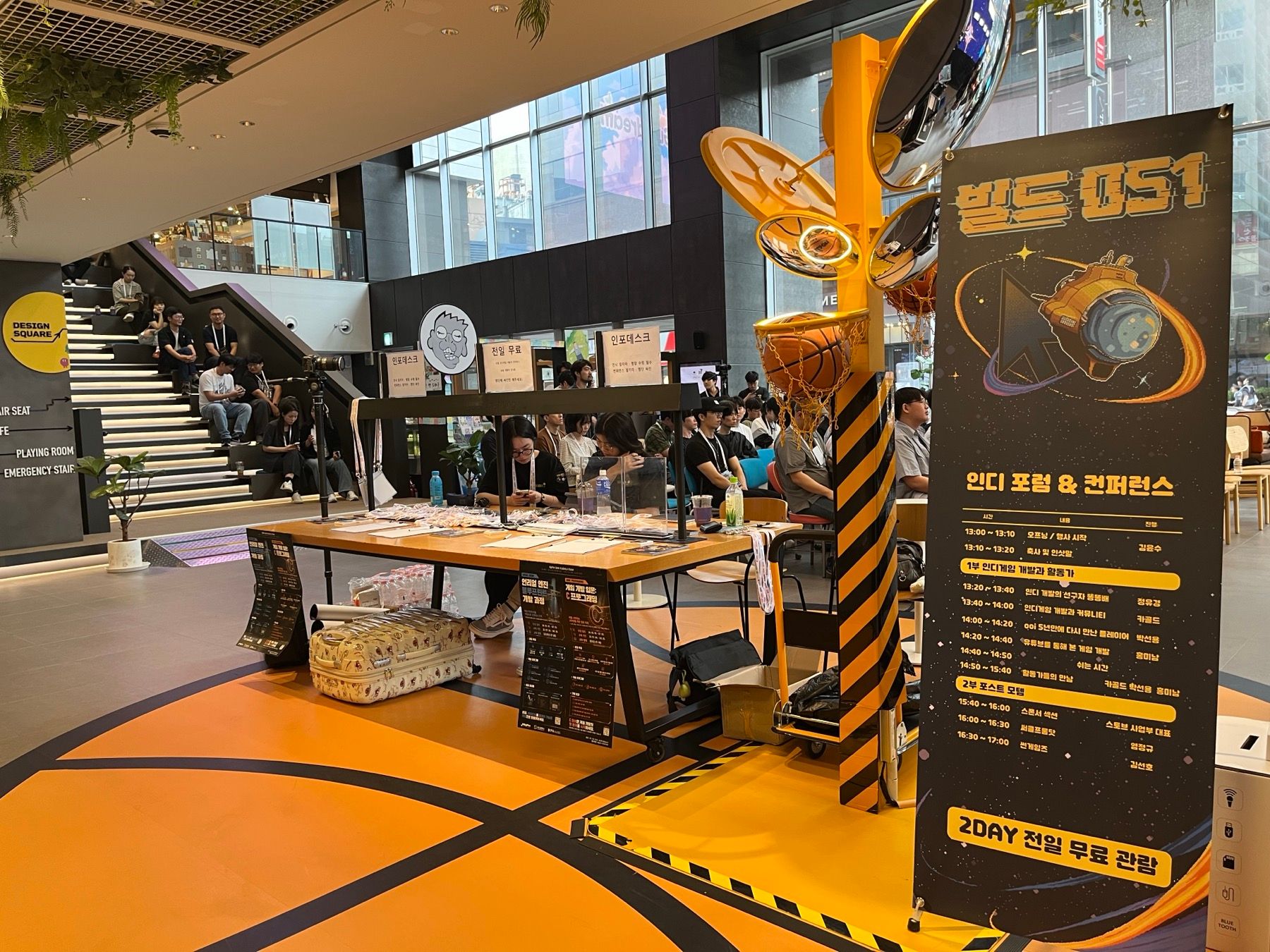
In the heart of Seomyeon, at the Design Square on the ground floor of KT&G Sangsangmadang Busan. The floor is marked with the lines of a real basketball court; above, a sculpture hangs from the ceiling suspending a basketball hoop and a convex mirror. Between them stands a single black banner. Beneath an illustration of a spacecraft orbiting a planet, the words read: 'BUILD051 Indie Forum & Conference,' and in large type, '2DAY ALL-DAY FREE ADMISSION.' Organized entirely by volunteers through Indie-Bu, the Busan Indie Developers Association, this Busan-Ulsan-Gyeongnam indie game festival is now in its second year.
Every visual in the venue points in the same direction: a voyage toward space. The spacecraft on the banner, the starfield cascading behind the stage, and even the name of the 'Dream Forward Project' — a tribute to the late Park Dong-heung, mounted in partnership with Dongseo University's 'Let's Weigh Anchor' team — all converge on the same image. It felt like the way this city's indie scene chooses to name itself: raise the anchor, sail toward the stars.
Part One on the Basketball Court
The forum was held not in a separate auditorium but in a café-style lounge. People settled into mismatched chairs of different colors; to one side, a camera mounted on a tripod framed the stage. The opening began at 1 p.m. with welcoming remarks from Kim Yun-su. The info desk was spread with merchandise, and right at its center, the Ddongddongbae character greeted visitors. Free entry, free attendance — no one who walked through the door needed to ask about a ticket price.
Part One, 'Indie Game Development and Activists,' opened with a moment to honor the late Park Dong-heung, known as Ddongddongbae. Jeong Yu-gyeong spoke about 'Ddongddongbae, pioneer of indie development.' Only after calling out the name of someone who had walked this path before the rest did the program move forward. Kagold from Geosil Community then spoke on indie game development and community; Park Seon-yong from TurtleCream on 'ooi, meeting players again after five years'; and Hong Mi-nam from Play Mephistowaltz on game development seen through the lens of YouTube. These were not talks about the craft of making — they were about how to keep people close after something has been made.
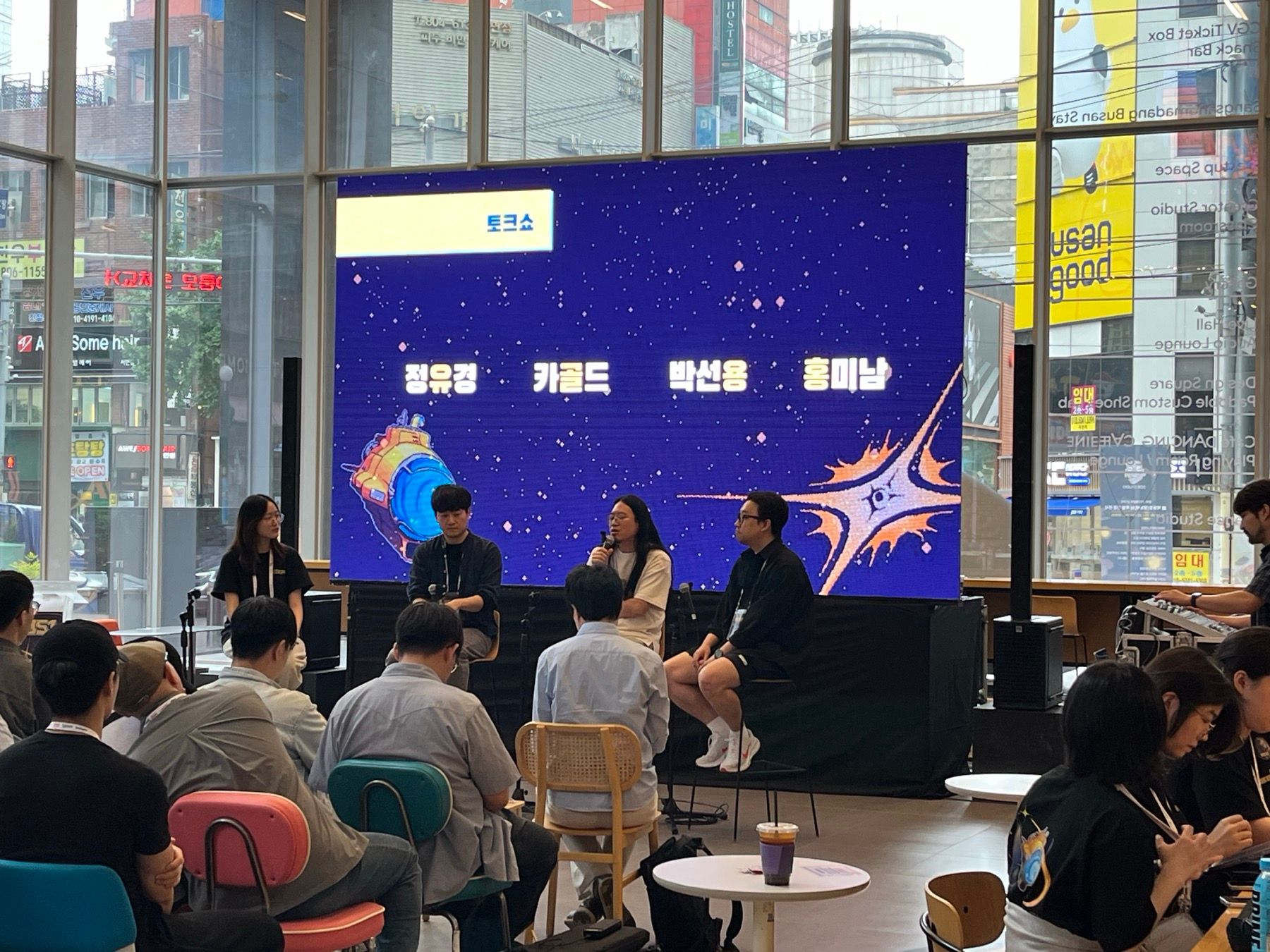
The closing panel of Part One, 'Meeting of Activists,' brought Jeong Yu-gyeong, Kagold, Park Seon-yong, and Hong Mi-nam together on one stage. On the screen behind them, a pixel spacecraft drifted through a deep navy cosmos, their four names displayed side by side. Through the glass wall, Seomyeon stretched out — a movie theater marquee, a guesthouse, a bespoke shoe shop. In the middle of that perfectly ordinary downtown, Busan's makers passed the microphone around and asked each other how they were doing. A few audience members had notebooks open on their laps, writing it all down.
Part Two: Those Who've Seen It Through to the End
After a short break, Part Two moved into postmortems from developers who had seen a game all the way to release. Following a sponsor segment from the Stove Business Division, Yeom Jeong-gyu of CircleFromDot and Kim Seon-ho of SunGames each took the stage in turn. A postmortem is not a victory lap — it is a dissection. What worked and what went wrong, where money and time hemorrhaged, laid bare in front of people walking the same road. One team's failure becomes another team's map. It is the most honest way a local scene can grow together.
Making Games, Making a Scene
Indie-Bu, which stages BUILD051, is not simply a club that puts on an event once a year. It is the connective tissue of Busan's game ecosystem, the thread running through the Busan Indie Connect Festival and Global Game Jam Busan Port. From 20 teams in its first year, the festival surpassed 40 this year. The city is home to more than 130 game studios and over 600 developers who collectively release more than 60 titles annually. A city far from the capital builds its own stage, calls in newcomers, and remembers those who have gone.
To borrow the title of Park Seon-yong's talk, making games and making a scene are two different things. You can make a game alone; a scene you cannot. Someone rents the venue. Someone carries the chairs. Someone calls out a departed colleague's name first. What was on display today, on this basketball court, was unmistakably the latter.
June 26 is the day for exhibitions and direct feedback. Developers stand right beside their games to explain them, and the audience picks up a controller on the spot. If you want to see with your own eyes what Busan is building right now, head to Sangsangmadang. Both days are free.
This article was automatically translated from the Korean original by AI. For the authoritative version, read it in Korean.
한국어 원문 읽기 →