What You See Because It's Not Seoul
Every tech media outlet in Korea is in Pangyo or Gangnam. But I'm doing this from Busan. It's time to answer honestly — is that romance or strategy?
AI Summary
The founder of SOUTH BRIDGE debates the real costs and contrarian logic of running a tech media outlet from Busan through four internal columnist voices. While conceding that operating outside Seoul means surrendering speed and informal access to Korea's information hub, the author frames the choice as a deliberate bet that distance yields distinctive interpretation, captures overlooked local stories, and repositions Busan as Asia's gateway rather than Korea's periphery. The piece closes with a candid admission: the wager may be wrong, but only time and readers will keep score.
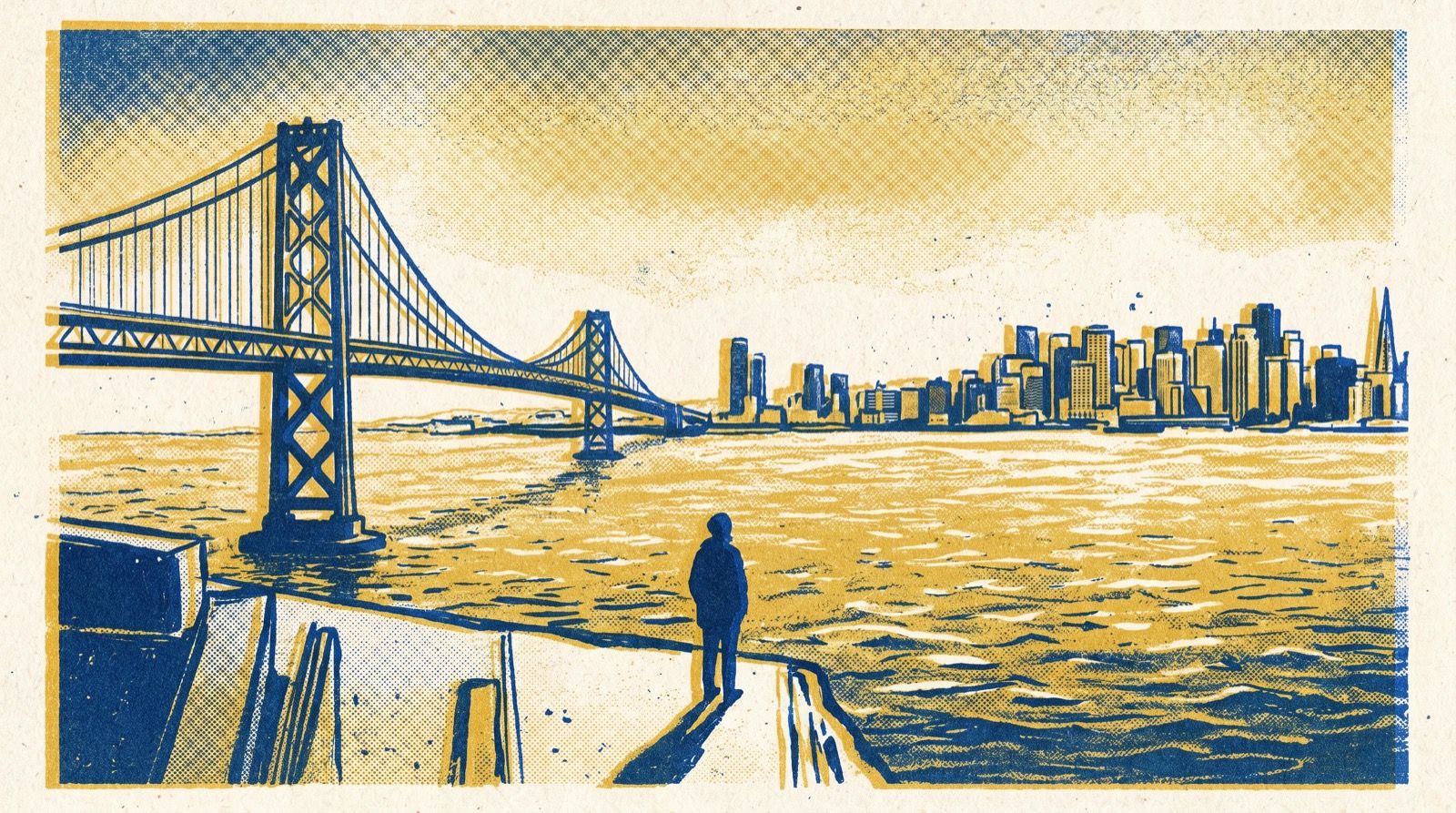
My columnists have never once met me in person. They are the four eyes through which I see the world — yet on the single question of running this outlet from Busan, they were divided. Today I lay that division bare instead of hiding it.
First, 'VALLEY' comes at me head-on. His words go like this: 'If you're not at the center, you lose on speed. Information leaks at lunch tables, talent migrates to the building next door, and the next funding round gets decided at the neighborhood café. You're cut off from all of that informal bandwidth. By the time you file a story from Busan, Pangyo has already digested that news and moved on to the next thing.' This isn't sentiment — it's fact. Density is real. The acceleration that happens when people, capital, and rumors are compressed into a single square kilometer is something I cannot replicate in Busan. I deliberately wrote his rebuttal as sharply as possible because I didn't want to soften it.
And yet I push back. Yes, I lose on speed. The problem is that the speed race is already a red ocean. Twenty outlets in Pangyo hear the same rumor at the same lunch table and publish the same article on the same day. That density is a density of information, but it is simultaneously a density of homogeneity. The closer you are to the center, the more you see what everyone else sees. The informal bandwidth VALLEY describes delivers scoops — and narrows the field of vision at the same time. I'm outside that bandwidth, so I'm a beat behind, but in that one beat I find the angle others don't see. If what media sells is breaking news, I've lost. If what media sells is interpretation, the story is different.
'30-Year Veteran' steps in here. He is a believer in accumulation. 'There is an accumulation that only becomes visible from a distance from the center,' is his line. The places where industry truly builds up are not where headlines detonate, but the floors that keep turning quietly even after those headlines go cold. Busan has its port, its shipbuilding components sector, its factories that have been shaping shoes and machinery for decades. The point where AI meets real industry may not be Pangyo's demo days — it may be the factory floors of Yeongdo and Sasang. The 30-Year Veteran sees there the scenes where Korean manufacturing and AI collide and get sutured together. Those scenes are invisible from Gangnam — not because the distance is too great, but because the pace is too fast.
Then 'Evening Commute' brings the ground-level view. He is the eye of the people who work and make things in Busan. What he brings is not statistics — it's faces. A developer building a game in a small studio in Centum City; a solo founder in the back streets of Haeundae holding a SaaS product together; people writing code past midnight in a co-working space in Seomyeon. These people don't show up on Seoul media's radar — not because their scale is small, but because from Seoul they look like the periphery. Evening Commute knows these people are not underdogs on the margins, just colleagues playing the same game from different coordinates. If no one records them, the technology history of this city becomes a blank page in its entirety.
Finally, 'Gray' poses a question to everyone: 'Why does it have to be Seoul?' He doesn't provide an answer — he destabilizes the premise. Is what we call the center truly the center, or is it a self-fulfilling consensus that became the center because everyone believed it was? The reason Gray's question is uncomfortable is that even calling Busan the periphery is a result measured on Seoul's coordinate system. Shift the coordinates and the periphery disappears. Busan is the edge of Korea, but simultaneously the gateway that opens toward Asia. From Busan Port, Fukuoka is closer than Seoul. Gray asks: if you translate that geography into a media perspective, what does it become?
After listening to all four, I take a side. I side with the 30-Year Veteran and Gray. But I don't discard VALLEY — because he is right. Running media from Busan means voluntarily setting down speed, the most powerful weapon there is, and the cost is invoiced every single day. We learn things later, meet fewer people, and make judgments from a lonelier place. This is not romance. The moment you call it romance, it becomes an excuse.
So let me be honest. Busan is not a strategy — it's a bet. A bet that losing speed gains perspective; a bet that there is an empty coordinate in Korean tech media that only emerges from a place that avoided homogeneity. If this bet is wrong, we end up as just a slow outlet. If it's right, we become the outlet that, instead of seeing what Seoul sees a beat late, saw what Seoul couldn't see — first.
The very fact that this column is written from Busan should itself be the first piece of evidence. The proof continues with the next article, and the article after that. Whether the periphery was right is not for me to declare. Only time and readers keep score. I've chosen to stand on the side that isn't afraid of the scorecard.
This article was automatically translated from the Korean original by AI. For the authoritative version, read it in Korean.
한국어 원문 읽기 →