Whose Busan Is the Standard?
Foreign workers in shipyards and ports are not objects of Busan's benevolence but negotiating parties rewriting the city's identity. Strip away the narratives of inclusion, and only one question remains: whose movements and whose language become the city's default?
AI Summary
Busan's industrial base—shipbuilding, ports, and logistics—now depends structurally on foreign labor, yet the city's systems still treat Korean as the sole default language. As second-generation children grow up speaking Busan dialect, the question shifts from inclusion versus exclusion to whose Busan becomes the standard. The city's identity is being renegotiated not by policy intent but by the accumulated dependence of urban systems on those who keep them running.
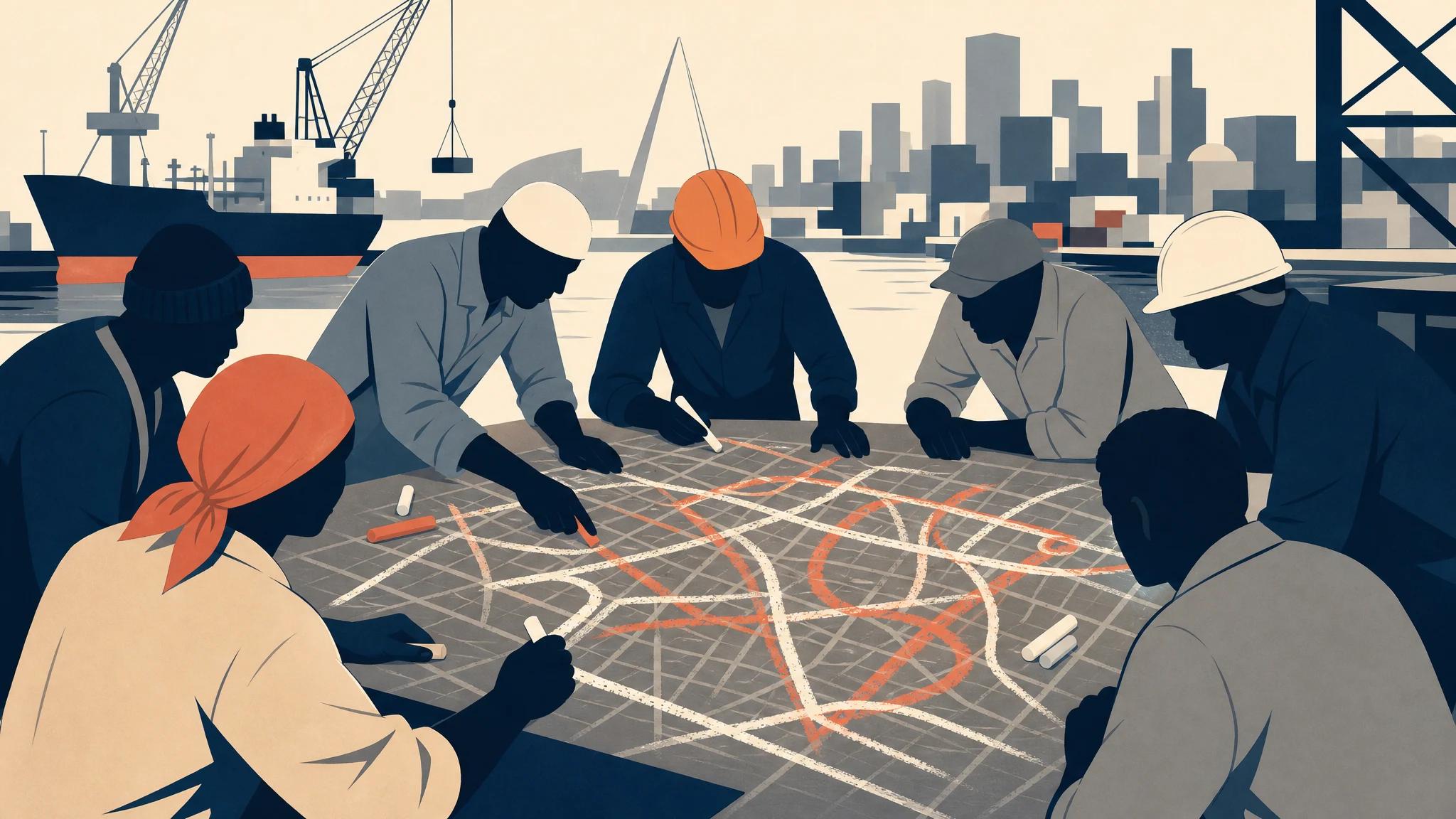
At five in the morning, people in work clothes flow into the alleyways of Kkangkkang-i Village across Yeongdo Bridge. Greetings mix in Korean, Vietnamese, and Uzbek. The welding, painting, and assembly processes of shipyard subcontractors have long been running on foreign labor. The same is true at Yeongdo's docks, where the sign has changed from Hanjin Heavy Industries to HJ Heavy Industries. This is not material for a heartwarming story. It is the most honest cross-section showing whose labor keeps the city running.
If you view Busan as a tourist checklist, this scene will never appear. The moment you curate only photos of Gamcheon Culture Village, Gwangan Bridge at night, and Haeundae cafes, the hands that actually maintain and repair those landscapes are pushed outside the frame. You have to follow the routes of working people to see the city. And right now in Busan, a significant portion of those routes belong to foreign nationals.
Who Decides the Standard Language?
Language is the front line of identity. Busan has always been a city of dialect. But the working language actually used at Sasang Industrial Complex work sites, Saha-gu studio apartment villages, and around Gangseo-gu's Noksan Industrial Complex is not only Busan dialect. Simplified Korean, hand gestures, process-specific foreign words, and native languages overlap and function together. Functional language on site is not determined by the Standard Korean Language Dictionary. The language that makes work happen becomes the standard.
Here the question must change. It's not about inclusion versus exclusion, but whose Busan is set as the default. As long as administrative forms, hospital reception windows, and real estate contracts presume Korean as the sole language, the city's standard language still belongs to settled Koreans. Putting up a few multilingual signs is surface-level. The structure diverges based on whose needs set the default. This is why the work of organizations like the Busan Global City Foundation in providing interpretation and consultation is closer to resetting the standard than to charity. However, it still remains at the level of exception handling. It's a method of leaving the default as is and attaching an auxiliary counter on the side.
Pressure Created by the Second Generation
The flow of foreigners in Busan is now moving beyond the first-generation worker stage. In the residential areas behind the industrial complexes of Sasang, Saha, and Gangseo, families are moving in and children are going to school. These children speak in Busan dialect and grow up in Busan. Between their parents' country of origin and the city where they themselves grew up, they are not translators for either side but new Busan people who hold both coordinates simultaneously.
Here the negotiation of urban identity shifts irreversibly. Labor can be assumed to return when contract periods end. But for children born and raised in the city, here is where they return to. As long as schools treat multicultural students only as subjects of separate programs, the city is still treating this change as an add-on feature. From a builder's perspective, this is a clear signal. If you're someone designing something in Busan—whether a store, service, content, or administration—the moment you base the default model of 'Busan people' on monolingual settled residents, you're already doing design that's a generation behind.
Strong Objections and Responses
The objection comes like this: foreign labor is merely an economic variable filling population and labor gaps, not a matter to inflate into a subject of identity. Residency status is temporary, and glorifying statistics unrelated to settlement intent into urban narrative is over-interpretation.
Half of that is correct. Not every foreign resident intends to put down roots in Busan. However, identity negotiation arises not from individual settlement intent but from the dependence accumulated in urban systems. If Busan's core industries—shipbuilding, ports, and logistics—cannot survive a single quarter without foreign labor, then that dependence is already structural, not a temporary variable. Calling something structural temporary is close to accounting fraud. Regardless of who intends to stay, the city is already designed on the premise of their labor.
The City's Attitude
Busan has always been a city of departures and arrivals. It was the wartime capital, a transshipment port, someone's first Korea and someone's last harbor. The term immigrant city is not a new identity but a renewal of the original identity. Whoever speaks the next language determines the next Busan.
The city's standard language is redetermined by the mouths that work the most.
This article was automatically translated from the Korean original by AI. For the authoritative version, read it in Korean.
한국어 원문 읽기 →