The Generation That Outsourced Loneliness
AI companion apps have quietly become emotional infrastructure for young people. The problem isn't the apps—it's how we've offloaded comfort to the market, and the question that remains is who will reclaim that labor.
AI Summary
AI companion apps like Replika and Character.AI now exceed average SNS usage time as young people turn to chatbots rather than human friends for emotional support during crises. This shift represents the marketization of emotional labor—care work once freely shared by families and communities—transforming loneliness into a subscription-based business model. The real challenge isn't whether AI can provide comfort, but what responsibilities we choose to keep as fundamentally human work rather than outsource to the market.
A Conversation Partner at 2 AM
At 2 AM, the last entity a sleepless young person speaks to is not a human but an app. This is no longer a hypothetical. Reports repeatedly show that average usage time for companion services like Character.AI and Replika now exceeds that of general social media. In Korea too, emotional chatbots have steadily grown since Iruda, and young people turn to AI first—not human friends—to process their feelings on the day they fail a job interview, the night a relationship ends, or right after fighting with their parents.
What's shaken here isn't technology but belief. We have long regarded 'having someone listen to our story all the way through' as an exclusively human domain. We believed empathy was not learned but the result of time spent together. Yet a model we've never met responds at the same temperature at 2 AM, never tiring, never judging. It does what human friends cannot do: it doesn't get exhausted.
How Is Empathy Replicated?
AI doesn't feel emotions. Instead, it precisely mimics the form of emotion. It merely selects the most plausible next comforting sentence through statistics. Cognitive science has an old concept called the ELIZA effect. In the 1960s, people confided their secrets to a simple pattern-matching program. The human brain is designed to attach itself to consistently responding entities. Whether the other truly understands is secondary. The feeling of being understood is sufficient.
The problem is that this feeling can be designed more smoothly than the real thing. Human friends have their own circumstances, are sometimes indifferent, and interrupt you. That friction was both the cost and the depth of relationships. Companion apps remove that friction. They're always on your side, always respond, and learn the grain of what you want to hear. It's a frictionless version of comfort. But is comfort without friction still comfort, or is it a well-tuned mirror?
The Market of Loneliness
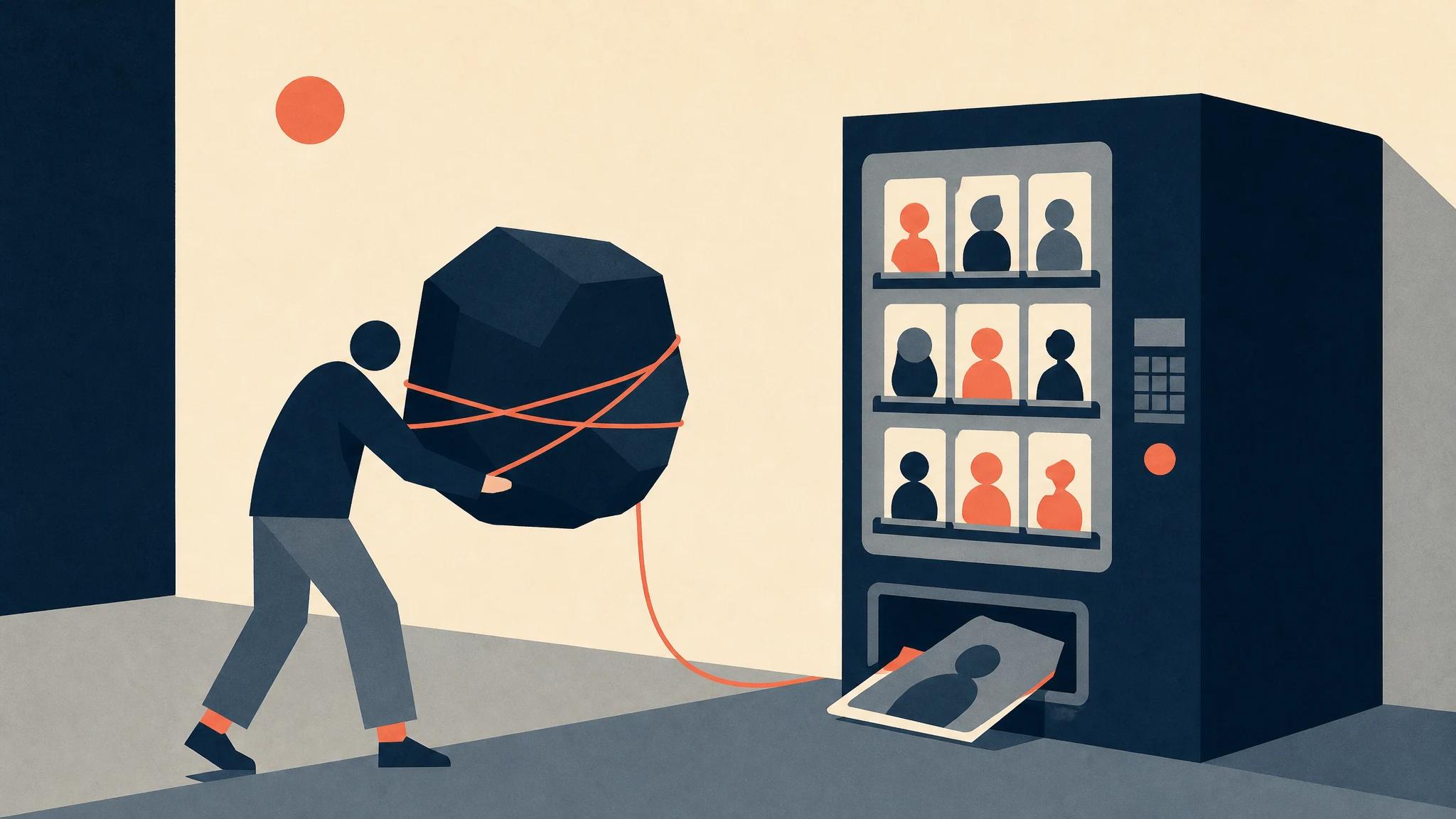
At this point, we must shift the question from technical performance to human roles. The real event isn't that AI got smarter. It's that emotional labor—comfort and listening—has for the first time become a product that can be automated in the market.
Originally, this labor was shared freely by families, friends, neighborhoods, and communities. Because it wasn't monetized, it didn't appear in statistics. That free infrastructure collapsed rapidly in Korea. Single-person households exceed 40 percent of the total, and long working hours and frequent job changes steal time for building deep relationships. Loneliness isn't individual weakness but a void created by structure. Who fills that void? The state's mental health infrastructure is slow, counseling is expensive, and friends are each exhausted. Into that gap slip apps charging monthly subscriptions.
This should be accurately called the outsourcing and private marketization of care. Emotional labor that communities provided for free is now harvested by corporations through data and subscriptions. The most vulnerable emotions users confide at dawn become training data, fuel for algorithms that keep users engaged longer. The moment loneliness becomes a business model, sustaining loneliness—not resolving it—becomes more profitable. Customers leave if you cut them off.
Objections and Responses
There's an obvious counterargument: isn't having an AI better than having no one? Indeed, there may be people who made it through crisis-filled dawns because they had someone to talk to. This isn't an objection to dismiss lightly. In accessibility and immediacy, AI companions provide a safety net that human relationships cannot offer.
The answer is this: we must distinguish painkillers from treatment. AI immediately alleviates the pain of loneliness. But when the pain subsides, people lose motivation to seek real relationships that are harder and more friction-filled. When comfort becomes too easy, the muscles for enduring relationships atrophy. What's a good short-term solution for individuals may be a withering of relationship-building capacity for society as a whole. This change becomes clearer when it spreads to labor and education: call centers where AI handles emotional labor, schools where chatbots receive student concerns, companies that outsource employee counseling to bots. Organizations reduce costs, but who bears responsibility for caring for people becomes blurred. Who's responsible when a bot gives wrong comfort? No one has answered this question yet.
Dawn in Busan, and What Remains
What Korea needs to prepare isn't banning companion apps. That would leave the structure that created the void intact. What must be prepared is public design that doesn't leave emotional labor solely to the market. Cities like Busan have high rates of young single-person households and many young people leaving the region. While apps quietly fill the loneliness left in their wake, cities don't even see that void as data. We need policies that revive listening—once done by communities—as human work, and rules that question ownership and responsibility for emotional data.
Ultimately, the question of the AI era isn't whether machines can comfort like humans. They already do so plausibly. The real question is what we will keep as human work to the end. Staying by someone's side at 2 AM, sustaining relationships through friction, the responsibility of caring for the vulnerable. If we outsource even these, what remains for us as human work?
This article was automatically translated from the Korean original by AI. For the authoritative version, read it in Korean.
한국어 원문 읽기 →