Empty Exhibition Halls, Sold-Out Pride
When Busan's art museums and biennales operate as devices selling social proof rather than appreciation, into whose pockets does the public art budget flow? The city's discernment as seen from the workflow of those who build.
AI Summary
Busan's art institutions increasingly prioritize Instagram-friendly installations over contemplative works, driven by visitor count metrics that justify public funding. This creates a skewed incentive system where budgets flow toward photogenic spectacles rather than supporting local artists, while exhibition spaces sell proof of attendance rather than meaningful artistic experiences. The article argues builders and planners must design for both photo moments and sustained engagement, measuring success through repeat visits rather than mere foot traffic.
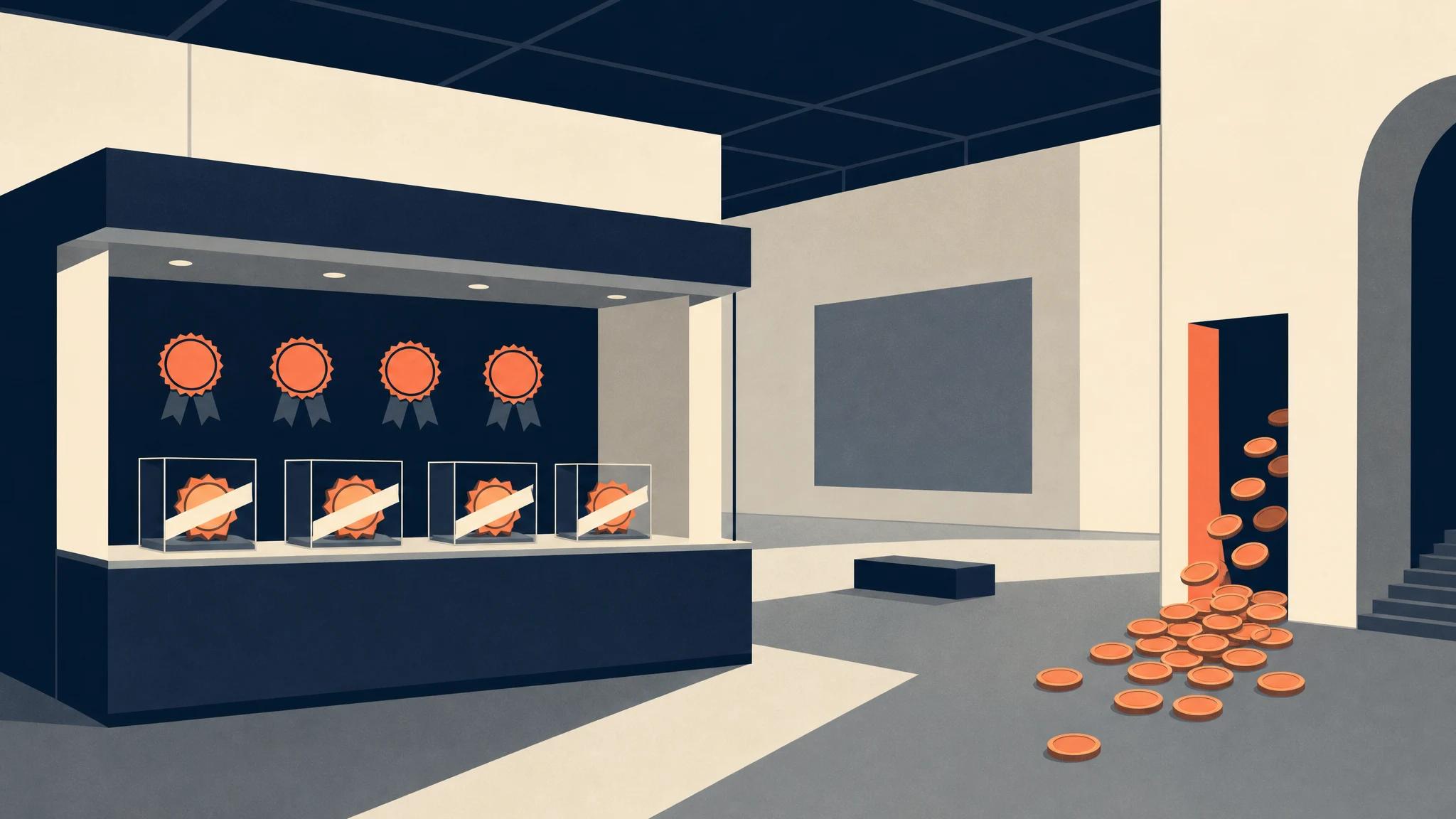
Two o'clock on a weekday afternoon, in an exhibition room at F1963. Three people stand before an artwork, but two have their backs turned. With their backs to the piece, they position it as a backdrop, extend their arms, and adjust the angle. When the shutter clicks, they move to the next room. Time spent viewing the artwork: fifteen seconds at most. Time spent holding the camera: twice that. The circulation route the curator spent three months designing becomes, in practice, a pilgrimage toward the single wall that photographs best in wide-angle.
Blame this scene on lazy visitors and you see nothing. The perspective that reads a city only as a tourist checklist stops right there. Been to F1963, snapped Busan Museum of Modern Art, saw Dadaepo Light Festival. Check off the list and believe you've consumed the city. But from the maker's position, the question changes. What commodity is really being traded here? The answer isn't the artwork. It's the image of me standing before the artwork.
Proof Replaces Appreciation
Exhibitions originally sold two things at once: the experience of encountering the work, and the fact of having had that experience. Before Instagram, these two were one body. Only those who saw could say they saw. Now they've split. Creating the signal that you saw no longer requires appreciation. Enter, photograph, tag—proof complete. This is why exhibition halls sell out even when empty. What people buy isn't the admission ticket but the alibi of having entered.
It's no coincidence that Busan Biennale has increased SNS-friendly installation works with each iteration. Giant mirrors, light-flooded rooms, immersive spaces with strong colors. Such works often receive criticism for being critically weak, but operational metrics rise honestly. From the museum's standpoint, it's a rational choice. Visitor numbers are the language that justifies budgets. The problem is what those numbers count. People who viewed the work, or people who passed in front of it?
Budgets Feed on Numbers, Numbers Feed on Photos
Public art budgets are measured by performance. The easiest proxy indicators for that performance are visitor numbers and online reach. This creates a distorted circuit. To secure budgets you need numbers, to fill numbers you need photogenic works, and then budgets come again. Within this circuit, what receives the least reward are works requiring quiet, prolonged viewing. Works that can't deliver one powerful shot within ten seconds lose the competition for the same wall space.
Let's trace the real beneficiaries. The common answer is artists, but that's only half right. In the proof-shot economy, the biggest earners are the minority of artists who design photogenic spectacles, the operating entities selling cafes and goods alongside them, and the administrators who claim visitor numbers as their achievements. Meanwhile, the majority of Busan artists continuing unsellable work in peripheral studios remain outside this circuit. While small studios in Yeongdo and Suyeong alleys are pushed out by rent, budgets flow toward the most photogenic walls. What's called arts promotion actually operates as backdrop promotion.
A counterargument is possible. Don't proof shots at least drag people to the museum door? True. As bait lowering entry barriers, spectacle has a clear function. But bait and main course must be distinguished. Is there design that makes people who came to photograph come back next time to look, or do they just switch to the next hot place? That Busan Museum of Modern Art draws crowds despite its remote Eulsukdo location proves the bait works. But whether those people return a second time is a different question, and current metrics don't ask it.
Seeing Again Through the Builder's Eye
The discernment builders should maintain here is clear. First, when creating spaces, design for two separate timeframes. Time for photographing and time for dwelling require different circulation routes. Too many spaces in Busan try to capture both and lose both. Next, when counting performance, insert at least one metric that measures dwell time and return visits rather than reach. Values not measured disappear straight from the budget circuit. Finally, consciously separate bait and main course in placement. Without a pathway where the entrance's one shot leads people to slower works inside, that space isn't a museum—it's a photo zone.
That exhibition halls sell out while remaining empty isn't failure but signal. A signal that the city has learned to sell experience converted into proof. Busan is becoming skilled at this transaction, and therefore more precarious. A city that photographs well and a city you want to see again are not the same. If you're a builder, you must choose the latter. Photos end in ten seconds, but discernment is built on the second visit.
This article was automatically translated from the Korean original by AI. For the authoritative version, read it in Korean.
한국어 원문 읽기 →