When Long-Standing Shops Become Raw Material
Busan's old shops and markets were once living spaces for people. Now the camera arrives first. As locality shifts from identity to a mineable resource, what are the people who work there giving up?
AI Summary
This article examines how Busan's traditional shops (nopos) and neighborhoods are being extracted as visual content rather than preserved as functioning ecosystems. While cameras capture the aesthetic textures of old markets and alleys for branding and media, the actual livelihoods and community functions of these spaces receive little benefit and face displacement through rising rents. The author argues builders and creators must design systems that return value to these communities, not just extract their imagery.
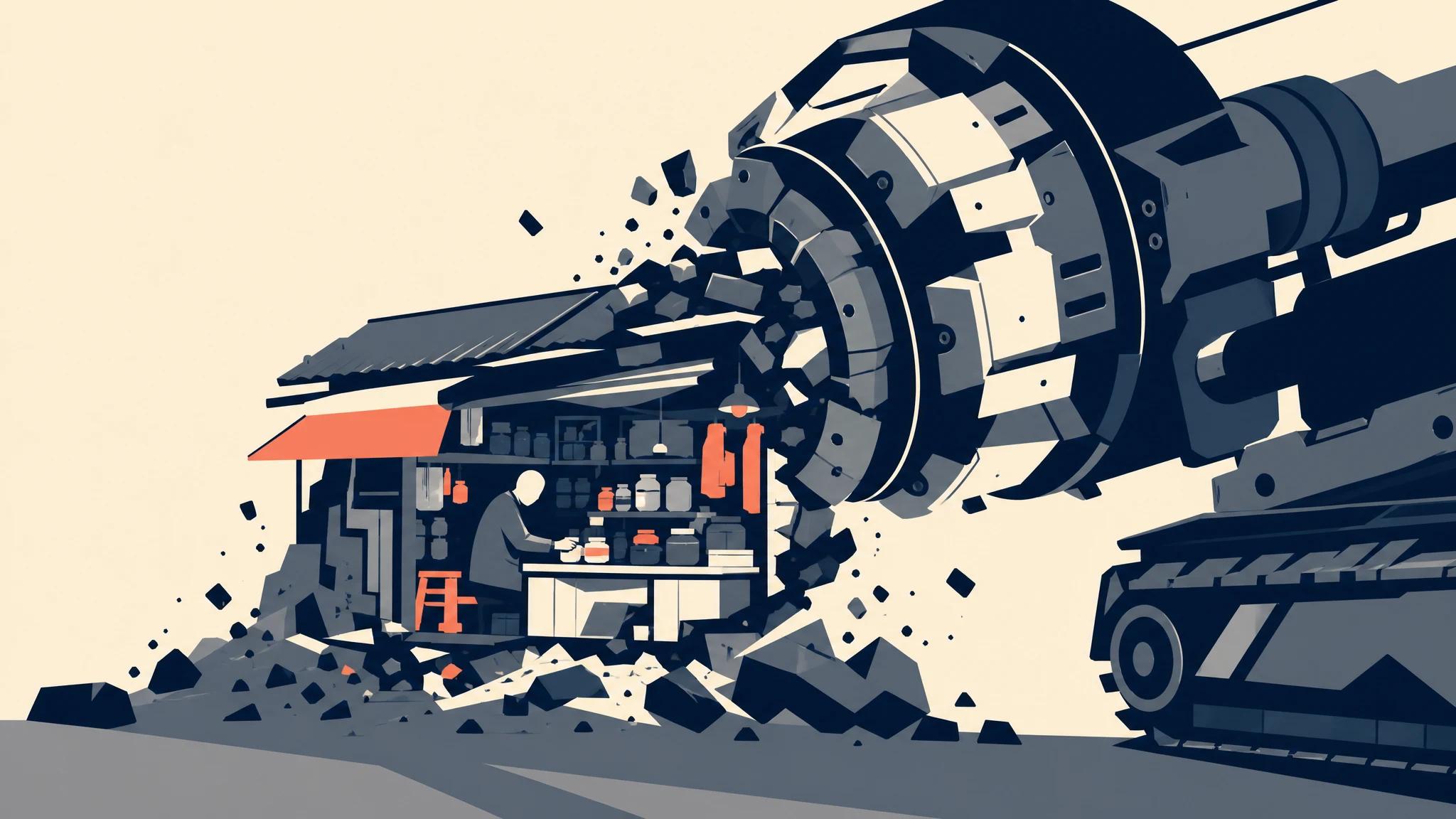
At 5:30 a.m., the inner passageways of Busanjin Market still have their shutters half-down. A fabric shop owner loads rolls onto a handcart and makes a sharp right turn into the narrow corridor. The wheels catch and release from a crack in the floor tiles. The angle of those wrists, the width of the passage, the height of the shutters—these are the results of this person's body being worn down to fit the market over 30 years. Two hours later, a film crew with tripods enters the same corridor. They're trying to capture exactly the same scene. Except to them, it's not a route—it's a shot.
The difference between these two is everything I want to say today.
Who Discovered the Nopo?
The statement that nopos have become content is only half true. Nopos haven't been discovered—they've begun to be extracted. If discovery is recognizing what was already there, extraction is selecting what can be taken away from it.
Think about where Busan's video production and local branding have turned in recent years: the stairs of Yeongju-dong's hillside roads, the night market lights of Bupyeong Kkangtong Market, old Chinese restaurants in Choryang, the ironworks alleys around Beomil-dong. Every one is thick with atmosphere and worn by human touch. The camera wants precisely that wear. New things exist everywhere, but time cannot be replicated. So time becomes the most expensive raw material.
This is where perspectives diverge. To someone viewing the city as a tourist checklist, a nopo is an item under 'must-visit places.' It's a coordinate where consumption ends once you've been there. But from the perspective of a working person's route, a nopo isn't a coordinate—it's a system. An ecosystem where dawn auctions and wholesalers' schedules, regulars' credit ledgers, and mutual aid with neighboring shops all turn together as one mass. Content skims off only the most photogenic surface from this ecosystem. Skimming the surface isn't theft. The problem is that only the surface gets traded while not a penny flows to the system beneath.
What Can Be Extracted and What Cannot
Let's push the raw material metaphor all the way. When ore is mined from a mine, a refinery processes it and the market sets its price. For nopos, the mine is the alley, the refinery is the editing timeline, and the market is the feed. But unlike minerals, people live attached to the nopo's raw material.
What gets extracted is visual texture: faded signboard lettering, handwritten menus, the weathered face of a longtime owner, steam rising from a soup pot. What doesn't get extracted is the function that shop has performed in the neighborhood. The role an old shop in Yeongdo played for 40 years—feeding the neighborhood elderly their lunch and checking in on solitary regulars—doesn't fit in the frame. Even when captured, it's not valued. Feeds are generous with texture but indifferent to function.
| What is extracted | What is not extracted | |
|---|---|---|
| Content | Visual texture | Function in the neighborhood |
| Example | Faded signboards, handwritten menu boards, large pots | Elderly lunches, checking in on regular customers |
| Feed's attitude | Generous | Indifferent |
This asymmetry is dangerous. When people flock to a nopo that's gone viral as content, rent signals respond first. Busan is no exception. Looking at the paths walked by Jeonpo-dong Cafe Street, Haeridan-gil, and Huinnyeoul Culture Village, the pattern is clear. Cameras that came to shoot the real thing make the real thing expensive, and the expensive spots push out the people who originally worked there. The source of the texture the camera loved disappears because of the camera. That old logic of extraction industries exhausting their veins repeats itself in the alleys.
Here's the discernment builders need. If you're making something with the local as your material, are you a discoverer or an excavator? The standard that separates the two isn't intention but the direction of flow. If value only flows out of the alley, it's excavation; if even some of it flows back in, it's discovery.
Designing the Return Flow
There's a counterargument. Isn't the criticism of extraction ultimately a rejection of change itself, just nostalgia? There are definitely shops that became content, saw increased sales, and avoided closure. If a Busanjin Market fabric merchant receives orders from across the country thanks to SNS, that's a clear benefit. That's true. The issue isn't whether it's extraction or not, but the design of the extraction.
Design splits at the details. A video that uses a close-up of an owner's face while omitting the shop's business information, versus a video that uses the same face but also shows the ordering process and regular customer reviews—these aren't the same extraction. The former takes only the texture; the latter transports the function alongside it. The same goes for local branding. There are no shortage of projects in Busan that borrow a neighborhood's name for a brand while sharing not a single line with that neighborhood's merchant association. Names are easy to take, but the design that returns the name's value doesn't emerge unless deliberately created.
So the question makers need to ask boils down to one: When this content takes a nopo's texture, what does it leave for the nopo's function? Does it actually send one customer? Does it lend a hand once? Does it add even a handful of reason for the next generation to keep working in that place? If the answer is no to all of these, you're not building the city—you're mining it.
A nopo isn't a backdrop—it's a workplace where someone still commutes today. Before you film the city, go live one dawn in the life of the people who work there.
This article was automatically translated from the Korean original by AI. For the authoritative version, read it in Korean.
한국어 원문 읽기 →