Who Deleted the Comments?
While we view freedom of expression solely through the lens of censorship, real power has shifted to 'what will be made visible.' AI moderation and opaque algorithms are quietly redesigning South Korea's public discourse.
AI Summary
South Korea's online public sphere is being reshaped by AI moderation and non-transparent algorithms that don't delete content but make it invisible by controlling reach and exposure. While automated moderation is necessary for blocking harmful content, the lack of transparency in how platforms demote posts—and the absence of appeal mechanisms—creates a new threat to freedom of expression. The article argues Korea needs rules requiring platforms to notify users of reach restrictions, mandate human appeals processes, and publicly report moderation decisions.
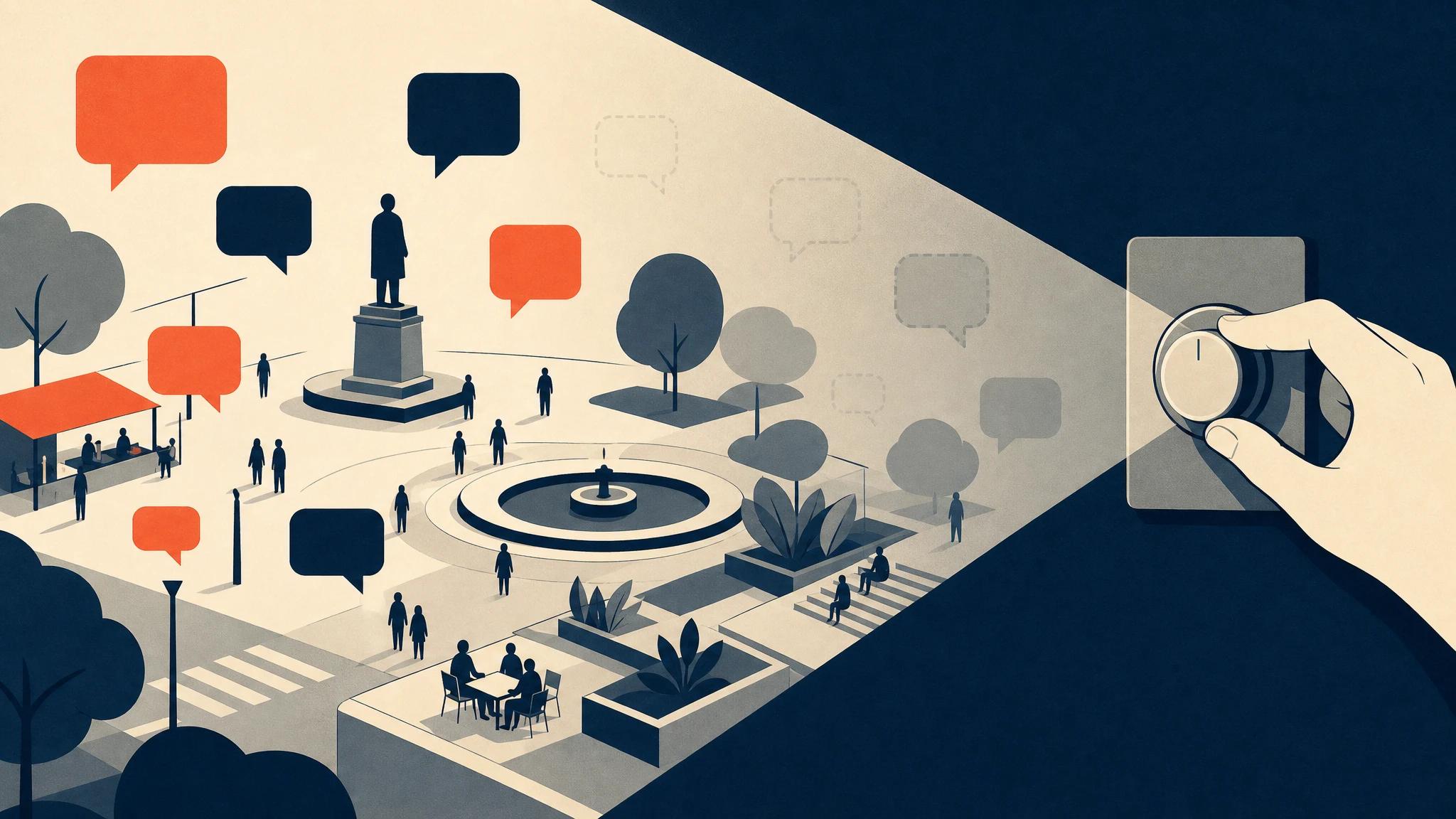
A comment section disappeared from a forum. The operator wrote "healthy discussion environment." Nobody was dragged away, and no sentences were crossed out in red. The space simply ceased to exist. It feels awkward to call this censorship. That's what makes it more dangerous.
We have long learned freedom of expression as the opposite of censorship. If someone silences you, it's a violation of freedom; if not, it's freedom. In this framework, a hand is visible. The state gripping your wrist, the operator pressing the delete button.
But in what's happening in today's public discourse, that hand is invisible. Posts go up. They're not deleted. They just don't reach anyone. Zero exposure, excluded from recommended feeds, not displayed in related posts. Content that is alive but invisible is produced every day.
Here, Prism's question is singular: The core cost of freedom of expression has already shifted from 'can you speak' to 'can you reach,' yet aren't our laws and sensibilities still stuck on the former?
This happened in the name of efficiency. Hate speech, spam, illegal footage, flooding. Humans can't block everything manually. AI moderation classifies thousands of cases per second. In fact, this automation has saved people in blocking profanity and digital sex crimes. We must acknowledge this before proceeding.
The problem is that the same pipeline also functions as a 'reach distributor.' The weighting that determines what rises to the top and what sinks to the bottom. Those weights are not disclosed. Because they're corporate assets, to prevent abuse, trade secrets.
So South Korea's online public sphere is now closed in two ways. We don't know what's been blocked, and we know even less about what's simply been made invisible. At least for the former, statistics are released. For the latter, statistics don't exist by design.
Who bears the cost here? First, the writer doesn't know their post has sunk. They don't know whom to protest to. Algorithms don't become defendants. Appeal windows are mostly auto-responses, and the path to human reviewers is deliberately narrow.
The next cost is borne by moderation workers. Behind automated classification, there are ultimately people. Outsourced reviewers who spend all day viewing and judging the most horrific content. The class action lawsuit by Facebook moderators for post-traumatic stress showed where this labor has been outsourced. Behind the clean screen of efficiency, costs flow to the weakest contractual tier.
And citizens bear it. No one can see the whole picture of what the public square looks like. The moment we mistake our own timeline for everyone's timeline, public opinion becomes something unmeasurable. With elections approaching, this is not an abstract concern.
A common counterargument arises here. "Isn't it natural business freedom for private platforms to determine exposure in their own spaces? If you show everything, hate and spam will occupy the square." It's half right. A square without curation becomes a place where the loudest wins.
But when influence exceeds a certain scale, circumstances change. If tens of millions get their news and make political judgments there, it's not a private café but effectively public infrastructure. It's the same reason we impose rules even when private companies operate electricity and telecommunications. When scale creates power, power comes with an obligation to explain.
So Prism is not saying to stop technology. AI moderation is necessary. What we're asking about is how it operates. By whose rules is what determined to be demoted, and can the demoted party know this fact and challenge it?
The rules Korea should create can be condensed into three lines. Reach restrictions are also sanctions. Notify the parties not only of blocks but also of exposure demotions. Don't narrow but mandate appeal routes that lead to human review. Platforms above a certain scale must aggregate and disclose moderation results. What was demoted, how much, and why.
The EU has already set this direction with the Digital Services Act. Whether it's a small business community in Busan or a national portal, if invisible demotions affect business and speech, the same question applies. Who holds the weights, and is there a window to challenge them?
When comments disappear from the public square, what we lose isn't the comments. It's the state of not even being able to know what disappeared—that's the real loss. The next front line of freedom of expression is not on the delete button but on the exposure slider. Who moves that slider, by what rules. If we don't decide now, it will arrive already decided for us.
This article was automatically translated from the Korean original by AI. For the authoritative version, read it in Korean.
한국어 원문 읽기 →