When Faith Becomes Retention
Online worship services, AI-generated sermons, and prayer subscription apps make religion more convenient. But who pays the bill for that convenience? This article asks what quietly slips away from spirituality when faith communities are broken down into app monetization structures.
AI Summary
As religious practice increasingly moves to apps and online platforms, convenience comes at a cost: the erosion of community bonds, the transfer of spiritual authority to tech companies optimizing for engagement metrics, and the extraction of deeply personal prayer data. The question is not whether to use technology, but whose rules will govern it—Silicon Valley's retention formulas or the hospitality grammar faith communities have upheld for millennia.
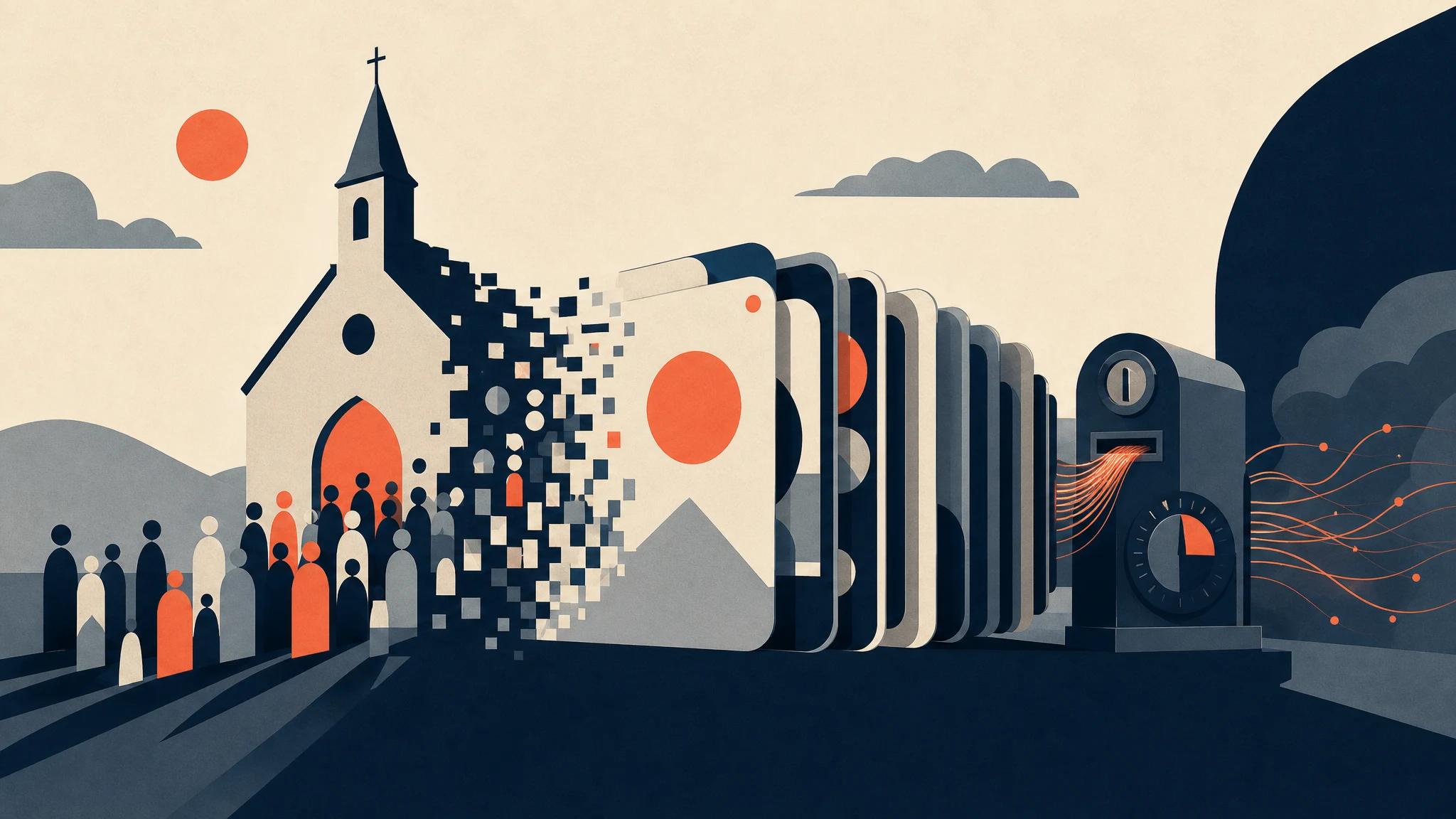
A dawn notification arrives
At five in the morning, a smartphone gently vibrates. "Begin today's prayer." On the screen, today's meditation verse appears alongside gentle music, and a badge for 7 consecutive days of prayer achievement glitters. Hallow, a prayer app made in California, has already recorded tens of millions of downloads in English-speaking countries alone, and similar meditation apps, contemplation apps, and online temple dharma talks have rapidly proliferated in Korea as well. COVID-19 forced contactless worship, and the habit formed then has not disappeared.
Everyone calls this convenience. Believers far away can participate in worship services, and elderly people with limited mobility can listen to dharma talks. When a temple in Busan streams morning prayers on YouTube, a child who has moved away leaves that screen on while preparing for work. It's a good thing. No one can dispute this part.
The problem comes next. Convenience isn't free. When there are reduced costs, there are also increased costs. The question is simple. Whose are the reduced costs, and who bears the increased costs?
When gatherings disappear, costs are not the only thing that diminishes
Physical gatherings are full of inefficiencies. You have to drive there, greet the uncomfortable person sitting next to you, and after worship someone has to arrange chairs and someone has to make soup. Apps eliminate all this friction. But there's one fact that sociology of religion has long observed: a significant portion of the core values of faith communities comes from precisely that friction.
Recall the analysis sociologist Robert Putnam made of American churches. The greatest asset religious organizations contribute to society was not doctrine but the network of connections between people—social capital. The informal network where someone brings side dishes to a sick congregant's home and introduces a job to an unemployed believer. This doesn't arise from turning on a screen. It accumulates only after passing through the inefficiency of sitting beside each other, making eye contact, and eating together.
Apps redefine faith as individual consumption. My screen, my progress, my badge. Community is pushed into background music. This is precisely what slips away from spirituality: the ability to endure together, the training to welcome uncomfortable others, the faces that recognize me. What efficiency reduced may not be just travel time but community itself.
Who holds the rules?
Here we must go one step deeper into the question. When faith becomes an app, the company that made that app comes to hold the rules of religious life.
The app's business model is honest: retention and monetization. Streaks that track how many consecutive days you've logged in, continuous records that make you feel guilty if you break them, premium content subscriptions. This design is exactly like games. It's built to optimize not the depth of faith but frequency of access. AI-generated dharma talks or personalized meditations are even more subtle. Algorithms learn the words users like to hear. The essence of faith includes words we don't want to hear, like repentance or rebuke, but systems chasing engagement metrics shave off such friction. Faith with comfort remaining and challenge disappeared—whose designed faith is that?
And then there's data. Is there any information more intimate than prayer requests? Someone's anxiety and illness, family matters, guilt are recorded on servers. Religious data is classified as sensitive information under Korea's Personal Information Protection Act and protected more strictly. Yet most believers don't know how prayer requests entered into global prayer apps using overseas servers are stored and who analyzes them. The bill for efficiency is ultimately paid with users' most private data.
There will be objections. If you don't like it, just don't use it, right? That's true, but only half true. In the flow of young people leaving churches and the average age at temples rising, apps are increasingly becoming survival tools for religious organizations. The fact that individuals can refuse and the fact that the entire religious ecosystem is becoming dependent on the design of certain platforms are problems at different levels.
So this is not a call to turn off apps
Let's not misunderstand. This isn't about stopping technology. Online worship is clearly a channel of salvation for someone. For believers far away, sick people, and the marginalized, screens become real doors. The problem is not technology itself but whose rules that technology operates under.
Better design is possible: pathways that lead to actual community gatherings instead of login streaks, content oriented toward faith maturity rather than engagement metrics, and above all, structures that keep prayer data as believers' property rather than company assets. Instead of religious organizations handing believers over wholesale to external apps, there's also the option of having their own platforms where they hold data sovereignty and operating rules themselves.
The rules Korean society must create are clear: ensure that protection levels treating religious data as sensitive information effectively reach apps using overseas servers; have civil society and religious communities jointly monitor whether the monetization and algorithmic design of religious apps harm believers' spiritual welfare; and churches and temples themselves must ask: are we gathering believers or locking in users?
The flow of faith becoming apps cannot be stopped, nor is there reason to stop it. Only one thing needs to be determined: whose rules will that app run on? Silicon Valley's retention formula, or the grammar of hospitality that faith communities have upheld for a thousand years? Technology does not provide the answer. The answer depends on what rules we use.
This article was automatically translated from the Korean original by AI. For the authoritative version, read it in Korean.
한국어 원문 읽기 →