Whose Night Is Gwangalli?
What drone shows and Instagrammification have changed is not the scenery, but ownership of the scenery. If you're a builder, you shouldn't just look at the night view—you need to see how that night view is being divided.
AI Summary
Gwangalli Beach in Busan has transformed from a shared public space into a commodified景观 where scheduled drone shows and Instagram culture have turned the night view into limited 'inventory' with invisible pricing. While this commercialization has revitalized the local economy, it pushes out everyday users—residents, runners, locals—who once enjoyed the scenery without competing for prime photo slots. Builders should look beyond saturated hotspots to find undistributed angles and times, preserving the diversity of use that keeps urban landscapes as common resources.
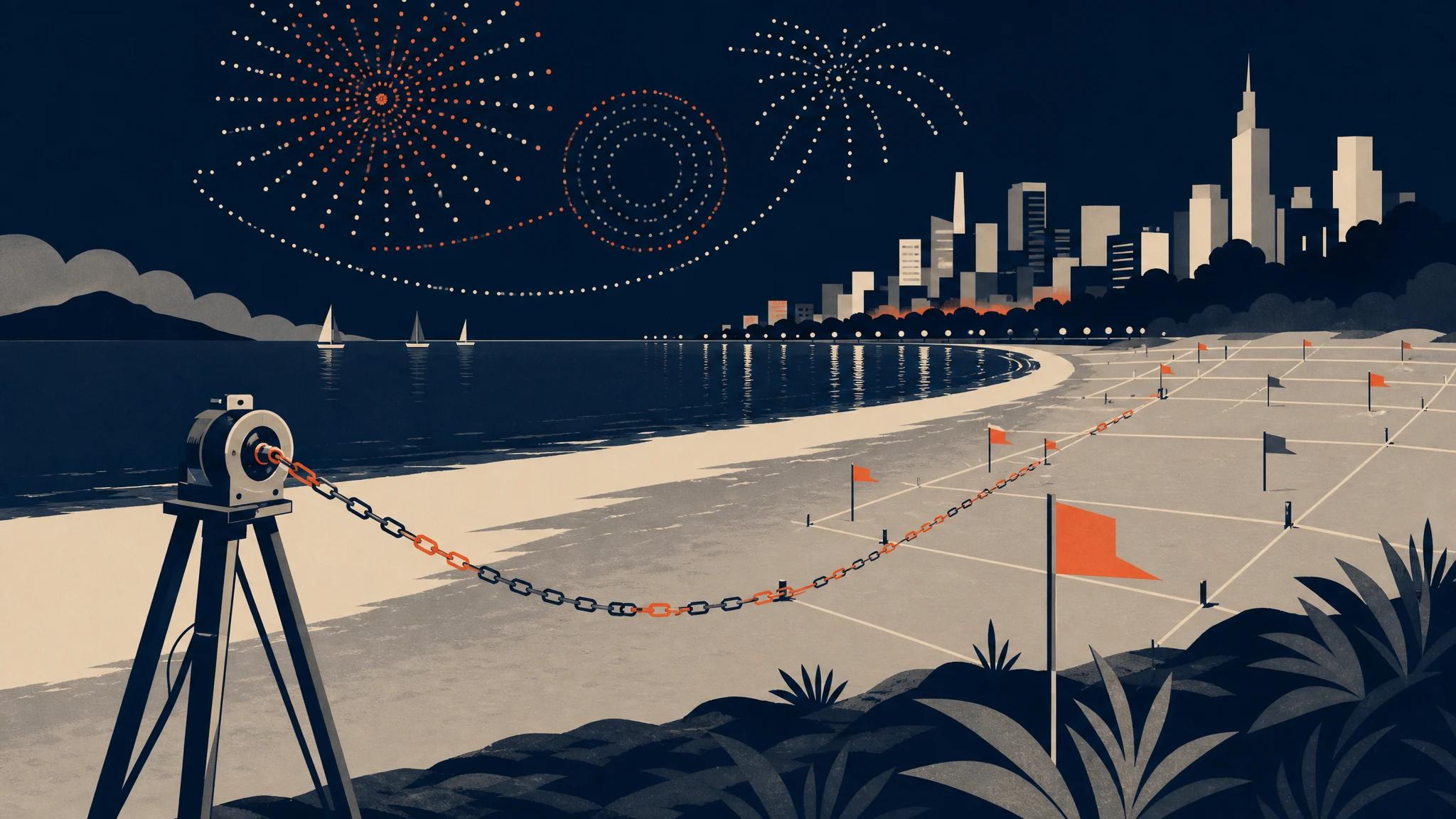
At eight-thirty at night, a line forms at the railing of Millak Waterside Park. People holding cameras toward the bridge and people with their backs turned collide in the same spot. As the Gwangan Bridge lights turn on, someone briefly shouts "Now." In that moment, dozens of phones rise at the same angle. A family gathered around a plate of raw fish, a night runner holding a tumbler, and a photographer setting up a tripod overlap in one frame. The scenery remains the same, but the ways of using that scenery are split apart.
When Scenery Becomes Slots
Gwangalli's night used to belong to no one, and so it belonged to everyone. The bridge lights stayed still, and people passed before them at their own pace. Now it's different. When the drone show launches at a set time, the entire beach transforms into an auditorium. Good spots fill up ten minutes before it starts, and the moment it ends, the crowd drains out all at once. The night has acquired a timetable.
When there's a timetable, spots acquire prices. There's no separate admission fee, but invisible charges operate. A cafe window seat with a frontal view of the bridge, a certain section of the deck where the drone swarm reflects on the water, the brief time slot when sunset and night view overlap. These are now closer to 'inventory' than 'scenery.' They're limited in quantity, have turnover rates, and whoever captures the better shot claims them first. The city's night has begun to be traded like real estate.
The question I'm asking isn't good or bad. Who does the Gwangalli night view belong to now? Is it the view outside the window of people who live there, bait product for people doing business there, or content material for people visiting once? Three parties simultaneously own the same light, each in completely different ways.
What Builders Need to See
This is the point where we diverge from the perspective that sees cities only as tourist destination lists. Eyes that pick ten hotspots and assign star ratings close Gwangalli off as 'a place to visit.' What builders really need is to understand what kind of resource this scenery operates as. Gwangalli is one of Busan's few 'validated backgrounds.' Cafes set up there, pop-ups target it, and video creators head there not because the scenery is pretty, but because that scenery has already gathered people's attention. It's land where traffic is laid down.
In that case, a builder's eye lies in seeing not the scenery itself, but the 'margins' of the scenery. Frontal bridge views are already saturated. Spots where everyone takes the same shot are, paradoxically, the least differentiable spots. Rather, spots one block into the alley with your back to the bridge, after ten at night when the drone show ends and crowds have left, the routes not of spectators but of people heading home after finishing work—these still have undistributed views. When others fight over slots, a builder's job is to make their own the times and angles that can't become slots.
Protecting Common Resources Ultimately Comes Down to Routes
The counterargument is clear. Thanks to becoming a hotspot, Gwangalli's commercial district revived, drone shows lifted off-season tourism, and a single photo spread the city nationwide. That's correct. The real-estatification of content made money flow. However, real estate has the property of pushing out tenants. When scenery becomes expensive, the space for people who used to just look at that scenery every day shrinks first. Locals who viewed the bridge lights without lining up, runners who ran the empty beach on weekday dawns, young people who drank canned beer with friends without being conscious of spot value—their night gets pushed to the edges of filming slots.
The path to protecting urban landscape as common resources begins not with grandiose ordinances but with preserving diversity of routes. When only one timetable, one prime spot, one usage method remains, scenery becomes homogenized into content. Only when multiple speeds and multiple angles coexist can that night become everyone's again.
Good scenery isn't where more photos are taken, but where it's used in more ways.
This article was automatically translated from the Korean original by AI. For the authoritative version, read it in Korean.
한국어 원문 읽기 →