The Infinite Boredom of Infinite Generation
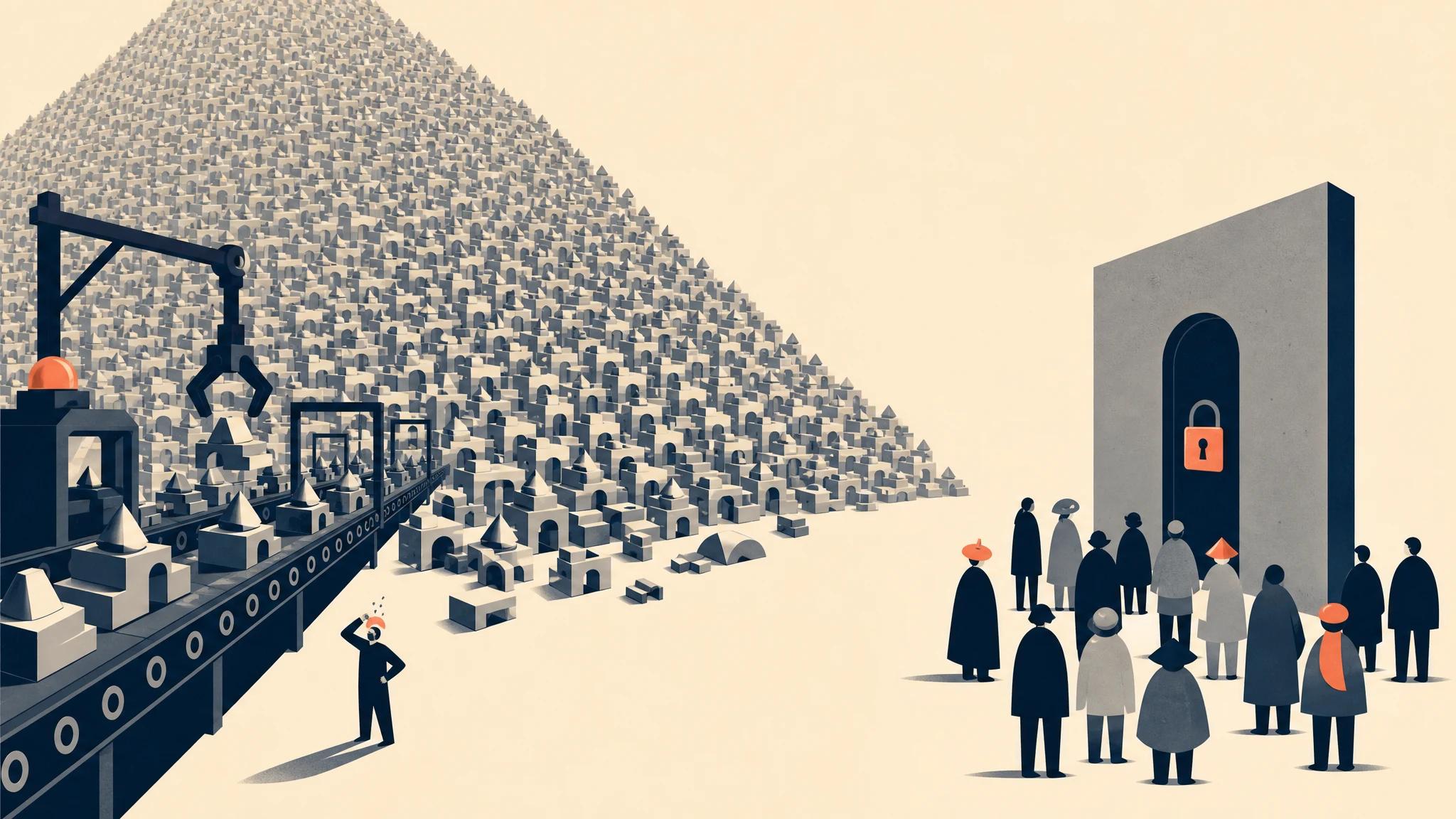
Playing the new titles that use AI to churn out endless content reveals a paradox: the more that's generated, the less fun it becomes. Fun doesn't come from the volume of what's created — it comes from the walls that block your way.
AI Summary
Games that use AI to generate infinite content eliminate the friction and designed resistance that make play meaningful, leaving players indifferent rather than engaged. Titles like AI Dungeon demonstrate that when a game can never say 'No,' the player's victories and choices become equally weightless. For Korean indie developers especially, the lesson is to use AI as a behind-the-scenes efficiency tool while keeping human-designed constraints at the forefront — because fun begins not with abundance, but with limitation.
The Problem With a Dungeon That Never Ends
I spent an hour with a new release that promised AI-generated dungeons without end. Every room I left spawned a new one; enemies had different names and appearances each time; treasure descriptions never repeated. On paper, this game has more content than any handcrafted dungeon ever could. But somewhere around the fortieth room, my hands stopped. It didn't matter what came next. The guarantee of a new room was the very thing that made the new room feel worthless.
This is the point AI game criticism keeps missing. Reviews praise generative variety, dock points for awkward graphics, or convert buzz into scores. All three look at the game from the outside. From the inside, there is only one question: does the act of opening this door carry any weight?
The great roguelike dungeons aren't beloved because they're handcrafted. Hades' rooms are finite and their patterns can be learned. That's why players memorize room layouts and figure out which weapon combinations fall apart at which stages. Finitude enables learning, and learning builds mastery. Infinite generation severs the first link in that chain. With nothing to memorize, there is no mastery; without mastery, the next room is just the next room.
Where Friction Used to Be
Fun comes from friction — more precisely, from resistance that is clearly designed for the player to overcome. AI generation sands that resistance down into a smooth, featureless surface.
The AI narrative game AI Dungeon, which I played myself, is a textbook case. Type anything and the story continues. Write that you want to kill the dragon and you do; write that you want to become a god and you become one. The moment everything is possible, nothing is meaningful. A desire that is never refused is not a desire. When a game loses the ability to say 'No,' the player's 'Yes' loses its value too. Good games refuse constantly: you can't get past this wall, you don't have the resources, you die here. Those refusals accumulate into the rush of a breakthrough.
Valve's designers once observed that when you give players infinite choices, they stop choosing. Constraints are not the enemy of creativity — they are its fuel. That is why Tetris uses only seven blocks, and why Go, confined to a 19-by-19 grid, has held the human mind captive for thousands of years. Multiplying the number of possible outcomes and creating meaningful decisions are entirely different endeavors. Most AI games mistake the former for the latter.
A strong counterargument exists. Infinite generation isn't inherently boring, the argument goes — curation is just still weak. Layer a difficulty curve and reward rhythm on top of AI-generated rooms and they become as good as handcrafted ones. That's half right. But the stronger the curation, the less 'infinite' actually remains, because a well-designed curve demands finite choices and deliberate repetition. In the end, AI games that actually work are games that gave up on leading with AI. Generation retreats to the background as an invisible tool, and human-carved friction steps to the front. The moment you make infinite generation your headline feature, you've covered your fun engine with a billboard.
Intentional Refusal as Design
The best design is design that prevents you from doing things. Dark Souls' sluggish dodge, Inside's single-line controls, Outer Wilds' 22-minute time loop — all are constraints that confine the player, and those constraints are the game's identity. Refusal is not a deficiency; it is a form.
AI cannot refuse by nature. It is a machine trained to produce more, with greater variety, faster. Place AI at the heart of a game and you get a game that doesn't know how to say no. A world where every path is open and every request is granted. That isn't a game — it's a fountain. The water flows endlessly, but no one grows by swimming in it.
Let's bring Busan into this. There is a line you hear in the indie scene: we don't have the resources, so let's use AI to generate infinite content and fill up the runtime. The logic is backwards. For a small team, the real weapon isn't volume — it's a single, razor-sharp constraint. Vampire Survivors was made by one person and controls almost entirely through movement alone. That extreme refusal defined the game. What Korean indie developers should be copying isn't AI's generative power — it's the ruthlessness of that decision.
So Who Actually Makes the Fun?
In AI games, AI doesn't make the fun. The person who stands atop the pile that AI has dumped out — deciding what to block and what to keep — makes the fun. If generation is clay, fun is sculpture. An infinite supply of clay doesn't produce sculpture on its own. If anything, the more clay there is, the more decisive the sculptor's hand must be.
Here is what I want to say to the Korean indie and casual scene. Use AI as a tool for 'how much can we generate' and you arrive at infinite boredom. Use AI as a tool that buys you time to think about 'what not to show' and the result is different. Push generation into the background, put friction out front, and be willing to tell the player 'No' with conviction. Only when the next room isn't guaranteed does the hand reaching for the door finally carry any weight. That's where fun begins.
This article was automatically translated from the Korean original by AI. For the authoritative version, read it in Korean.
한국어 원문 읽기 →