The Bill Comes Every Quarter
Whether AI infrastructure investment is a bubble is the wrong question. The real question is when the fixed costs — depreciation schedules, power contracts, and GPU lifespans — land on whose income statement. In which quarter do Korea's cloud and telecom companies receive that bill?
AI Summary
The debate over whether AI infrastructure spending is a bubble misses the point: the real issue is when deferred fixed costs — extended GPU depreciation schedules and rigid long-term power contracts — will finally hit earnings. Big tech has been buying time by stretching depreciation periods, but rapid GPU obsolescence and inflexible power agreements mean impairment losses will eventually concentrate in specific quarters. Korean cloud providers and telecoms face the same structural exposure but with weaker bargaining power and higher costs, leaving them most vulnerable when the bill arrives.
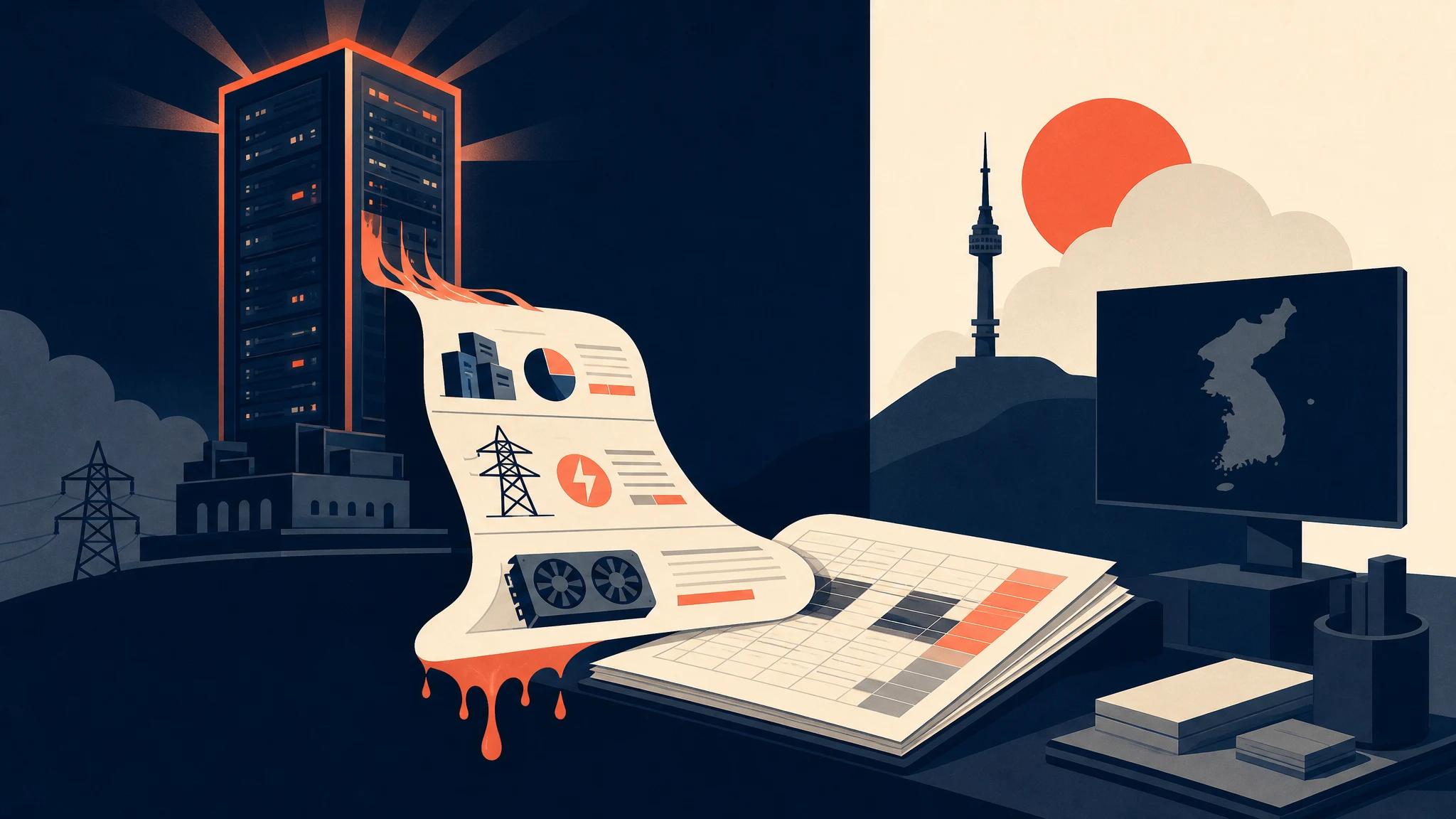
You Should Have Been Watching Accounting Policy, Not Quarterly Earnings
Microsoft, Alphabet, Meta, and Amazon repeated the same lines in every quarterly briefing through 2026. Capital expenditure is going up again; more data centers are being built. Each time, the market split in two: either it's a bubble, or it's a bet on the future.
Both framings miss the point. When big tech buys hundreds of thousands of GPUs and locks in power capacity long-term, what is really happening is not a bet — it's accounting. Cash goes out in one lump, but the cost is booked as an asset and flows down into the income statement over several years. So what matters is not the tone of the announcement but the depreciation schedule, the maturity of the power contracts, and how many years those GPUs actually last. These three numbers determine exactly when — and in which quarter — the bill arrives.
The bubble question is therefore lazy. It implies the outcome is binary: the bubble either pops or it doesn't. Cost incidence works differently. It is already in motion — it simply hasn't been recognized in the P&L yet.
Big Tech Is Buying Time with Depreciation Schedules
The core trick is straightforward. Expense the same server over four years and the quarterly charge is large; stretch it to six years and the charge shrinks. That US big tech has been extending server useful lives over the past several years is a matter of public record. The result: the same investment produces better-looking quarterly profits.
The problem is that Nvidia drops new chips on a one-to-two-year cycle. The books say an asset lasts six years, but in practice chips become obsolete within two. That gap gets settled somewhere. The moment an older GPU's performance-per-watt falls behind a newer chip, you have assets with intact book values sitting on top of collapsed market values. The costs deferred through long depreciation schedules can come back all at once as impairment losses.
Power is an even harder fixed cost. Data center power is locked into long-term contracts. Even when utilization falls, contracted capacity charges still go out. If AI demand doesn't materialize as projected, GPUs can sit idle while the electricity bill arrives on time every single month. What big tech fears is not the price of chips — it is the rigidity of those power contracts.
The competitive dynamic becomes visible here. Model companies like OpenAI and Anthropic need to drive down inference cost per unit to survive; Microsoft, Google, and Amazon need to tie that inference to their own clouds to recover margin. The model layer is in a price war; the infrastructure layer is in fixed-cost recovery mode. There is a strong counterargument: if demand keeps surging, fixed costs get buried under revenue and cease to be a problem. That is true — but only when inference demand rises at the same slope as the capex curve. The time lag between those two curves is the magnitude of the loss.
Capital Has Shifted from Revenue Companies to Fixed-Cost Companies
Where VC money and big tech cash are flowing now reveals the intent to own the stack. Money has moved down from applications to the infrastructure beneath them: power, land, cooling, chips, fiber-optic cable. Companies that were once software businesses are beginning to carry the cost structures of real estate and energy companies.
Software was attractive precisely because marginal cost converges to zero. AI infrastructure is the opposite: it burns electricity and wears out chips. The reason big tech takes on this heavy layer directly is singular — controlling what lies beneath means every inference request above passes through their gateway. Infrastructure ownership is not a cost; it is toll-road design. Depreciation schedules and power contracts are the debt incurred to build that tollbooth, and the debt is paid every quarter.
Korea Is Neither Supplier Nor Customer — It Is the Bill Recipient
So where do Korean companies stand in this competition — as suppliers, customers, or standard setters? Honestly, none of the three. Most are bill recipients.
Naver and Kakao's cloud services and the three major telecoms' data centers use the same accounting structure as their US counterparts. Buy GPUs, capitalize them as assets, run depreciation. The difference is scale and timing lag. The depreciation risk that US big tech stretched to six years accumulates with every new chip generation — and Korean operators bring in those new chips at higher prices and with a longer delay. The impairment risk runs in the same direction, but negotiating leverage is weaker.
Power is a sharper issue in Korea. Securing power for data centers in the capital region is already a bottleneck, and KEPCO tariffs are a policy variable. In a position where replicating US-style long-term, low-price power contracts is structurally difficult, non-capital regions — including Busan — gain room to come to the negotiating table with power capacity and land. This is not location marketing; it is fixed-cost competition. The region that can design power unit prices and contract structures is the region that designs the P&L of the next data center.
The timing of the bill's arrival can be estimated as follows. Operators that adopted GPUs in bulk will see depreciation begin pressing their P&L in earnest around the second or third year after adoption. Power contracts go out every quarter regardless of utilization. If demand fails to fill the gap in between, impairment losses concentrate and hit in a specific quarter. It is not a bubble popping — it is deferred costs being recognized.
The cost of watching from the sidelines is clear. Korean operators who treated Silicon Valley capex announcements as news about someone else's products will arrive at that quarter without knowing which quarter their own depreciation schedules and power contract maturities converge. By contrast, companies that now recalculate their GPU lifespans and power contracts against US big tech's accounting policies will have time to adjust pricing and utilization before the bill arrives. Silicon Valley news is not someone else's story. It is a bill already written for Korean companies' cost structure in the next quarter.
This article was automatically translated from the Korean original by AI. For the authoritative version, read it in Korean.
한국어 원문 읽기 →