Talent Doesn't Leave for Salary
While we frame AI talent drain as a salary problem, what's really walking out the door is something else entirely: access to compute and the scale of problems worth solving. This isn't a matter of individual choice — it's a question of national capacity.
AI Summary
This opinion piece argues that framing AI talent drain as a salary problem misses the real drivers: access to large-scale compute and the opportunity to work on meaningful, high-impact challenges. Researchers grow in proportion to the scale of problems they tackle, and both compute infrastructure and curated public data — currently fragmented across ministries in Korea — are what truly determines where talent flows. The author calls on Korea, and regions like Busan in particular, to build public compute infrastructure and establish clear accountability frameworks for public data, arguing these structural investments will retain talent far more effectively than salary competition.
We Are Counting the Wrong Numbers
Articles about AI talent drain almost always come with a salary comparison table. Silicon Valley pays this much, Korean conglomerates pay that much, and the gap is some multiple. The conclusion follows: we need to pay more. This framing is comfortable for a simple reason. Salaries are countable. They can be put into a table and appear to be a problem you can fill with a budget.
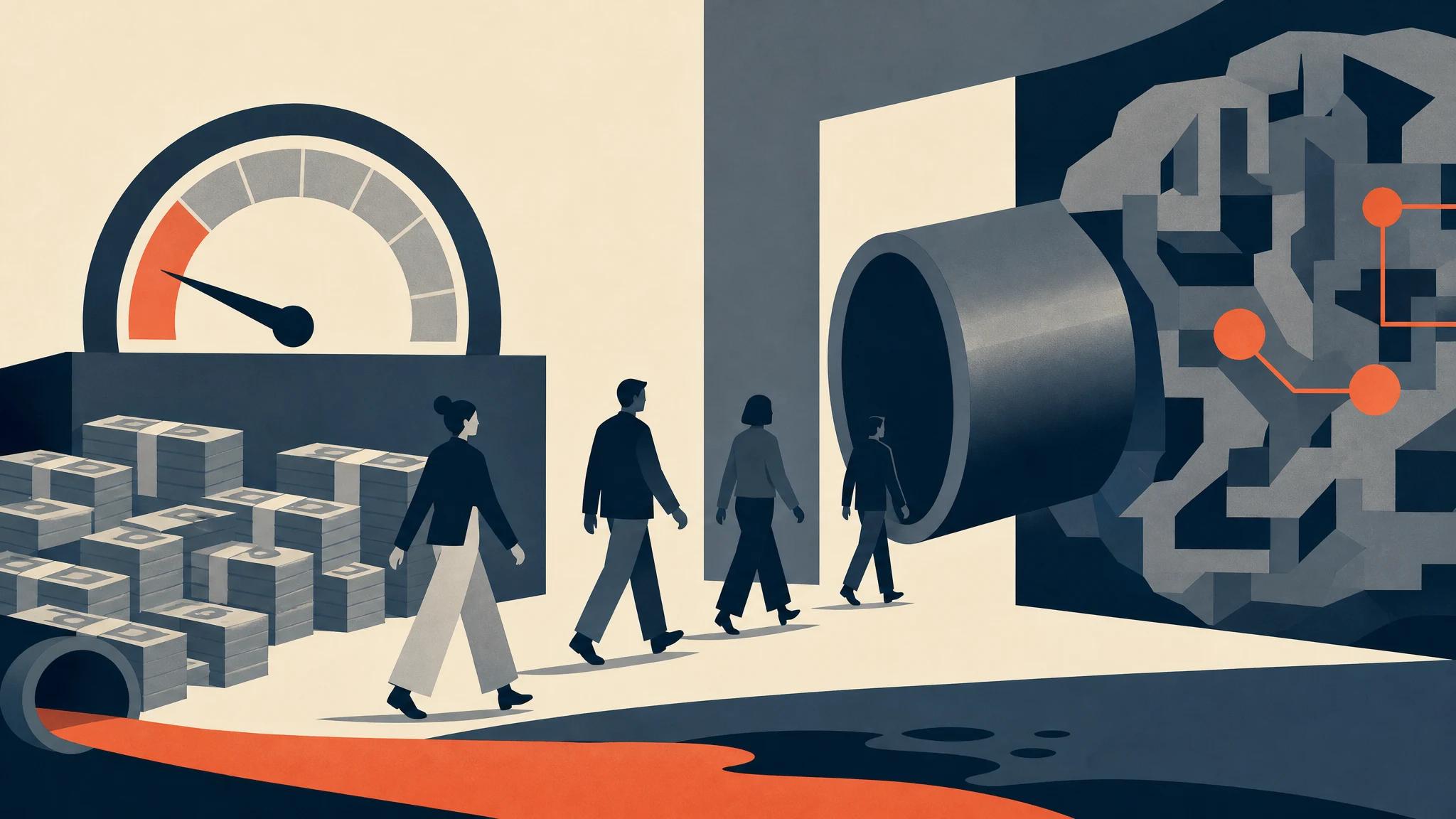
But when you collect the actual accounts of people who have left, money rarely ranks first. What comes up more often sounds like this: I couldn't work on the problems I wanted to solve here. There wasn't enough computing to properly run a model even once. In the end, we are reducing the problem of retaining talent to one of individual compensation. The people leave, but what drains away is the capability they could have built.
Two Resources That Can't Be Seen
There are two decisive resources for AI researchers. The first is access to compute. Training and experimenting with large models requires massive quantities of accelerators like GPUs — not something an individual can buy on a laptop. Think of it as a telescope. No matter how brilliant an astronomer is, if they cannot get in line for a large telescope, the universe they can see shrinks. It is not a question of ability — it is a question of access.
The second is the scale of the problems. Researchers grow to the size of the problems they work on. Someone designing the safety architecture for a system used by hundreds of millions of people and someone building an internal demo chatbot will be entirely different people a year later. Big problems congregate where there is big data and big compute. That is why talent follows problems, not money. Salary is closer to a byproduct that comes attached to those problems.
This is where a reverse-import dynamic emerges. Talent educated in Korea goes abroad, gains experience working on large problems with large compute, and returns carrying that experience. That is not inherently bad. But if this flow is not managed at the level of national strategy, we are locked into a structure where we bear the cost of developing talent while lending the output of their critical growth years to others.
This Is Not an HR Problem — It's an Infrastructure Problem
The moment you treat compute and problem access as resources, the question changes. It is no longer who do we pay more, but who gets access to large-scale compute and quality data. This is not a question of individual productivity. If you see AI only as a tool that individuals can each learn to use well on their own, the question itself becomes invisible.
This is where the role of the public sector diverges. One of the largest assets a nation holds is public data. Administrative, medical, transportation, and education records, when well-curated, become research resources that are rare even by global standards. The problem is that this data is scattered across ministries, and there are almost no standard channels through which researchers can access it safely. There is no common language for who can access it, under what conditions, and who bears responsibility for what results. From a researcher's perspective, the raw material for solving big problems clearly exists inside the country — but the means to work with that material is better equipped elsewhere.
The Slots Korea Has Left Empty
There are two institutional slots currently missing in Korea. One is public compute infrastructure — computing as foundational infrastructure, like electricity and roads, where universities, startups, and regional researchers who meet certain criteria can access large-scale compute. The other is a language of accountability for public data: rules that define access rights, anonymization standards, and responsibility in cases of misuse, written in terms ordinary citizens can understand. As long as these two slots remain empty, compensation alone cannot reverse the flow.
There is a strong counterargument: compute ultimately comes down to money, and money is a game you cannot win against global corporations. That is true. In absolute scale, you cannot compete. But what a nation must do is not own the largest compute — it is to build the most equitable access channels. Corporate compute opens only to that corporation's problems. Public compute can open to the problems society must solve, and to the problems the market ignores. Designing access rights, not competing on scale, is the move a nation can make.
For regions like Busan, this is even more urgent. A region trying to retain talent by matching the salaries of the Seoul metropolitan area and global corporations is playing a losing game from the start. Instead, if you open up the real data of local industries — port logistics, manufacturing processes, medical records from an aging city — and attach compute to those concrete, large-scale problems, you can offer something money cannot buy: problems that cannot be found anywhere else.
In the end, this is the core insight: many countries will learn to use AI well. But few will genuinely understand why talent leaves and why it returns — that the flow follows compute and problems, not salaries. Countries that truly understand this will be the ones that keep their talent. Countries that merely use AI well will not.
This article was automatically translated from the Korean original by AI. For the authoritative version, read it in Korean.
한국어 원문 읽기 →