The Org Chart Disappears
A solo founder in Silicon Valley producing the output of thirty people is not a product story. It is a signal that the company as a unit is shifting from headcount to an agent-orchestration graph. Korean startups' hiring roadmaps have a question to answer first.
AI Summary
The traditional company org chart — defined by headcount — is being replaced by agent-orchestration graphs in which tasks, not people, are nodes. Silicon Valley seed-stage companies are already operating with skeleton crews producing outsized output, and capital is flowing toward making inference cheaper rather than hiring more workers. Korean startups and investors still speak the language of headcount milestones, but those who learn to read and design orchestration architectures first will set the terms for the next funding cycle.
A seed-stage company in San Francisco posts 'We are not hiring more people' as a badge of honor rather than a job listing. Three employees, the output of thirty. It sounds like posturing at first. Look again, and it is a scene in which the very form of a company is changing wholesale.
The habit of reading big-tech announcements as product news misses the point most dramatically here. Anthropic's Claude, OpenAI's agent builder, and Microsoft's Copilot suite are not competing to build a smarter chatbot. What they are really selling is infrastructure that breaks labor into callable units. The work one person once did is decomposed into hundreds of function calls, and the real fight is over who controls the standard for those calls.
Measuring a company by headcount is a relic of the Industrial Revolution. Factories produced more when they had more hands. That is why revenue divided by employee count — output per person — became the metric. That denominator is now collapsing.
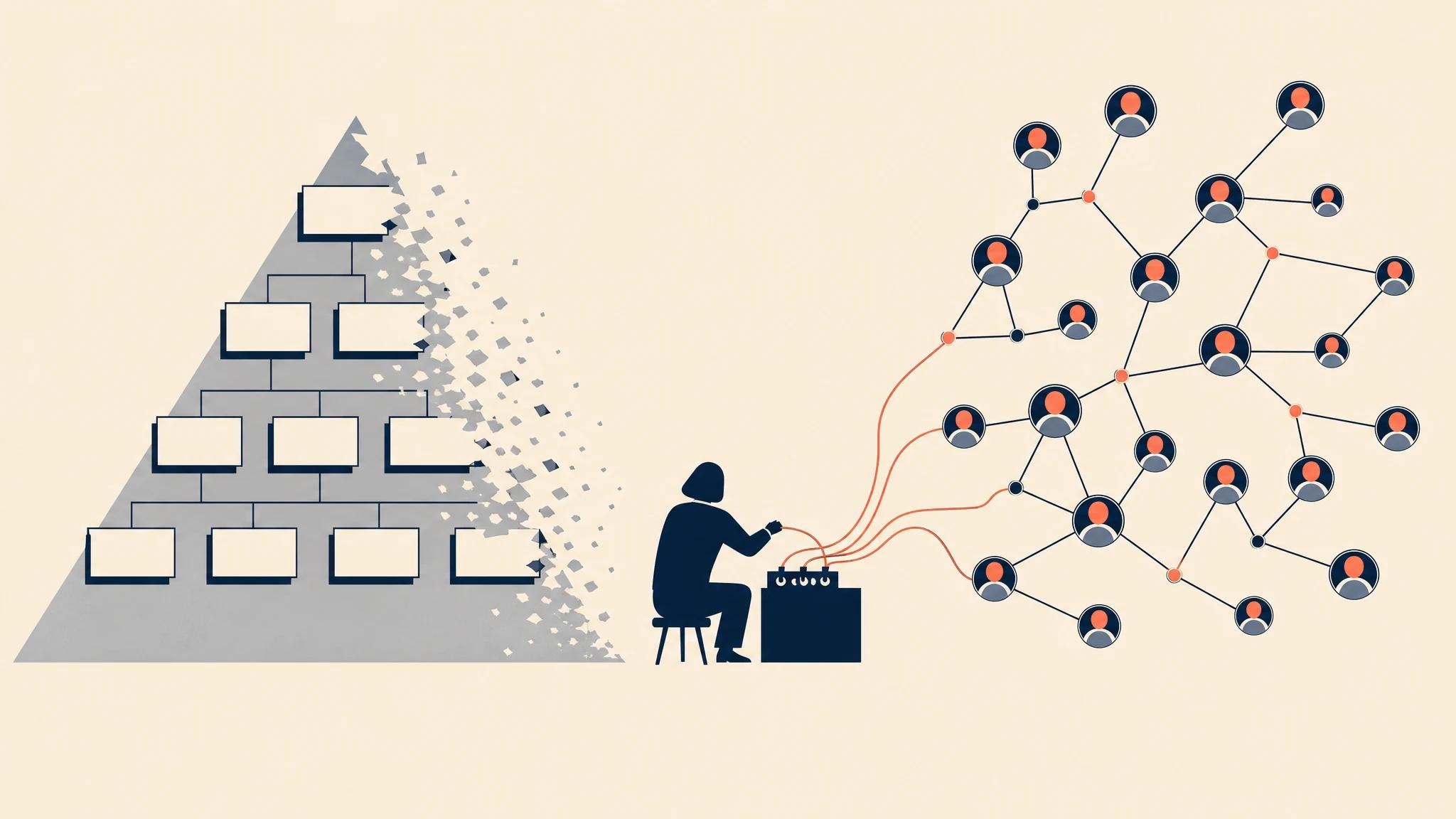
The new org chart is not a roster but a graph. Nodes are tasks, not people; edges are data flows, not reporting lines. Team leads design the call sequence of agents instead of managing human staff. When WhatsApp sold for $19 billion with 55 employees, everyone called it an exception. That ratio is now poised to become the average.
This is where you have to watch where the capital moves. Nvidia's market cap, the tens of billions flowing into OpenAI and Anthropic, the race to secure data-center power. Money is flowing toward making inference cheaper, not toward hiring people. The proof: VCs like a16z and Sequoia have started asking at the seed round not 'how big is the team?' but 'what is the core that cannot be replaced by agents?'
The critical question is which layer is being seized. Nvidia owns chips; OpenAI, Anthropic, and Google own models; and above them, an agent-orchestration layer is opening up. The company that controls that orchestration layer will own the operating system of the next decade — the same position Windows held in the PC era and iOS holds in mobile.
A strong counterargument arises here: 'A company built by cutting people lacks depth; real products are ultimately made by large organizations.' That is half right. In regulated industries, hardware, and domains where trust is the asset, headcount is the moat. But the argument is not that every company will get smaller. If the same number of people produces ten times the output, it means a competitor can match that output with one-tenth the staff. It is not a question of depth — it is a question of unit cost.
That is where the real question lands for Korean companies: in this competition, are we the supplier, the customer, or the architect of the standard?
Most Korean startup hiring roadmaps still sit on a headcount curve — ten engineers at Series A, twenty at Series B. Investors read companies through that same curve. The shared assumption is that headcount equals progress. That assumption is the most dangerous thing right now.
Imagine a SaaS team in Busan designing its way to the same revenue target with one-third the headcount. It walks into a funding meeting with an agent-orchestration blueprint instead of a staffing plan. Korean VCs do not yet have the vocabulary to read that blueprint. That is the opportunity. The first side to speak that language will set the benchmark for the next round.
Most will end up as customers. They pay monthly API fees to OpenAI and stack their apps on top of an American orchestration layer. That is not a bad position — except that from there, your cost structure is tied to someone else's pricing policy. When the per-call model price rises, your margins follow.
There is also a supplier position. Korean-language data, East Asian domain expertise, specialized evaluation sets, industry-specific workflow knowledge — assets American models do not have. But suppliers have weak pricing power. Without controlling the standard, those assets get sold cheap.
The standard-setter position is narrow and hard. But it is not a position Korea has never occupied. In semiconductors, we started as a supplier and eventually owned the standard in certain processes. The window to attempt the same path in the agent layer is open right now.
Organization design has to change first — not the sequence of hiring people and dividing up work, but the sequence of mapping work as a graph and then retaining only the nodes that genuinely require a human. Hiring comes after. The unit-cost gap between Korean teams that accept this inversion and those that reject it will open within two years.
This Silicon Valley scene is not someone else's story. It is an early look at a cost line that will appear on Korean companies' next income statements. The cost of watching from the sidelines is quiet. When a competitor hits the same revenue with one-third the staff, we will read the difference not in a job posting but in a closure notice.
This article was automatically translated from the Korean original by AI. For the authoritative version, read it in Korean.
한국어 원문 읽기 →