When Payment Becomes Plumbing
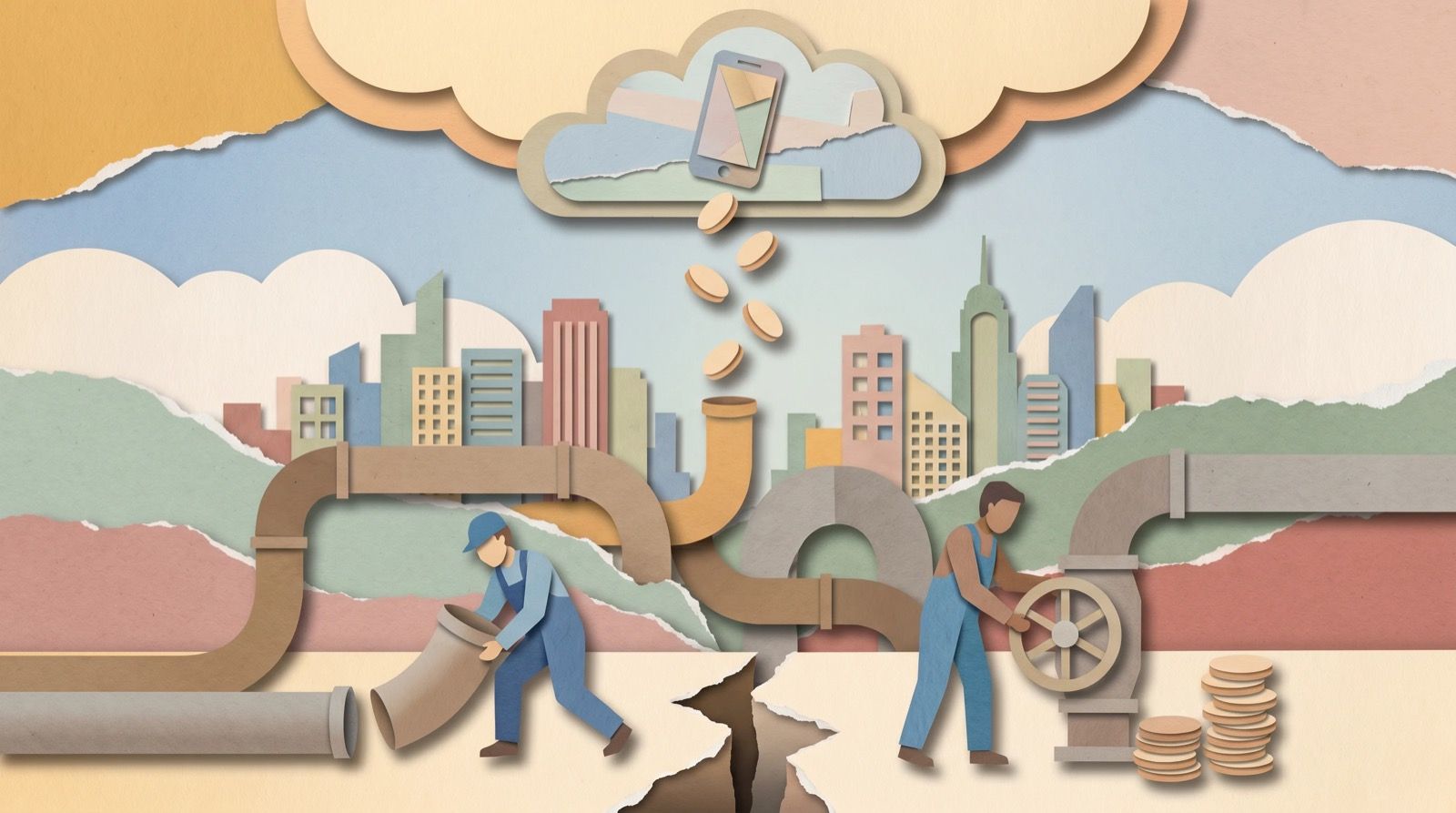
The real story of stablecoins entering the mainstream is not price. It is the transition of payment from an app feature down to society's plumbing. Those who lay the pipes and those who collect the tolls are on diverging paths.
AI Summary
Stablecoins and on-chain settlement are quietly transitioning payment from a user-facing feature into invisible infrastructure—analogous to TCP/IP or water mains—and the central question is who will define, and profit from, the new plumbing. As AI agents emerge as autonomous economic actors requiring high-frequency micro-payments, existing card infrastructure is structurally unfit for the job, making trust layers—identity, reputation, payment, and settlement—the real bottleneck. Korea, with proven strengths in gaming, digital content, real-time finance, and AI adoption, has a strategic window to define one segment of this emerging standard rather than paying tolls on infrastructure built by others.
It's Plumbing, Not Coins
People still view Web3 through charts. Bitcoin at what price, Ethereum at what price, what happened at which exchange. Within that frame, even stablecoins read as little more than "coins without volatility." That is wrong. The core of what has happened over the past two years is not price—it is a shift in position. Payment has moved from a button on a screen down to the pipes beneath the floor.
Plumbing only becomes infrastructure when it is invisible. When we turn on a faucet, we do not think about the water mains. Good payment works the same way. What Visa and Mastercard spent decades building was exactly this construction of invisibility. Stablecoins and on-chain settlement are now targeting precisely that position. The combined outstanding issuance of Tether and Circle exceeding $150 billion should be read not as "coin market cap" but as the laying of a new pipeline alongside the existing dollar infrastructure. The United States elevating stablecoin regulation legislation to a mainstream policy agenda sends the same signal. Nations do not regulate toys. They regulate plumbing.
What It Means to Automate Trust
So let us redefine the essence of this technology. Blockchain is not a currency-printing machine—it is a device for automating trust. In traditional payments, what we are really purchasing is not the transfer itself but the guarantee. Card companies guarantee merchants that "this transaction is legitimate and the money will arrive," which is what enables strangers to do business with one another. The price of that guarantee is the fee, the settlement delay, and the cost of dispute resolution.
The protocol economy moves this guarantee into code. Settlement is handled by consensus algorithms, ownership is proven by keys, and records are kept on a ledger no one can erase. Rules replace the human role of issuing trust. When we say payment becomes plumbing, this is what we mean: embedding trust as a default in the protocol rather than asking a human to issue it each time.
A common objection arises here. A single card swipe already gets the job done—why all this talk of plumbing? It is a fair point, and for person-to-person payments the existing infrastructure is good enough. But the parties making the next generation of payments will not be humans alone.
When Agents Carry Wallets
Imagine the moment AI agents become economic actors. My agent buys data from another company's agent, calls APIs, rents compute. Hundreds of micro-transactions per second, each worth $0.001. Card payments do not work here. Cards are infrastructure designed around human identity verification and dispute chargebacks—their very architecture is incompatible with high-frequency, small-value settlement by autonomous agents.
The agent economy requires four layers of infrastructure. First, identity: who does this agent represent? Second, reputation: has it kept its promises in the past? Third, payment: value that flows without human approval. Fourth, settlement: if a dispute arises, who decides, and how? Without these four layers, no matter how capable an agent is, it cannot initiate a transaction. Deploying a high-performing agent into the market without a trust infrastructure is like placing a genius on a street corner with no verifiable identity.
At this point, technologies that seemed scattered coalesce into a single stack. Stablecoins are the unit of value agents exchange. x402 revives the HTTP 402 response code to embed payment inside the web request itself—load a page and value flows. ERC-8004 is an attempt to give agents on-chain identity and reputation. Tokenization puts real-world assets on top of this infrastructure. Viewed separately they look like a jumble of acronyms; stood upright, they form a single pipeline diagram running from identity through payment to settlement. Read as coin news, it is invisible. Read as infrastructure, it comes into focus.
Who Collects the Tolls?
Lay the pipes and tolls appear. And whoever collects the tolls holds the power. Three camps are competing for that position right now. U.S. Big Tech wants to lay agent-payment standards directly on top of its own platforms. The Ethereum ecosystem presents itself as a neutral public pipeline, positioning itself as a settlement layer requiring no one's permission. Global payment networks are trying to extend their existing infrastructure onto the chain to protect their market share. The essence of the standards war is not technical superiority but whose specification becomes the default. Just as TCP/IP did on the internet, once the pipes solidify, the tolls are fixed for decades.
In this fight, Korea can remain a user or become a designer. When a Busan game company moves its economy on-chain, approaching it as "coin issuance" leads straight into the swamp of regulation and speculation. Approaching it as "the ownership and settlement infrastructure for in-game assets" is a different matter entirely. Korea has proven experience operating digital economies in content and gaming, real-time settlement capabilities in its financial infrastructure, and a fast pace of AI adoption. The realistic strategy is to be first to occupy a narrow standard at the intersection of all three—the point where content ownership and agent payments converge. You cannot lay all the pipes. Defining the specification for one segment is enough.
Trust Before Performance
The industry races toward smarter agents—more reasoning, more tools, more autonomy. But the moment an agent tries to actually handle money and enter into contracts, the bottleneck is not intelligence but trust. It cannot prove who it is, there is no one to hold accountable when it breaks a promise, and there are no rules to adjudicate a disputed settlement.
So the order must be reversed. Before boosting agent performance, we must first design the trust standards on which agents can stand. You cannot build a skyscraper in a city without plumbing. In this transitional period when payment is becoming plumbing, Korea has one question to answer: Are we the side paying tolls on pipes others laid, or the side that defines the specification for one segment?
This article was automatically translated from the Korean original by AI. For the authoritative version, read it in Korean.
한국어 원문 읽기 →