AI Grows on Crypto
Smart models fabricate falsehoods; honest ledgers cannot think. Where these two flaws fill each other's gaps, the next industry emerges.
AI Summary
AI models are capable but cannot verify their own outputs, while blockchain is tamper-proof but cannot reason — mirror-image flaws that make their convergence an engineering necessity rather than a marketing trend. Their integration enables three concrete outcomes: verifiable provenance for training data, machine-native micropayments for autonomous AI agents, and a distributed market for computing resources. South Korea — and Busan in particular, as a designated blockchain regulatory sandbox and logistics hub — is unusually well-positioned to capture this convergence.
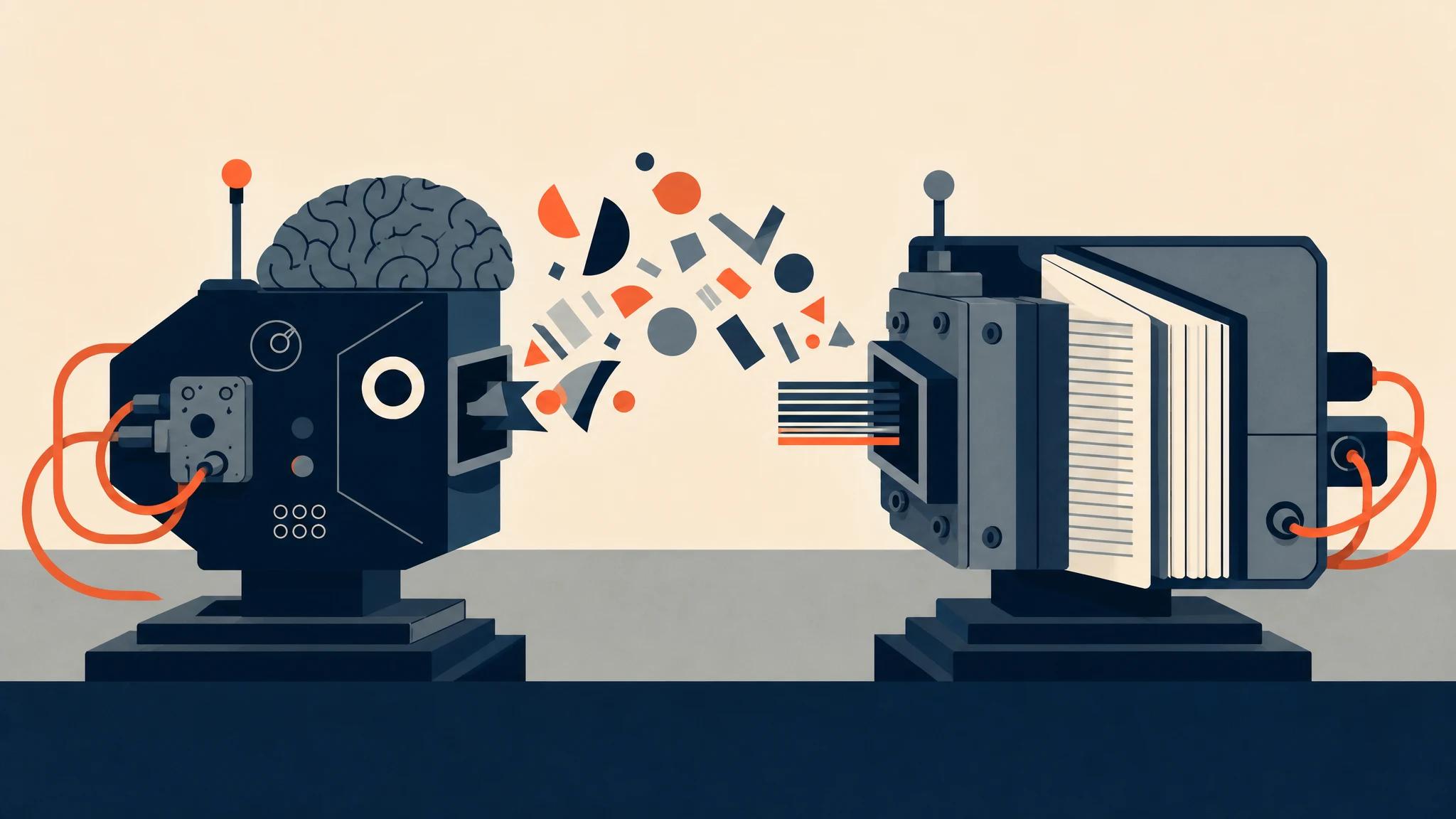
Most people see AI and crypto as two separate bubbles spinning in their own orbits. One is an all-purpose tool that writes and draws; the other is a speculative arena where coin prices rise and fall. In this framing, there is no reason for the two to meet — which is why the phrase 'AI coin' is usually dismissed as marketing.
That framing closes off the question. If you see a tool as only a tool, the point of integration stays invisible. The real question lies elsewhere: what can AI not do on its own, and who fills that gap?
A Machine That Is Smart but Not Honest
Today's large models fabricate plausible falsehoods with casual ease. This problem — known as hallucination — does not disappear as models grow larger. The deeper flaw is that outputs cannot be verified. There is virtually no way for an outsider to check what data a model was trained on, where a given answer came from, or whether an output was manipulated along the way. AI is clever, but it cannot prove its own track record.
Blockchain is the opposite creature. It is slow, expensive, and incapable of making any judgment on its own. But once something is recorded, anyone can verify it and arrive at the same value. It preserves provenance, sequence, and ownership without the possibility of forgery. Rather than being smart, it is structured to be incapable of lying.
| AI (Large Models) | Blockchain | |
|---|---|---|
| Strengths | Thinking & Generation | Tamper-Proof Verification |
| Weaknesses | Cannot prove its own actions | Cannot reason on its own |
One can think but cannot prove; the other can prove but cannot think. The shape of their two flaws fits together with mirror-like precision. This is why their convergence is not a marketing story but an engineering inevitability.
Where Convergence Has Transformed Industries
History shows that it is not single technologies but combinations that repeatedly overturn industries. The shipping container is, by itself, a lump of steel. When it was paired with standardized dimensions, cranes, and port computer networks, global logistics costs collapsed and worldwide division of labor became possible. Busan Port's rise as a transshipment hub was built not on the invention of a single box, but on that convergence.
GPS too started as nothing more than a military coordinate signal. Only when it was combined with smartphones, map data, and payment systems did it give birth to new economic actors like Uber and Baemin. Those companies could not have existed before the convergence. Technology is a dot; industry is born on the line connecting dots.
The convergence of AI and crypto follows the same grammar. When the dot called a model is connected to the dot called a verification ledger, an actor that does not yet exist will come into being.
Data Gets Priced, and Machines Get Wallets
Let us look concretely at what this connection produces. The first result is provenance verification for data. Amid the flood of fake images and text pouring out of generative AI, what was actually made by a human becomes an asset. Inscribing the time and source of content creation on a ledger gives training data a verifiable value for the first time. From this emerges a new actor: the data provider who lends their writing and photos to model training in exchange for compensation.
Next is the economic activity of autonomous agents. For an AI agent to call APIs on its own and delegate tasks to other agents, it needs a means of payment that bypasses a human's credit card. Financial networks built for people were not designed to handle machines making thousands of micropayments per second. Coin-based wallets process those micropayments and automated settlements at the machine level from the ground up. A market opens where agents are simultaneously customers and workers.
The final outcome is a distributed market for computing resources. In an era of GPU scarcity, blockchain serves as the ledger that aggregates dispersed computing power and settles who contributed how much without the possibility of forgery. Computing capacity that was monopolized by big cloud providers is released as a verifiable shared resource.
The counterargument is sharp: crypto is too slow and its fees too high for real-time AI use. That is true. But it is a critique that misunderstands the role. Blockchain is not an engine that processes all computation; it is closer to a notary that seals only the authenticity of results and their settlement. A division of labor is already taking shape — heavy computation runs fast off-chain, and only the proof is recorded on the ledger. The speed problem does not form a wall blocking convergence; it draws the boundary line of a division of labor.
Korea's Position
Korea holds cards in both hands — a rare position in this convergence. On one side sits world-class computing infrastructure and semiconductors; on the other, a crypto user base that is among the densest in the world relative to population. Normally these two assets run on separate tracks. Going head-to-head with the tech giants that build models directly would be a heavy lift, but the connection point of verification ledgers and data provenance proofs is still unclaimed territory.
Busan occupies a uniquely intriguing coordinate within that picture. It is both a designated blockchain regulatory sandbox city and a logistics hub. As a location to experiment with verification infrastructure — data provenance proofs, autonomous-agent payments — it is a rare site where regulatory testing authority and port data are gathered in one place.
Where the Future Arrives
If you see AI as nothing more than an increasingly smarter tool, this entire picture disappears. AI's weaknesses cannot be filled by a larger AI. The flaw of being unable to prove itself is only resolved when it joins hands with another technology that excels at exactly that — proof.
The future does not come from a single technology. It comes from the connection point where a smart machine and an honest ledger fill each other's gaps.
This article was automatically translated from the Korean original by AI. For the authoritative version, read it in Korean.
한국어 원문 읽기 →