When Idle Resources Become Capital Goods
DePIN is sold as a triumph narrative for distributed infrastructure. But the real question lies elsewhere. Is Korea building the industrial structure to bind idle hardware into capital goods?
AI Summary
DePIN networks aggregate scattered hardware — GPUs, storage, sensors — through token incentives, giving previously untradeable idle resources a price tag for the first time as AI compute demand surges. Korea's fast-follower manufacturing model positions it as a capable hardware supplier, but risks ceding rule-setting authority — and the bulk of value capture — to the networks that define verification standards and token protocols. The author argues that winning at the frontier requires not fast imitation but a three-layer institutional accumulation: hardware verification expertise, hands-on token economy design experience, and long-term programs, potentially anchored in Busan, that treat failure as shared ecosystem knowledge rather than a career liability.
GPUs Sitting Idle Next to Data Centers
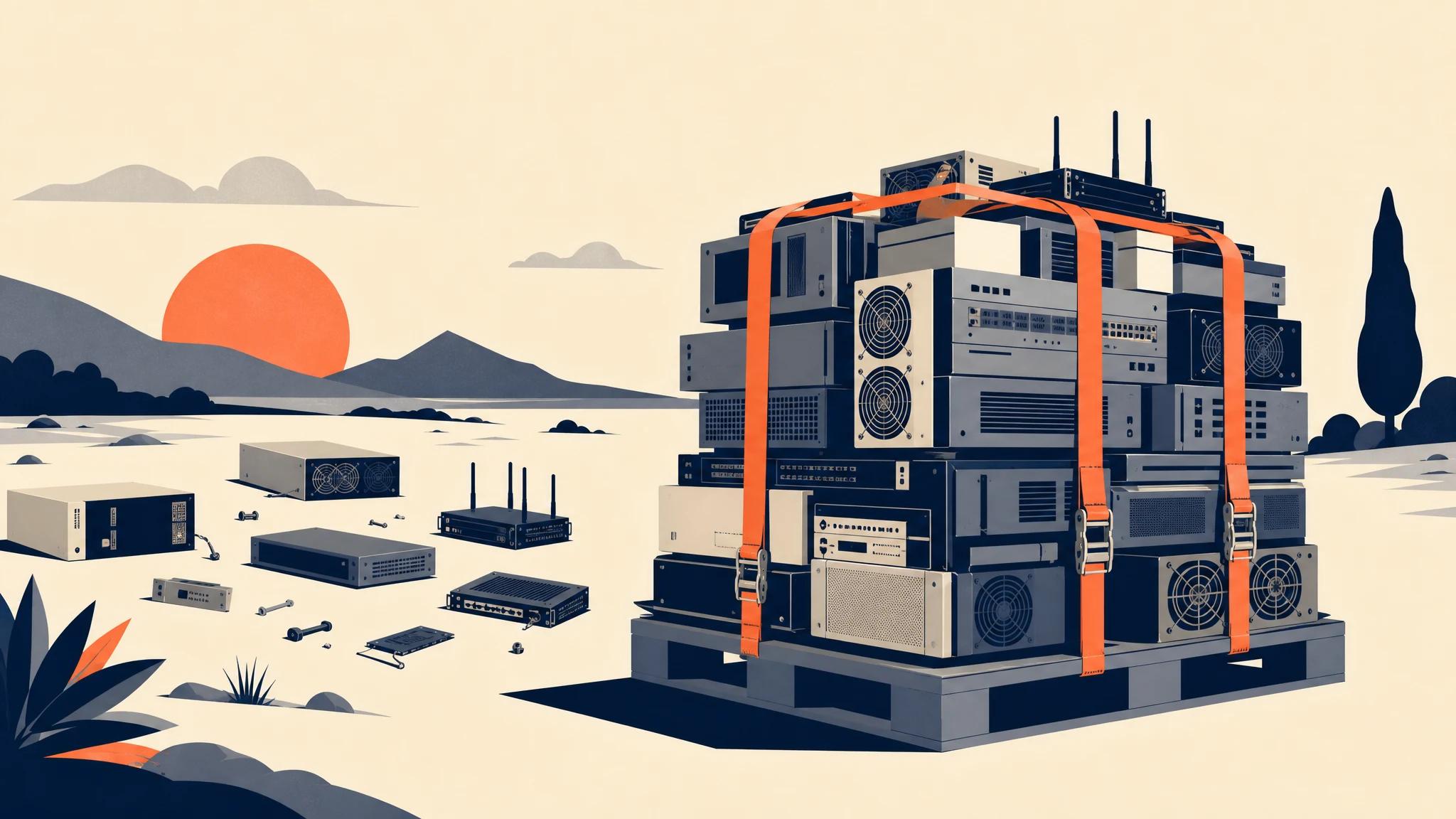
In a server room at a game company in Pangyo, GPU racks purchased to handle the launch of a new title sit more than half empty every night, with nothing but depreciation accumulating on the books. Meanwhile, across the Pacific, DePIN networks like io.net and Akash are bundling those very same idle GPUs through tokens and lending them out to meet AI inference demand. Idle resources are a cost on someone's balance sheet — and capital goods on someone else's network.
DePIN — Decentralized Physical Infrastructure Networks — is an experiment in linking scattered hardware, from telecom base stations to GPUs, storage devices, and vehicle-mounted mapping sensors, through token incentives. The market values this sector's total capitalization at roughly $9.4 billion — a figure that fluctuates depending on how it is measured, so treat it as a directional signal rather than a definitive number. The core point is not the scale but the direction. As demand for AI compute explodes, idle hardware that had never before been measured or traded is, for the first time, acquiring a price tag.
The common interpretation goes like this: it is a battle between centralized data centers and distributed networks, and Korea just needs to spin up a token project and jump on board quickly. I believe this interpretation is wrong. DePIN is not a coin trend — it is an attempt to rewrite the ownership structure of industrial infrastructure. And infrastructure structure is not a category you win by catching up fast.
A Domain That Cannot Be Won by Fast-Following
Korea has excelled at catch-up. It manufactured products defined by others' standards cheaper, faster, and more consistently. Memory semiconductors and displays are the pinnacle of that model. In games where the problem is clear and a correct answer exists, Korea has almost never lost.
DePIN is not that game. There is no right answer. Helium laid down telecom base stations via tokens, but when actual demand and token issuance fell out of alignment, the network was forced to overhaul its entire economic model from scratch. Filecoin filled up storage capacity, but still struggles with what to put in it. io.net and Render have aggregated GPUs, but the question of how to guarantee the reliability of distributed resources to enterprise-grade standards remains unsolved. This is not a domain where you find the right answer quickly — the problem itself changes every day.
Here the weakness of the fast-follower model is exposed. Catch-up is powerful when the target is fixed. On a frontier where the target moves, followers are always racing toward where it was one beat ago. Nobody knows the right answers for DePIN's token economics, hardware verification, or demand matching. Everyone is chiseling out answers through trial and error. The moment you try to shortcut past others' trial and error, the very experience that should have accumulated simply vanishes.
A Structure Where Failure Remains an Asset
Frontier technologies inherently carry high failure rates. What matters is not the frequency of failure but where that failure accumulates. The reason America's distributed infrastructure ecosystem is strong is not that it has more geniuses. It is because there is a structure in which failures — Helium's record of overhauling its economic model, io.net's experience of a fake-node incident and subsequent rebuilding of its verification system — are absorbed as the starting line for the next project. Failure does not end as individual loss; it becomes shared knowledge for the ecosystem.
Korea's short-termism works in precisely the opposite direction. Quarterly earnings reports and one-year R&D project evaluations treat failure as a blemish, not a record. Failed projects are erased from reports, and the people who learned from them scatter. The next team hits the same wall again. What accumulates is not experience but the repetition of the same mistakes. While advanced countries make tenacious investments in a single field for ten years at a stretch, we swap out only the keyword in the project title every three years to match whatever is trending.
A strong counterargument is also possible: for token infrastructure like DePIN, couldn't Korea simply participate as a hardware supplier to global networks without needing to accumulate anything of its own? This is partially correct. However, if Korea only participates as a supplier, others set the price of its resources. Even if Korea's idle GPUs become capital goods, if others hold the standards and protocols for evaluating, bundling, and trading those capital goods, we are once again reduced to a parts-supplying nation. It is the familiar picture of achieving world number one in memory while others write the rules of the AI value chain running on top of it.
What Korea Needs to Accumulate
So what should be accumulated? Not a single token project, but three layers of accumulation.
The first is technology for measuring and verifying idle resources. A verification layer that proves whether distributed GPUs and storage actually deliver the performance they promise is the hardest chokepoint in converting untrusted hardware into capital goods — and it is precisely where Korea's manufacturing quality-control experience and semiconductor reliability know-how connect directly. Next is token economy design and failure data. What breaks when incentives fall out of alignment with actual demand is something you can only learn by breaking it yourself. Finally, there is the long-term program that consolidates all of this trial and error in one place. If Busan were to become a hub that ties data centers and distributed compute nodes to the manufacturing infrastructure of the southeastern region, persistently recording failures over five- and ten-year horizons, that would be worth a hundred times more than chasing the next keyword trend.
The question is simple. Does Korea have the structure to accumulate this technology over the long term? Does it have a system in which failure remains experience rather than a blemish?
In the age of catch-up, the country that found the right answer first won. In the age of the frontier, the country that formulates the question first wins. The question DePIN poses is not who converts idle hardware into capital. It is who writes the rules of that conversion. To earn a seat at the table where those rules are written, what is needed is not the ability to copy quickly but the structure to break things persistently and accumulate over time.
This article was automatically translated from the Korean original by AI. For the authoritative version, read it in Korean.
한국어 원문 읽기 →