When Agents Have Wallets
The moment autonomous agents become blockchain's first true users, what's missing isn't code — it's an accountability structure. Who will fill the space where the signature once stood?
AI Summary
As autonomous AI agents begin booking flights, settling API fees, and purchasing data without human oversight, a critical gap emerges: blockchain infrastructure built for human signatories has no clear framework for assigning legal accountability when an agent transacts on its own. A five-layer stack — identity, reputation, payment, settlement, and ownership — is being assembled to fill that void, with Coinbase's x402 protocol and standards such as ERC-8004 leading the effort. The race to control these standards will shape economic power over the next decade, and Korea, with its game industry expertise, content IP, and established payment infrastructure, is positioned to become an architect of these protocols rather than merely a user.
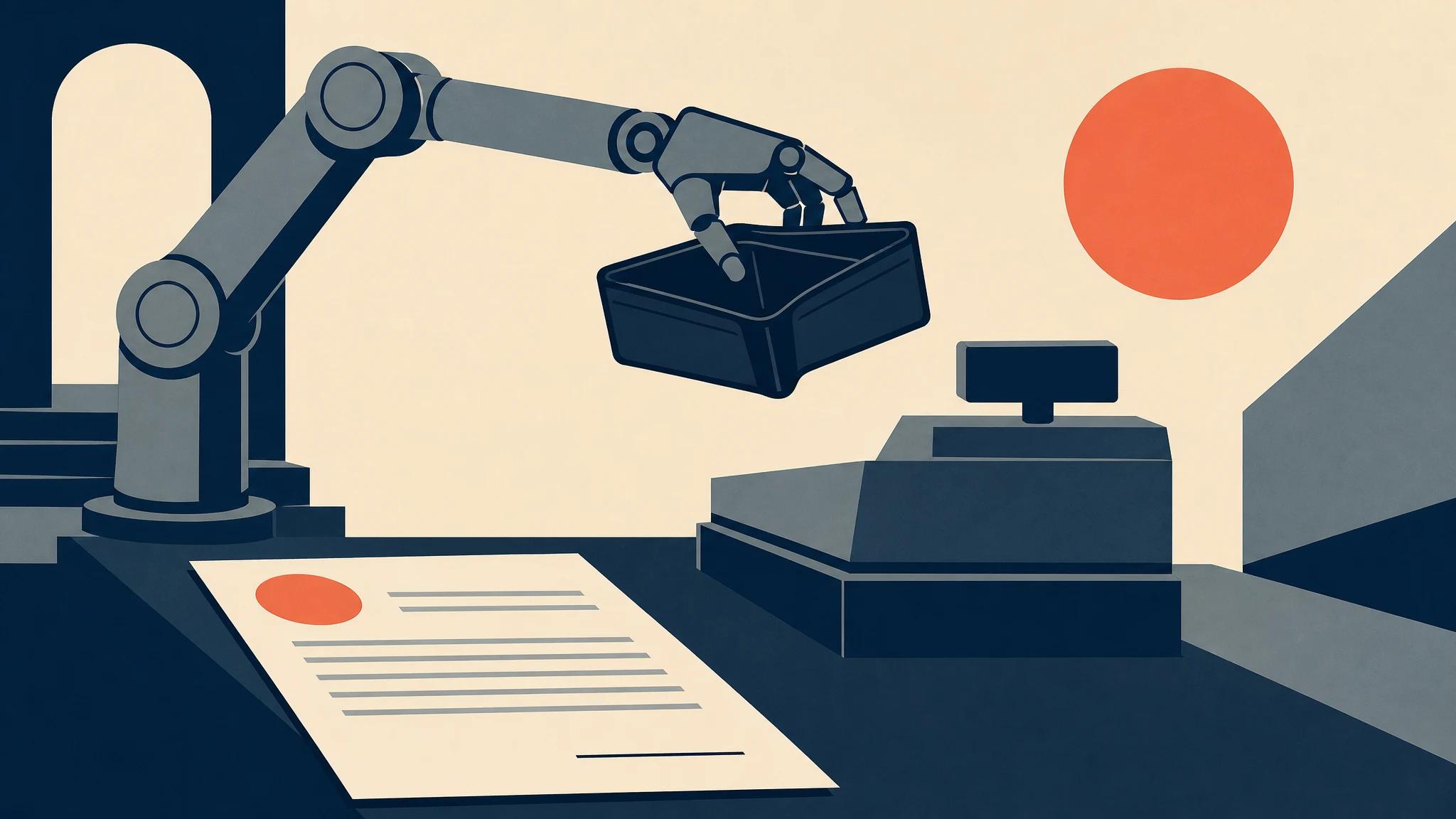
Agents are already booking flights on your behalf, settling API fees, and purchasing data. This isn't a distant future — it's the present, being tested right now through Coinbase's x402 payment protocol.
Most people still read Web3 through the lens of coin prices and exchange listings. Through that frame, this movement looks like nothing more than 'yet another payment token.' But that's wrong. What's being built now isn't a token — it's a standard for restoring trust to transactions that take place without a human in the loop.
Let's redefine the fundamentals. Blockchain isn't a speculative asset — it's infrastructure that automates three things: trust (who is real?), settlement (when and how is payment made?), and ownership (who does this output belong to?). In human society, these functions were divided among banks, courts, and registries.
Until now, the ones using this infrastructure were humans. Humans opened the wallet, humans signed, humans bore responsibility. A single signature was a legal declaration: 'I did this, and I am accountable.'
When agents enter the picture, that declaration begins to crack. Autonomous agents don't wait for a human signature on every transaction. They receive only an intent — 'optimize and pay this week's cloud costs at the cheapest provider' — and execute on their own. This is intent-based execution.
This is where the gap appears. The moment the signature leaves human hands, the legal subject of the transaction vanishes. Who is responsible for the $10,000 in GPU time an agent mistakenly purchased? The company that built the agent? The user who deployed it? The model weights? No one. That's the problem.
The absence of an accountable subject. That is the true challenge of the AI agent economy. What's missing first isn't performance — it's accountability.
What's needed, then, is a stack — not a single coin, but a layered structure. At the base is identity: on whose authority does this agent act? Standards like ERC-8004 aim to give agents an on-chain identity and a verifiable origin. Not a human ID number, but a birth certificate for the agent.
On top of that, reputation is built. Did this agent honor past commitments? Did it commit fraud? On-chain reputation is constructed on an immutable transaction history — essentially a human credit score translated into a form that code can read.
Above that comes payment and settlement. x402 revives the HTTP 402 (Payment Required) response code, enabling machines to pay without a human intermediary. Settlement stability is underwritten by stablecoins, because volatile coins cannot support machines settling hundreds of transactions per second. That's why dollar-pegged assets like USDC become the lifeblood of the agent economy.
At the top sits ownership. The outputs an agent creates, the data it purchases, the assets it learns from — all tokenized to establish definitively who they belong to. Identity, reputation, payment, settlement, ownership. When these five are bound into a single stack, agents finally become economic actors.
Who controls these standards will determine the power dynamics of the next decade. U.S. Big Tech leads on model performance; the Ethereum ecosystem races to capture the trust layer; payment networks like Visa and Mastercard are drawing defensive lines to keep their settlement infrastructure out of machines' hands. The standards war has already begun.
The counterargument is fair: 'Law will ultimately pin accountability on human companies. Agents are just tools of those companies — no new infrastructure needed.' Half of that is true. In the short term, liability will fall on operators. But the moment an agent transacts directly with another company's agent, and there is no neutral standard to mediate between the two operators, the transaction cannot take place at all. Infrastructure doesn't replace companies — it connects them.
Korea stands at a crossroads: remain a user of protocols, or become their architect. If a single game company in Busan embeds a reputation standard into its in-game agent transactions, that becomes not just one game's rule set — it becomes an exportable trust layer. Content IP, experience operating in-game economies, the payment infrastructure built by Kakao and Naver: Korea already has the raw materials to build identity and reputation standards.
The conclusion is simple. We are pouring every resource into building smarter agents. But if we cannot define on whose authority those agents act and what they are accountable for, performance becomes an uncontrollable cost. What must be designed before AI agent performance is a standard for trust. The wallet is already open — and what's empty is the seat of accountability.
This article was automatically translated from the Korean original by AI. For the authoritative version, read it in Korean.
한국어 원문 읽기 →