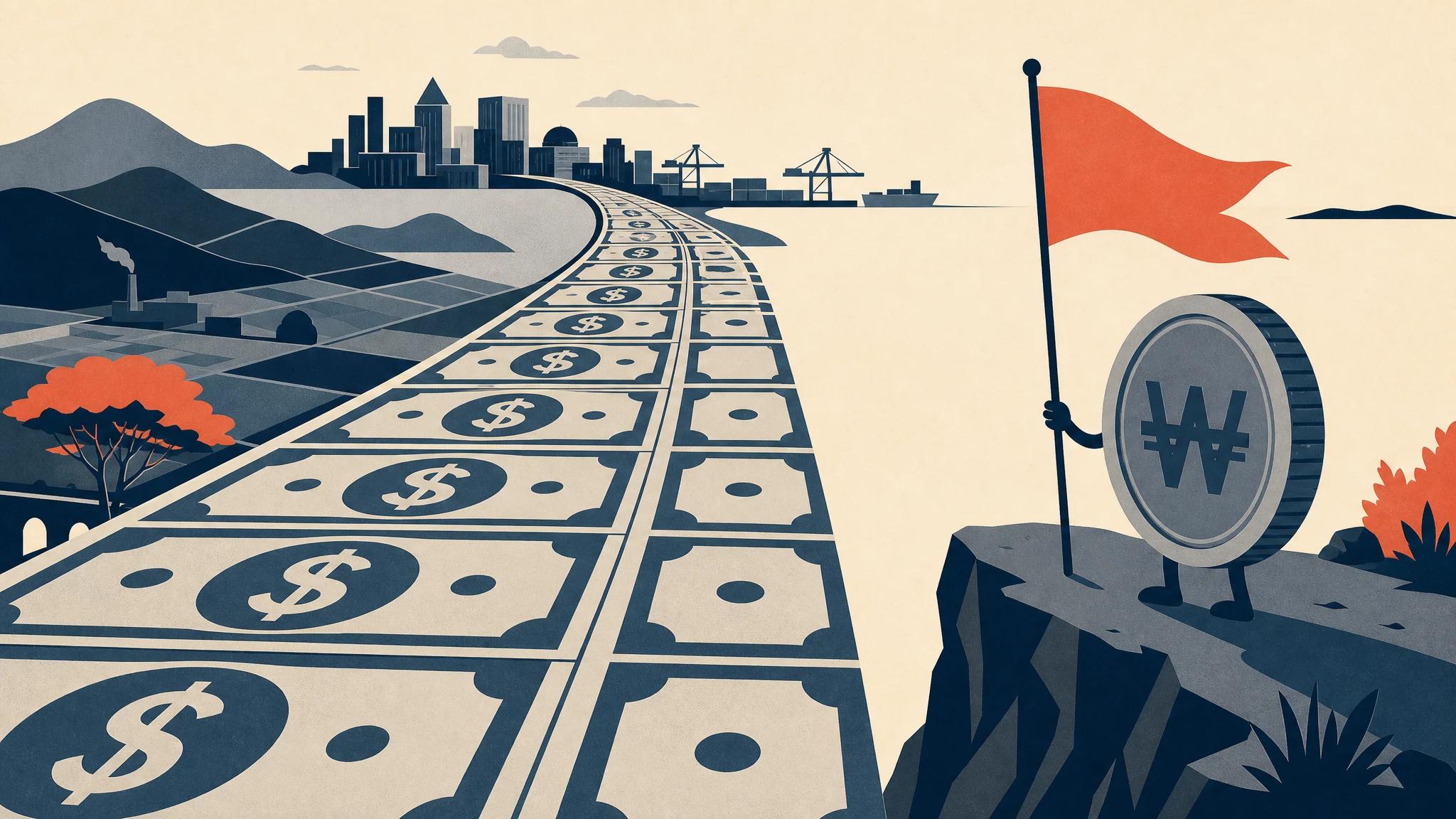
The Dollar Has Already Laid Its Tracks
USDT got there first, embedding itself in the payment networks of emerging economies. Monetary sovereignty is the rallying cry of won-based stablecoins — but whether that cry is realized or silenced ultimately comes down to interest rates and dollar liquidity.
AI Summary
Dollar-denominated stablecoins such as USDT have secured first-mover advantage across emerging-market payment networks, effectively funneling household savings into U.S. Treasuries through Tether's reserve holdings. South Korea's Lee Jae-myung administration is pushing a won-backed stablecoin as a defense of monetary sovereignty, but the Bank of Korea warns the move could erode the very control it seeks to protect. The article argues that the Federal Reserve's interest rate path and the won-dollar exchange rate — not technology — will ultimately decide whether Korea's initiative succeeds or remains a domestic Galapagos product.
Reading stablecoin news through the lens of coin prices misses the point. What matters is who laid down the payment infrastructure first. And once infrastructure is in place, it rarely changes.
Start with the numbers. USDT has a market capitalization of approximately $189.6 billion; USDC, $77.6 billion. Estimates suggest that stablecoin payment settlements in 2025 exceeded the combined volume of Visa and Mastercard. And most of that money moves outside the United States.
Here is the crux. The moment a Turkish lira, Argentine peso, or Nigerian naira is converted to USDT, that user becomes indirectly connected to short-term U.S. Treasuries. Tether takes the dollars it receives and buys government bonds. The payment made by a street vendor in an emerging economy becomes a source of demand for American fiscal debt.
Why call this colonial infrastructure? Because whoever laid the road sets the toll rules. Remittances, currency exchange, savings — in emerging markets, dollar-backed coins have replaced all three at once. The weaker the banking system, the deeper the penetration.
So where is the money flowing right now? Household savings from people who do not trust their own currency are being funneled through dollar tokens into U.S. Treasuries. As long as the Federal Reserve keeps rates high, simply holding these tokens is equivalent to enjoying the nominal yield on dollars — except that yield, invisible to the token holder, goes to the issuer.
Leave the cost of capital out of this analysis and you have no analysis at all. The speed of stablecoin penetration was not determined by technology. It was determined by high interest rates and a strong dollar. The higher the opportunity cost of holding dollars, the stronger the incentive for emerging-market households to abandon their local currency. Technology lays the infrastructure; interest rates create the demand.
Now consider Korea. The Lee Jae-myung administration is pushing for a won-based stablecoin. The Democratic Party of Korea has introduced the Digital Asset Basic Act, opening the door for licensed corporations with equity capital of at least 500 million won to issue stablecoins. The stated rationale: preventing capital outflows and defending monetary sovereignty.
The rationale itself is sound. The problem is timing. Dollar-backed coins have already claimed the payment networks of emerging markets. The won-backed coin enters as a latecomer trying to break into that network. In the infrastructure lock-in game, the second mover always pays a steeper price.
The Bank of Korea is singing a different tune. Its payment and settlement report has stated clearly that stablecoins could undermine monetary sovereignty and erode the effectiveness of monetary policy. The government says build it; the central bank says building it means losing control. That disconnect is the central tension.
Let me address the strongest counterargument. Some argue that technology adoption is independent of the cost of capital — that if a payment network is good enough, it spreads regardless of interest rates. That is only half right. Convenience pulls the trigger on adoption, but the depth and speed of adoption are set by the price of money. In a low-rate environment, the incentive to hold dollar tokens would have been far weaker than it is today. The strong-dollar cycle is the invisible hand that laid this infrastructure.
The fate of the won-backed coin is therefore also tied to interest rates and exchange rates. The weaker the won-dollar rate, the more even Korean households will gravitate toward dollar coins. The very coin designed to protect monetary sovereignty risks becoming, in the face of a weak won, nothing more than a conversion gateway into dollar-denominated coins.
Busan deserves a mention here. The city was designated a blockchain regulatory free zone and is being discussed as a potential testing ground for won-backed stablecoins. But designation does not create demand. Demand is made by exchange rates and interest rates. Regulation is merely the vessel.
The conditions under which the Korean market finds opportunity are narrow: the won holds strong, and won-backed coins prove demonstrably cheaper and faster than dollar coins within domestic payment networks. The conditions for exposure are far broader: a prolonged strong-dollar cycle, the cementing of USDT as the standard for emerging-market payments, and the won-backed coin relegated to a purely domestic Galapagos product.
The conclusion is simple. Technology lays the infrastructure, but which currency flows over it is determined by interest rates and dollar liquidity. While won-backed coins proclaim monetary sovereignty, the real sovereignty is decided by the Federal Reserve's rate path and the won-dollar exchange rate. Before tracking the speed of technology, look at which way the money is moving. The road has already been paved in dollars.
This article was automatically translated from the Korean original by AI. For the authoritative version, read it in Korean.
한국어 원문 읽기 →