Who Controls the Context
If you view coding assistants merely as faster typing tools, you're missing half the picture. The real transformation begins at the intersection where scattered silos of context converge in a single window.
AI Summary
Coding assistants represent not just faster code writing, but a fundamental shift in how developers access context across fragmented tools—from code editors to Git history, Jira tickets, and logs. The real competitive battleground lies in who controls the convergence surface that unifies these silos, with platform owners like Microsoft and Atlassian racing to retain ownership of this critical junction. For Korea, opportunity exists not in the model layer but in building convergence surfaces tailored to Korea-specific organizational silos that U.S. big tech doesn't understand well.
Most people look at coding assistants and say, "That'll make typing faster." In that one sentence, they've already missed half of it.
Writing code faster is an extension of autocomplete. It's what IDEs have been doing for 30 years. What's truly new isn't the tool's ability to write code, but what it enables you to see simultaneously.
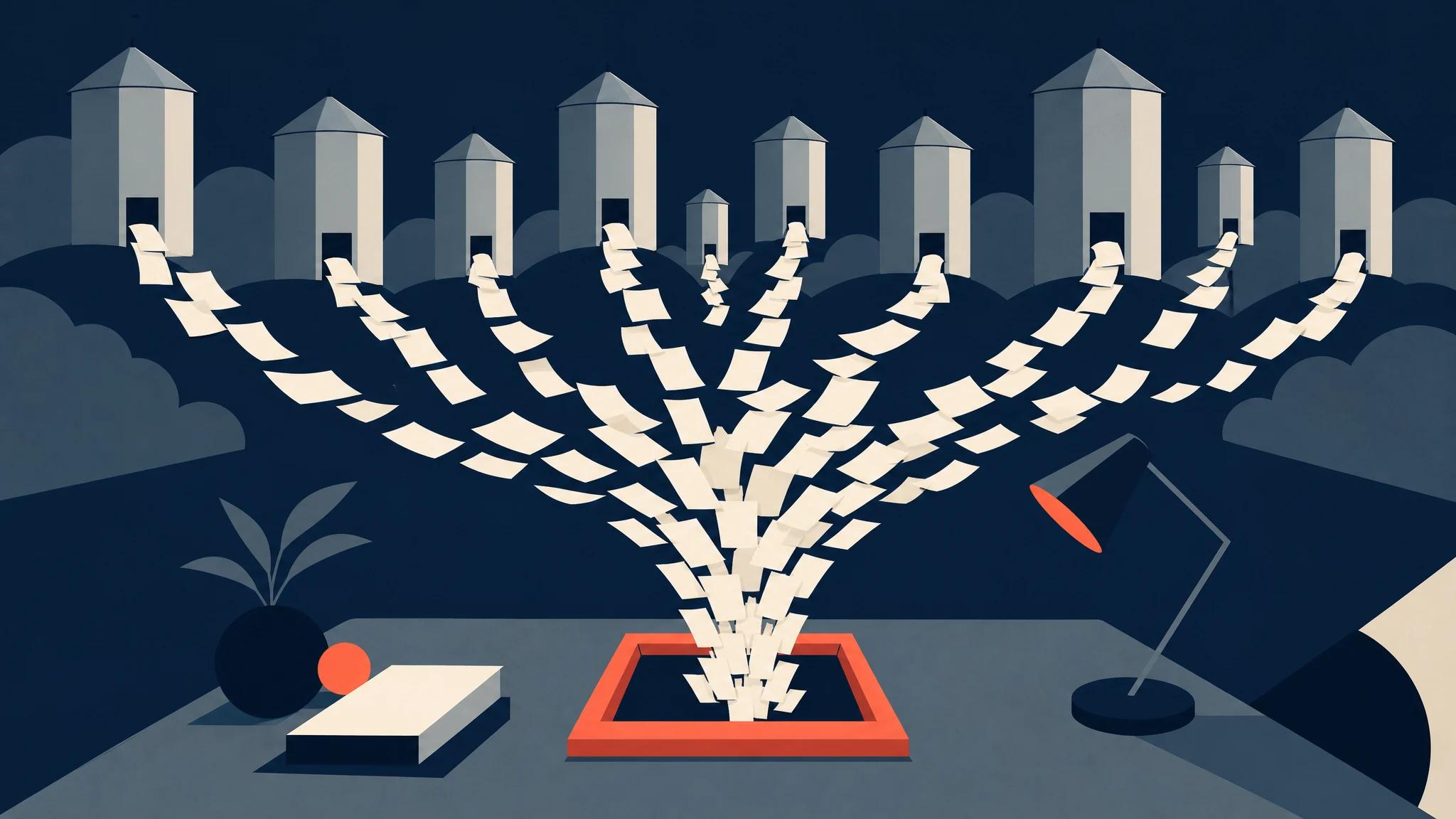
Count the windows a developer typically opens to fix a single function. Code editor, Git history, Jira ticket, Confluence docs, Slack thread, error log dashboard, API specs. That's seven silos. Each is a different product made by a different company, and they don't talk to each other.
A developer's mind has been a workshop manually stitching these seven pieces together every time. The true identity of coding assistants lies in bringing that stitching work inside the tool itself. They don't just look at code—they read documentation, tickets, and logs in the same window.
History shows that industries are always transformed not by a single technology but by connection points. The shipping container wasn't the invention of a single steel box. The moment trucks, trains, port cranes, and ships aligned to the same standard, the cost structure of global trade collapsed. The box was the excuse; the standardized interface was the substance.
Smartphones are the same. When telecommunications, GPS, cameras, payments, and accelerometers converged in one device, Uber, Instagram, and delivery apps were born. No single technology could have created those industries. A surface where multiple functions converged created a new economy.
Coding assistants stand at the same juncture. By themselves, they're ordinary language models. Their significance comes from what they connect to.
The first branch of connection is internal knowledge data. When code repositories, wikis, and ticketing systems are bound into one index, the tool can answer "why was this code written this way?" The context of decisions made by a developer who left three years ago becomes searchable for the first time.
The second branch is operations and monitoring. When logs, traces, and alerts enter the same window, the act of writing code connects in a single line to the incident of that code breaking at 3 a.m. The wall between creation and observation grows thinner.
The third is the organizational process itself. Ticket creation, code review, deployment approval, and documentation updates are woven into one flow. At this point, this isn't a coding tool—it's a surface that absorbs the entire way a company works.
Here the structure changes. Until now, humans paid the toll between these seven silos. Developers moved between windows manually transporting context, and that transportation cost was invisibly absorbed into labor costs. When that bottleneck moves inside the tool, the position of the toll collector changes too.
The key question is this: who owns that window that aggregates the context of seven silos? Is it Microsoft with GitHub, Anthropic or OpenAI with their models, or the company itself with its internal data? Whoever controls the surface where convergence happens becomes the toll collector for the next decade.
If you reverse-engineer by incentives rather than press releases why Atlassian, which sells Jira and Confluence, and Microsoft, which owns GitHub, are suddenly betting everything on AI, the answer becomes clear. They're not selling a single tool—they're fighting to avoid losing the window where context converges. Lose the window, and the underlying data repositories become commoditized as mere backends.
Objections must be addressed honestly. Isn't this just an IDE with good search functionality? Isn't "convergence" a grandiose exaggeration? Half of that is correct. For most teams, this is still just convenient autocomplete. But shipping containers were initially just big wooden boxes too. Structural change is determined not by features but by what converges on a single surface. When the number of converging silos crosses a critical threshold, it stops being a tool and becomes a platform.
Let's plot Korea's coordinates. We're in the early majority phase of the adoption curve. The U.S. controls the model source, and that game is already settled. The likelihood of Korea collecting tolls at the model layer is low.
But the convergence surface is still open. Korean companies' silos look different from those in the U.S. Internal messengers are Naver Works or KakaoWork, documents are Hancom, and approval lines and hierarchies follow Korea-specific organizational structures. U.S. big tech doesn't understand well the interface that unifies these Korea-style silos into one window. Looking inside a single mid-sized manufacturing company in Busan, the disconnect between code, ERP, and on-site equipment logs is precisely the opportunity.
For fellow journalists writing tomorrow's stories, here's the question to ask: when you receive a press release about an AI tool launch, don't ask "what features were added"—ask "how many silos does this tool converge into one window, and who owns that window?" Features are surface-level; ownership of the convergence surface is structural.
The future doesn't come from smarter coding assistants. It comes from the junction where code, documentation, tickets, logs, and data meet in one window. Those who count individual technologies as tools are always one step behind. The future doesn't come from technology—it comes from where technologies meet.
This article was automatically translated from the Korean original by AI. For the authoritative version, read it in Korean.
한국어 원문 읽기 →