Robots Are Chips, Not Arms
In 2026, humanoids and collaborative robots are no longer standalone machines — they are endpoints of AI infrastructure. At the junction where semiconductors, data centers, and factory floors interlock into a single value chain, we ask where Busan fits in.
AI Summary
In 2026, robots are no longer discrete mechanical devices but endpoints of AI infrastructure, bundling embedded accelerators, sensor data, and cloud-connected model training into a single value chain alongside semiconductors and data centers. Just as containerization transformed global trade not through any single invention but through converging systems, the robotics industry is reshaping manufacturing into an infrastructure business — complete with per-unit inference subscriptions and data intermediary layers. For Busan, whose shipbuilding yards, port logistics, and industrial sites make it prime territory for early humanoid deployment, the strategic play is not robot design but becoming an irreplaceable supplier of operational training data at the junction of field and computation.
We Are Thinking Too Small About Robots
The word 'robot' typically calls to mind one of two images: a yellow arm repeating the same motion on a factory floor, or a humanoid-shaped machine awkwardly waving its hand at an exhibition. Both treat a robot as a self-contained object — a tool you buy, install, and use. That view misses nearly everything happening in 2026.
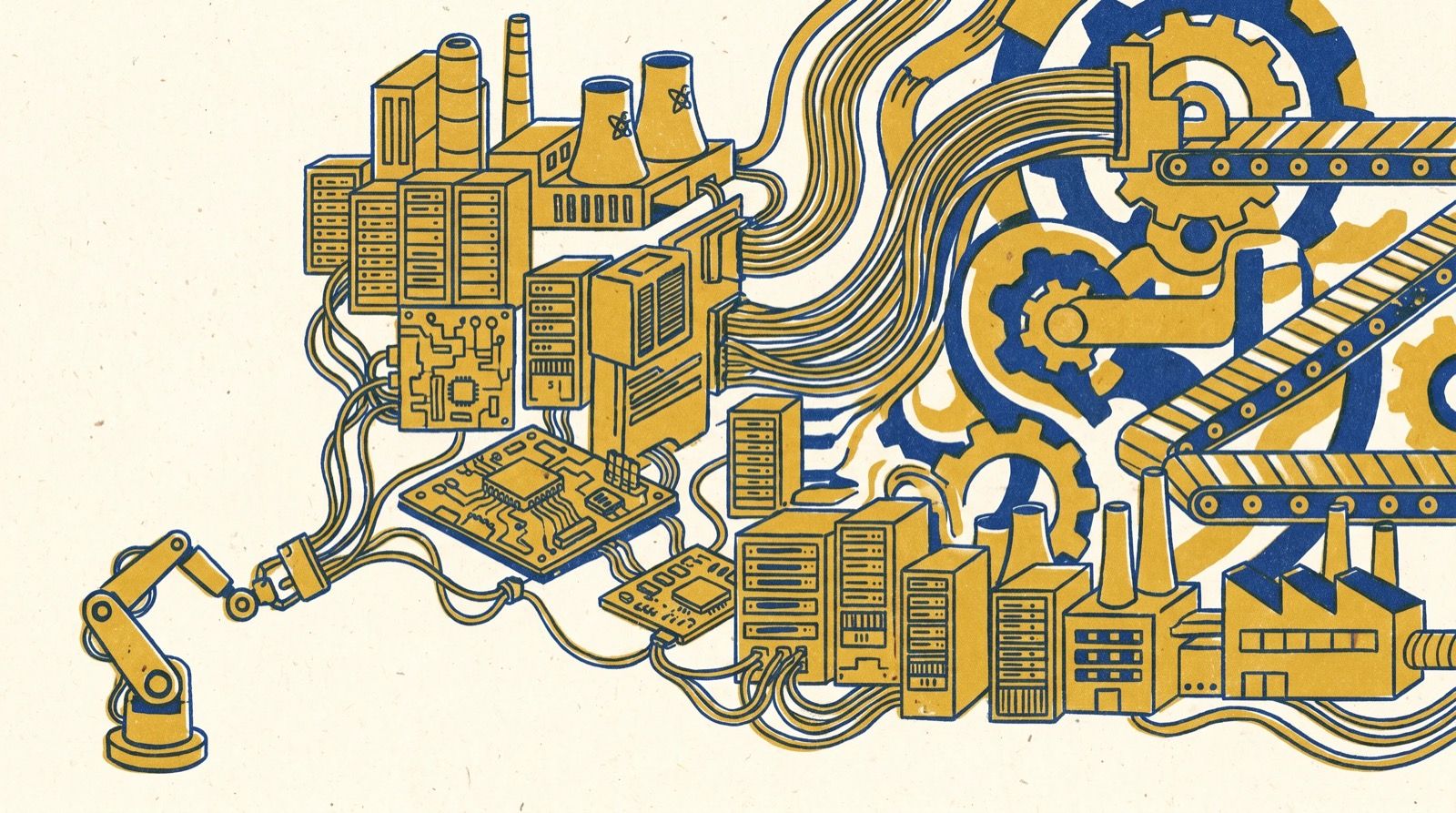
The real shift taking place inside today's humanoids and mobile manipulators has nothing to do with the degrees of freedom in an arm or the elegance of a gait. What has changed is this: embedded AI accelerators now live inside these machines, and the camera and sensor data they ingest flows up to the cloud to retrain models. Robots are becoming terminals that consume data and output inference — just as a smartphone is an endpoint of a communications network, a robot is an endpoint of AI infrastructure. The chip, not the arm, is what really matters.
This is why Nvidia is laying computing platforms for robotics, why Tesla is tying Optimus to its own data centers, and why companies like Figure are designing each humanoid unit as an output device for a large model. These companies are not selling robots. They are delivering inference.
How Convergence Reshapes Industries
Technology has rarely built an industry on its own. The steam engine alone could not create the textile factory. It took railways, standard gauges, and the telegraph coordinating timetables before mass production and mass distribution fused into a single system. The Industrial Revolution was not a single invention — it was the linking of power, transportation, and communication.
The container is no different. A steel box alone is nothing. Only when standard specifications, cranes, purpose-built vessels, and port information systems all interlocked did the cost structure of global trade collapse and rebuild itself. The Port of Busan rose to become a transshipment hub not because the box was clever, but because Busan stood at the junction where the infrastructure surrounding that box came together.
Robotics is following the same path. A single motor, a single joint, produces nothing by itself. A new industry opens only when AI models, semiconductors, data pipelines, communications, and power are strung together into one chain. The question is not how sophisticated the robot is. The question is what other technologies the robot is coupled with.
The Value Chain Robots Pull Behind Them
Disassemble a single robot and what you find inside is essentially the semiconductor industry. An AI chip for inference, power semiconductors controlling the motors, image sensors reading the surroundings, inertial sensors maintaining balance, and high-bandwidth memory moving all those signals through. Every additional humanoid sold means another bundle of these components sold alongside it. When we say robots pull semiconductors with them, that is not a metaphor — it is a bill of materials.
The connection runs in both directions. Data gathered by robots in the field flows up to data centers, retraining models; smarter models come back down into the next generation of robots. The more this cycle turns, the greater the data center's computing demand, and the greater the need for high-bandwidth memory and power infrastructure. Robots, data centers, and semiconductors generate demand for one another. When one grows, the others follow.
This is where new economic actors emerge. Companies that manufacture no robots but sell only the inference models that run inside them; companies that refine and resell the data uploaded by fleets of thousands of robots; operators that manage both fleet utilization and training data together. Where once there were only robot manufacturers and parts suppliers, there is now an intermediary layer brokering data and models between them. The moment a per-unit monthly inference fee becomes a subscription product, the robotics industry shifts in character from manufacturing to infrastructure.
The counterargument is clear: humanoids are still expensive and slow and have yet to prove their usefulness outside the factory. That is fair. But infrastructure has always begun with small, expensive terminals. The first mobile phones were bricks; early data centers occupied a single university lab room. To judge whether what looks small today will become foundational infrastructure tomorrow, you need to measure not the unit cost curve but the density of connections. The more technologies a robot is coupled with, the faster costs fall and the more paths to return on investment open up.
Where Does Busan Fit in This Chain?
Busan occupies an unusual position in this value chain. Advanced chip design and large-scale model development are not Busan's strengths. Yet the sites where robots actually work — shipbuilding component suppliers, port logistics, small and medium-sized manufacturing plants — are densely concentrated in and around Busan. The places where humanoids and mobile manipulators will be deployed first are not exhibition halls but exactly these rough, repetitive work environments.
The opportunity lies not in designing robots but in training them. The picture is this: Busan's manufacturing sites become a source supplying high-quality operational data for robots to learn from, and operators that refine that data and feed it back into models take root in Busan. The chips may come from somewhere else, but the work sites hold what those chips will be taught. The behavioral data of robots moving containers at the port and assisting with welding at shipyards cannot easily be replicated anywhere else.
Overlay this with the data center attraction momentum Busan already has, and the picture sharpens. If Busan can create a structure in which the data generated by robots is computed and stored close to where it is produced — a small loop where field operations and computation circulate within the same region — then Busan becomes not merely a consumer of the robotics industry but a source of training data. Just as Busan served as a transshipment hub in the age of containers, its role this time too may be not the place where things are made, but the junction where flows pass through.
The Future Comes from the Intersection
View robots as standalone machines and this current passes unseen. Translate robots as endpoints of AI infrastructure and a picture emerges: semiconductors, data centers, and factory floors linked as a single chain. What a humanoid unit truly is, is not a steel skeleton — it is the bundle of chips, data, and models flowing through that skeleton.
The future does not come from a single technology. It comes from the point where technologies interlock: robots pulling in semiconductors, semiconductors summoning data centers, data centers sending down smarter robots in return. The question Busan must ask is a narrow one: will we watch this chain from the sidelines, or will we stand at the junction where it passes?
This article was automatically translated from the Korean original by AI. For the authoritative version, read it in Korean.
한국어 원문 읽기 →