The Engine Swallowed the World
Unreal and Unity are no longer tools for making games. They have become the standard layer for pre-computing reality. Why film, architecture, robotics, and automotive are all converging onto the same engine.
AI Summary
Game engines like Unreal and Unity have evolved far beyond their gaming origins to become universal infrastructure for simulating reality across film, manufacturing, robotics, and autonomous vehicles. Industries from BMW to Disney are using them to rehearse reality cheaply and safely—whether building digital twin factories, training robots in virtual environments, or filming actors on real-time-rendered LED walls. Korea and Busan, with their rare combination of game engine talent and heavy industrial expertise, are well-positioned to capture the next wave by building the calibration data assets that close the sim-to-real gap.
The Illusion of a Gaming Tool
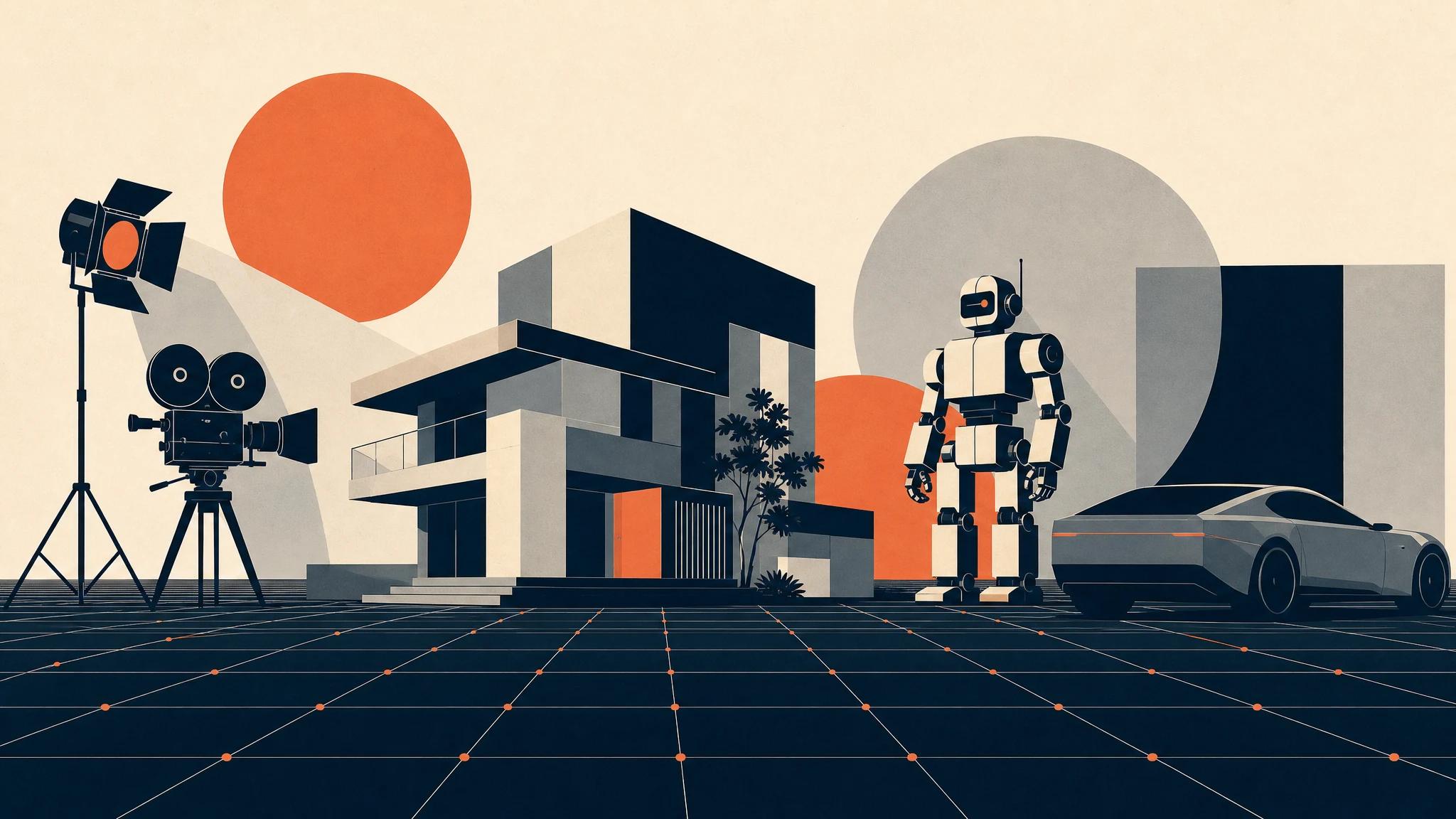
Calling Unreal Engine a program for making games is only half right. BMW runs its entire factory line as a digital twin on NVIDIA Omniverse before laying down any real equipment. Disney's The Mandalorian had actors performing inside a massive LED wall rendered by Unreal—known as StageCraft—instead of a green screen. Hyundai and Kia have also embedded the Unity runtime into portions of their in-vehicle infotainment displays. Gaming was merely the soil where these engines first took root; what they are selling today is not games.
The reason the public has such a narrow view of game engines is simple: they have only ever encountered their output on a game screen. Boiled down to a single sentence, what an engine actually does is this: it computes light, physics, time, and space in real time and renders the result on screen. That is not a problem unique to games—it is the shared problem of every industry that deals with reality. We want to see a car crash before the car crashes, to see where shadows fall before a building stands, to teach a robot to collide before it ever collides. The engine has become the universal answer to that desire.
Precedents: When One Technology Consumed an Industry
Technological convergence rewriting the industrial map is not new. Consider the PDF. It was originally a format for print publishing. But its ability to replicate paper on a screen proved so universally useful that contracts, government filings, academic papers, and tax returns all migrated onto it. A publishing format became administrative infrastructure. SQL followed the same arc. Born as a database query language, it now serves as the common grammar through which finance, logistics, and healthcare record the world.
A common pattern runs through these cases. When a technology is refined to its absolute limits in order to solve one industry's most demanding problems, that refinement accidentally solves unsolved problems in other industries. Gaming was the most brutally competitive real-time simulation market in existence. Fail to compute millions of polygons and physics collisions within one-sixtieth of a second, and players walk away. That merciless demand forged game engines into the undisputed leaders of real-time simulation—and now film and factory are borrowing that muscle.
The Technologies Connecting to the Engine
This is where the real interest lies. What other technologies does this one converge with? Game engines are now interlocking with at least four distinct frontiers.
The first is AI and robotics. Training a robot by knocking it over ten thousand times in the real world is slow and destructive. So environments like NVIDIA Isaac Sim or Google's simulation platforms train robots millions of times inside virtual physical spaces, then transfer that learned policy to actual machines. The engine has become a training ground for AI. The second is digital twins and manufacturing. Replicate a factory, a port, or a city inside an engine, and you can preview the outcome before moving a single piece of equipment. The third is autonomous driving. Collecting urban driving data purely in the real world is dangerous and expensive, so engineers generate infinite instances of a pedestrian jaywalking on a rainy night inside an engine and train on those. The fourth is spatial computing and virtual production. Video, exhibitions, and live performances are migrating onto real-time rendering.
Notice what the four frontiers share. In every case, reality is either too expensive, too dangerous, or too slow. The engine provides a rehearsal space in which reality can be run in advance, cheaply, and safely.
The New Economic Actors Emerging
When these technologies converge, what new economic actors emerge? On the surface, it looks like game companies are transforming into industrial software companies—Epic Games selling automotive and architecture licenses, Unity growing its industrial segment revenue. But at a deeper level, new professions and new asset classes are forming.
These are the creators of what might be called simulation assets. A digital twin that physically and accurately replicates an entire factory building inside an engine becomes an asset that can be bought and sold in its own right. Virtual cities for training autonomous vehicles, virtual warehouses for training robots, virtual organs for practicing medical procedures. Build one well and it can be replicated infinitely, generating data for rare scenarios that are impossible to collect in the real world—an accident in a torrential downpour, an uncommon surgical complication. In an era when real-world data is scarce and expensive, whoever can produce trustworthy synthetic reality holds data power.
A strong counterargument arises here. Synthetic reality is ultimately fake, the argument goes, and it collapses the moment it diverges from actual physics. The sim-to-real gap—where a robot that ran perfectly in simulation stumbles over a single grain of sand in the real world—is real. That is a fair point. And so the real competition shifts away from the engine itself toward whoever holds the calibration data that closes the gap between simulation and reality. The engine trends toward commodity, and the validation assets that align the virtual with the physical become the true moat.
Where Busan and Korea Stand
Korea holds a curiously advantageous hand at this point of convergence. It has a deep talent pool with real-world game engine experience, and at the same time it is one of the rare countries that also anchors the physical gravity of industries like automotive, shipbuilding, and semiconductors. Most nations are strong in only one of the two. Busan alone illustrates this. The city possesses the massive physical assets of its port and shipbuilding industry, while the game and content workforce that Busan is cultivating sits within the same city limits. A port logistics digital twin, or a simulation training ground for shipyard welding robots, can only emerge when people who hold game engine expertise and people who know the shop floor are in the same room.
The opportunity does not lie in building a new engine. Attempting to out-compete Unreal and Unity would be wasted effort. The real position to claim is stacking validation assets on top of those engines—assets that accurately encode the physical rules of Korea's manufacturing floors. The team that holds the data best able to close the sim-to-real gap for our factories, our ports, and our roads will command the chokepoint of the next generation of industrial software.
The Future Comes from the Points of Connection
The real story of game engines is not that the graphics got prettier. It is that a tool forged to the extreme limits by one industry crossed every partition to become the common language of every industry that deals with reality. AI trains inside it, robots fall inside it, cities are built inside it first. The future does not come from any single game engine. It comes from the intersection where game engines meet AI, meet robotics, meet manufacturing, meet cities. To recognize the next infrastructure before it arrives, look not for the most spectacular individual technology, but for the point where different technologies begin to overlap at the same coordinates.
This article was automatically translated from the Korean original by AI. For the authoritative version, read it in Korean.
한국어 원문 읽기 →